

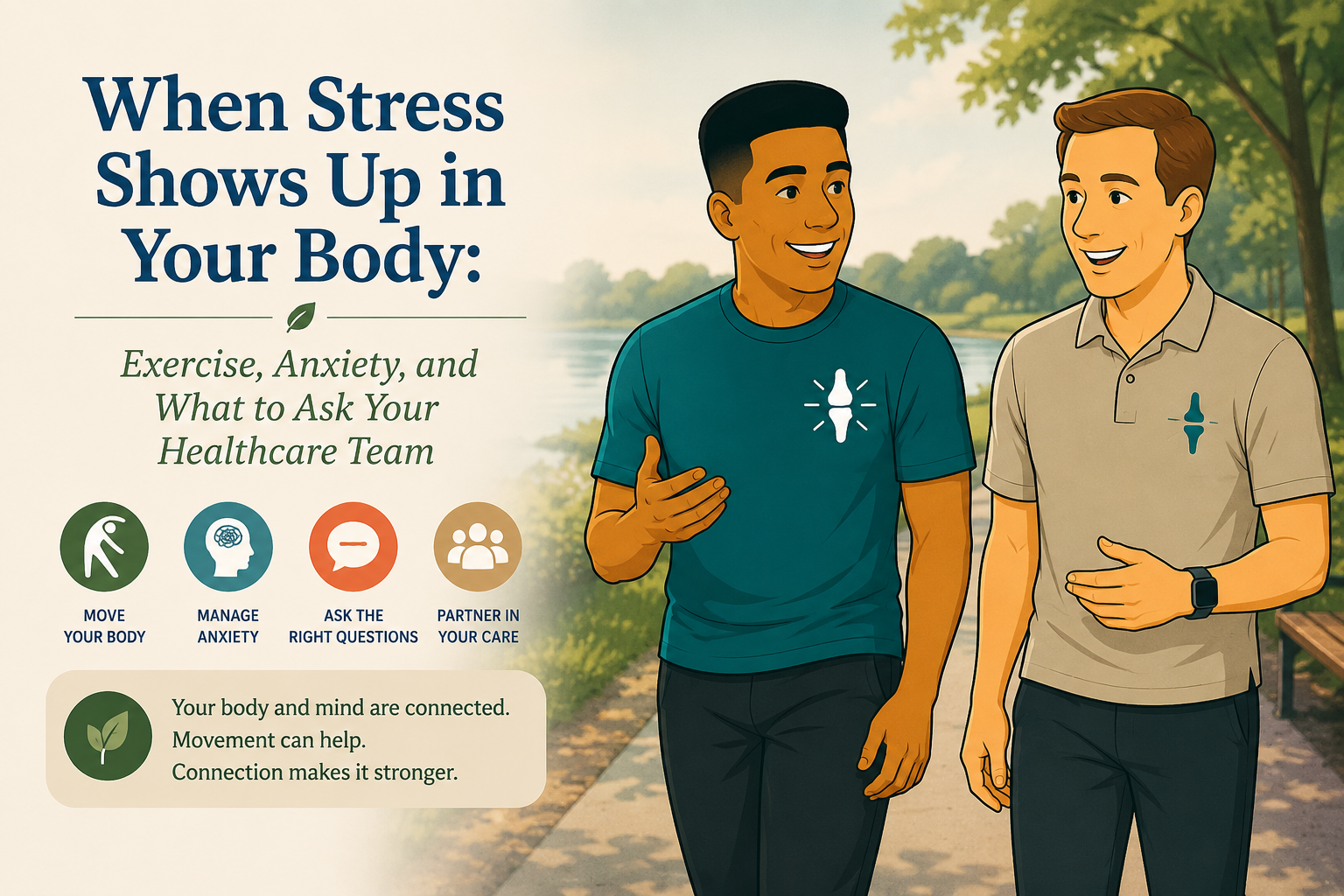
Stress does not always feel like worry.
Sometimes it feels like a tight neck, aching back, racing heart, short temper, sleepless night, or the sense that your energy is permanently running low.
You may know that movement could help but feel too exhausted to begin. You may worry that exercise will make things worse. You may also wonder whether to speak with your physician, physical therapist, counselor, or pharmacist—and what to ask when you get there.
Stress is not “all in your head.” It can affect your sleep, energy, concentration, muscles, pain, emotions, and daily routines.
The good news is that stress management does not require a perfect routine. Small, realistic changes can help.
✨ Too Long Didn’t Read (TL;DR) / Summary
Stress may contribute to:
Muscle tension and body aches
Poor sleep
Fatigue or exhaustion
Trouble concentrating
Worry or irritability
Reduced motivation
Fear of movement
Difficulty keeping up with daily life
Helpful tools may include movement, physical therapy, yoga, mindfulness, breathing, pacing, sleep support, social connection, pain education, and cognitive behavioral therapy.
No single strategy works for everyone. These approaches often work best when they are combined and matched to your needs.²⁻⁴
A useful place to begin is:
“What is taking the most energy from me right now?”
Then choose one manageable next step.
🧾 General Information
Stress, Anxiety, and Your Body
Stress is often connected to a specific challenge, such as work, caregiving, finances, illness, pain, or conflict.
Anxiety may continue even when there is no immediate threat. It can involve persistent worry, dread, restlessness, muscle tension, fatigue, sleep problems, or difficulty concentrating.
They often overlap. You do not need to label everything correctly before asking for help.
Talk with a healthcare professional when stress or worry begins interfering with sleep, work, relationships, exercise, personal care, or activities you normally enjoy.
Stress and Pain
Stress does not mean your pain is imaginary.
Pain may be influenced by the tissues, nervous system, sleep, activity level, emotions, previous experiences, and how safe your body feels during movement.
Stress may increase muscle guarding, interfere with sleep, lower your energy, and make symptoms harder to manage. In adults with chronic low back pain, improvements in perceived stress were related to some improvements in disability after physical therapy. Stress, however, was only one part of the picture.
Ask your physical therapist or physician:
“Could stress, poor sleep, or fear of movement be affecting my recovery without being the whole cause of my pain?”
Exercising When You Feel Stressed
You do not have to choose between a full workout and doing nothing.
Try using three movement levels.
Low-energy day
Take a five-minute walk
Do gentle mobility work
Complete a few comfortable strength exercises
Move during short breaks
Moderate-energy day
Shorten your usual workout
Use lighter weights
Complete fewer sets
Take longer rests
Regular-energy day
Follow your usual plan when you feel reasonably rested and your symptoms are stable.
Adults are generally encouraged to work toward 150 minutes of moderate activity each week plus strengthening activity on at least two days. This is a long-term goal, not a daily test. Small amounts still count.
Ask yourself:
“What amount of movement could I repeat without feeling punished tomorrow?”
A physical therapist can help you adjust exercise when pain, fatigue, dizziness, fear, balance problems, or a medical condition makes it difficult to know where to begin.
Yoga and Gentle Movement
Yoga may combine movement, balance, breathing, attention, and relaxation. It may help with general wellness, stress, sleep, and some pain conditions.
It does not need to involve advanced poses or extreme flexibility. It may include:
Chair-based movement
Wall-supported balance
Gentle stretching
Comfortable spinal movement
Relaxed breathing
Brief rest
Yoga has also been associated with modest reductions in blood pressure, especially when breathing and meditation were included. It should not replace medication or medical care.
Stop or modify the activity if you develop sharp pain, dizziness, faintness, unusual shortness of breath, or symptoms that feel unsafe.
Mindfulness and Grounding
Mindfulness means noticing the present moment with less judgment. It does not require an empty mind.
Try this short grounding practice:
Notice your feet touching the floor.
Notice the chair supporting you.
Name three things you can see.
Listen for one sound.
Let your breathing remain comfortable.
For people with chronic low back pain, a structured mindfulness program improved pain-related function compared with usual care in one study.
Mindfulness is not a cure for every condition. One large study found that mindfulness and exercise did not improve memory or executive function in older adults with cognitive concerns.
Mindfulness can also feel uncomfortable for some people, especially when it brings attention to anxiety, traumatic memories, or physical sensations. Keep your eyes open, focus on something outside your body, move instead of sitting still, or stop.
Breathing Exercises
Breathing exercises should feel gentle, not forced.
Try three comfortable breaths:
Inhale normally
Exhale slowly
Relax your jaw and shoulders
Return to your usual breathing
You can also exhale during a movement, such as standing from a chair.
Tell your clinician if breathing exercises cause dizziness, panic, or more shortness of breath. Evidence for mindfulness-based approaches in people with respiratory conditions has been inconsistent, and focusing closely on breathing may make some people more distressed.
Cognitive Behavioral Therapy
Cognitive behavioral therapy, or CBT, is a form of psychotherapy that examines how thoughts, emotions, behaviors, and physical experiences interact.
For example:
Thought: “If I move, I will damage myself.”
Feeling: Fear.
Behavior: Avoiding activity.
Possible result: Less strength and confidence.
CBT can help people test whether a thought is accurate, helpful, or incomplete.
In adults with chronic low back pain, both CBT and mindfulness-based stress reduction has been shown to improve pain-related function compared with usual care.
A physical therapist may use CBT-informed strategies, such as helping you gradually approach a feared movement or build confidence through successful practice. Formal CBT and treatment for anxiety, depression, or trauma should be provided by a qualified mental health professional.
Pain Education and Pacing
Good pain education should help you understand your symptoms without making you feel dismissed.
Helpful language sounds like:
“Your pain is real. Let’s look at movement, strength, sleep, stress, and what helps you feel safer.”
Pain education may be useful when combined with active, individualized rehabilitation.
Pacing can also help prevent the “boom-and-bust” cycle: doing too much on a good day and needing several days to recover.
Choose an amount of activity you can repeat consistently, then build gradually.
Sleep and Social Support
Poor sleep can make stress, pain, fatigue, and concentration harder to manage.
Helpful habits may include:
Keeping a consistent wake time
Getting daylight and movement during the day
Creating a short wind-down routine
Making your sleep position more comfortable
Reviewing medications that may affect sleep
Speak with a physician or sleep professional about persistent insomnia, loud snoring, pauses in breathing, gasping during sleep, or severe daytime sleepiness.
Remember that connection is also a stress-management tool. A friend, family member, support group, or healthcare professional may help you feel less alone and make your plan more realistic.
💙 For Patients
What to Tell Your Physician
You do not need to arrive with a diagnosis. Explain what has changed and how it affects your life.
You might say:
“I have been feeling stressed and exhausted for several weeks. It is affecting my sleep, concentration, and daily activities. Could this be stress, anxiety, a medical issue, a medication effect, or a combination?”
Mention:
When symptoms began
Whether they are worsening
Sleep or appetite changes
Fatigue
Persistent worry or sadness
Dizziness, headaches, heart racing, or shortness of breath
New medications or dose changes
How symptoms affect work, exercise, and relationships
Ask:
“Could a medical condition be contributing?”
“Do I need testing?”
“Could my medications affect my sleep, energy, heart rate, or balance?”
“Would exercise, counseling, or CBT help?”
“Should I be evaluated for a sleep disorder?”
“What symptoms require urgent care?”
What to Ask Your Physical Therapist
Physical therapists help with movement, pain, strength, function, and activity. Depending on their training and state law, they may also help with graded exercise, pacing, pain education, relaxation, and stress-related barriers to movement.
Ask:
“Is it safe for me to exercise with these symptoms?”
“What should I do on a high-stress day?”
“How can I tell normal exercise discomfort from a warning sign?”
“Could sleep or stress be affecting my symptoms?”
“Can you make my home program more manageable?”
“How quickly should I increase activity?”
“Can you help me return to a movement I fear?”
“Would yoga or grounding be appropriate?”
“Should I speak with my physician or a mental health professional?”
You should feel comfortable saying:
“I do not understand.”
“That does not feel safe.”
“I cannot realistically do this every day.”
“Can we try another option?”
“I would like a referral.”
What to Ask Your Pharmacist
Medicines, supplements, and over-the-counter products may affect sleep, energy, dizziness, balance, heart rate, or exercise tolerance.
Ask:
“Could any of these cause fatigue, dizziness, restlessness, or poor sleep?”
“Could they interact?”
“Does the time I take them matter?”
“Could this medicine affect exercise, balance, or driving?”
“What should I do if I miss a dose?”
Do not stop or change a prescription without speaking with the appropriate healthcare professional.
When to Seek More Help
Consider speaking with a mental health professional when worry, panic, sadness, trauma symptoms, or emotional distress interfere with sleep, work, relationships, daily life, or rehabilitation.
Seek urgent medical attention for chest pain, fainting, severe shortness of breath, sudden weakness, new confusion, a severe unusual headache, or rapidly worsening symptoms.
Call 911 in the United States for immediate danger or a medical emergency.
Call or text 988 for suicidal thoughts, severe emotional distress, or a mental health or substance-use crisis.¹⁸
One Small Step This Week
Choose one:
Take a five-minute walk
Write down your symptoms
Schedule an appointment
Ask for a medication review
Try one minute of grounding
Shorten an overwhelming workout
Call someone you trust
Ask for a mental health referral
Tell your physical therapist what worries you
Stress management is not another task to perform perfectly.
It is a way to make life more manageable—one conversation, one walk, and one honest question at a time.
📂 Supplemental Information / Citations
National Institute of Mental Health. I’m So Stressed Out! Fact Sheet. Accessed July 20, 2026.
Centers for Disease Control and Prevention. Managing Stress. Updated May 12, 2026. Accessed July 20, 2026.
Joyce CT, Chernofsky A, Lodi S, et al. Do physical therapy and yoga improve pain and disability through psychological mechanisms? J Orthop Sports Phys Ther. 2022;52(7):470-483. doi:10.2519/jospt.2022.10813
Flynn DM. Chronic musculoskeletal pain: nonpharmacologic, noninvasive treatments. Am Fam Physician. 2020;102(8):465-477.
Wu Y, Johnson BT, Acabchuk RL, et al. Yoga as antihypertensive lifestyle therapy: a systematic review and meta-analysis. Mayo Clin Proc. 2019;94(3):432-446. doi:10.1016/j.mayocp.2018.09.023
National Center for Complementary and Integrative Health. Yoga: Effectiveness and Safety. Accessed July 20, 2026.
Cherkin DC, Sherman KJ, Balderson BH, et al. Effect of mindfulness-based stress reduction vs cognitive behavioral therapy or usual care on back pain and functional limitations in adults with chronic low back pain. JAMA. 2016;315(12):1240-1249. doi:10.1001/jama.2016.2323
Tatta J, Willgens AM, Palombaro KM. Mindfulness and acceptance-based interventions in physical therapist practice. Phys Ther. 2022;102(3). doi:10.1093/ptj/pzab293
Lenze EJ, Voegtle M, Miller JP, et al. Effects of mindfulness training and exercise on cognitive function in older adults. JAMA. 2022;328(22):2218-2229. doi:10.1001/jama.2022.21680
Marris D, Theophanous K, Cabezon P, Dunlap Z, Donaldson M. Combining pain education with physical therapy for chronic pain. Physiother Theory Pract. 2021;37(4):461-472. doi:10.1080/09593985.2019.1633714
Harrison SL, Lee A, Janaudis-Ferreira T, Goldstein RS, Brooks D. Mindfulness in people with a respiratory diagnosis. Patient Educ Couns. 2016;99(3):348-355. doi:10.1016/j.pec.2015.10.013
National Center for Complementary and Integrative Health. Meditation and Mindfulness: Effectiveness and Safety. Accessed July 20, 2026.
US Department of Health and Human Services. Physical Activity Guidelines for Americans. 2nd ed. 2018.
National Institute of Mental Health. Caring for Your Mental Health. Accessed July 20, 2026.
American Physical Therapy Association. Scope of Practice. Accessed July 20, 2026.
National Institute of Mental Health. Tips for Talking With a Health Care Provider About Your Mental Health. Accessed July 20, 2026.
US Food and Drug Administration. Tips for Talking With Your Pharmacist to Learn How to Use Medicines Safely. Accessed July 20, 2026.
988 Suicide & Crisis Lifeline. Get Help. Accessed July 20, 2026.
This content drafted, researched, edited, and generated by:
McKinley Pollock, PT, DPT
McKinley Pollock, PT, DPT, OCS, CSCS is a physical therapist with a background in orthopedics and sports rehabilitation. Dr. Pollock earned his doctorate of physical therapy from Campbell University in 2021, is a board-certified orthopedic clinical specialist (OCS), and certified strength and conditioning specialist (CSCS). Dr. Pollock enjoys combining lessons learned from his DPT training and research, translating these into clinical practice. His passions include promoting relationships between patients & clinicians to promote clinical effectiveness, satisfaction, and efficiency, the implementation of primary preventative medicine into clinical practice, and leadership and education development.
© 2026 The Joint Connection Company. All rights reserved.
The content on this website, including all text, graphics, and materials, is the exclusive property of The Joint Connection Company and is protected by applicable copyright and intellectual property laws. No part of this site may be reproduced, distributed, or used without prior written permission.