

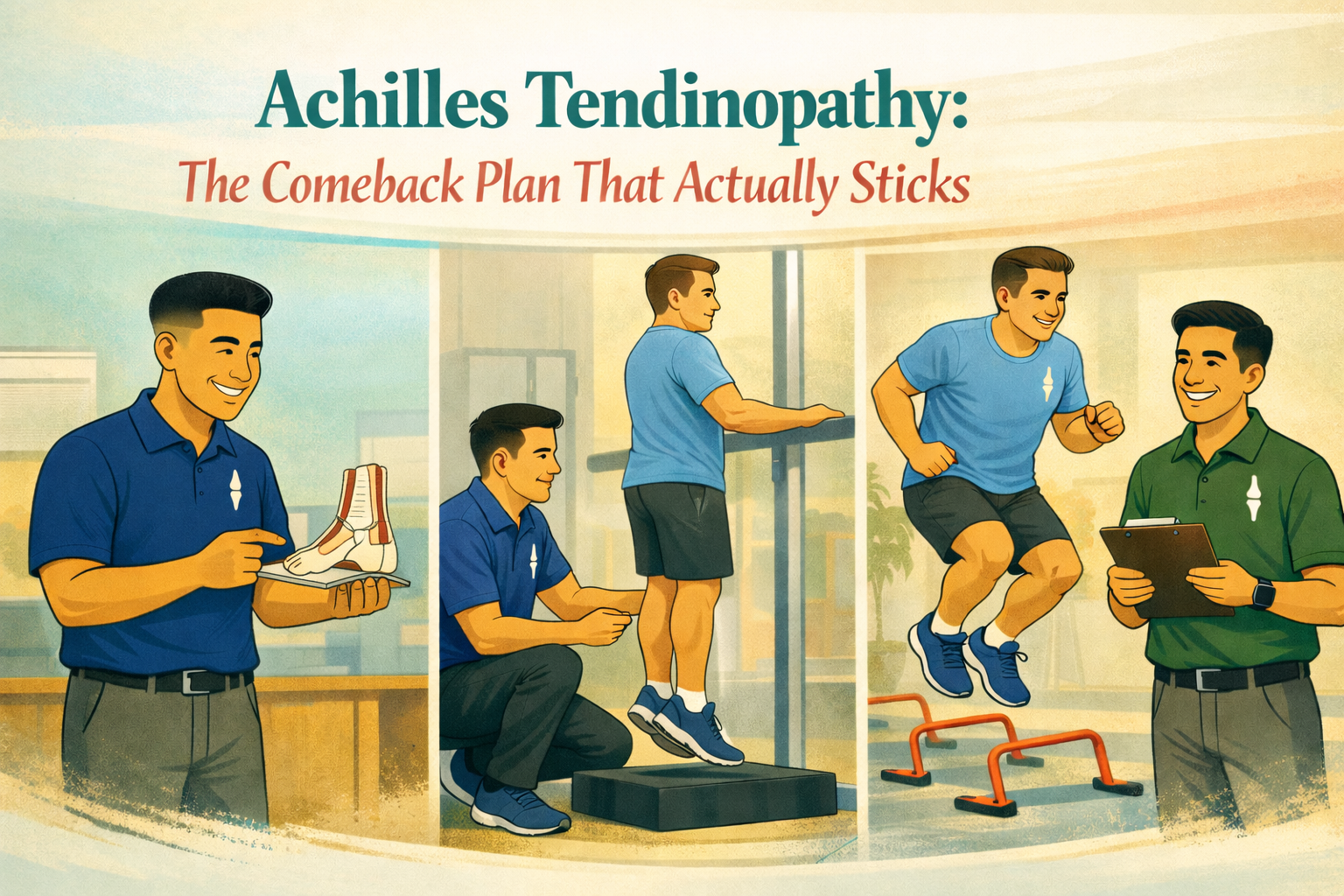
✨ Too Long Didn’t Read (TL;DR) / Summary
If your Achilles is mad after you suddenly asked it to do athlete things (like running after taking years off) or if you have asked it to do too many athlete things (like running 3 marathons in back-to-back weekends), you’re not broken. You’ve got a loading issue.
Here’s the gist:
Achilles tendinopathy is usually a load problem, not a “you’re doomed” problem. Progressive tendon loading is the backbone of recovery.
Complete rest can calm pain, but it rarely builds the tendon’s tolerance—so symptoms often boomerang and return when activity returns.
Early rehab often starts with symptom-calming loading (like isometrics), then progresses to strength (concentric/eccentric), and eventually plyometrics + sport-specific work.
What helps the most long-term: a clear plan + honest conversations about pain, goals, and pacing. Education + loading = better outcomes.
Takeaway: Your Achilles doesn’t need a lecture and it needs more than rest. It needs a progressive plan—and a provider who listens and can guide you through your recovery.
🧾 Condition-Specific General Information
What is Achilles tendinopathy (and why “tendinitis” is tricky)?
Achilles pain from overuse is commonly called “tendinitis,” but most persistent cases behave more like tendinopathy—a failed-healing/degenerative overload picture rather than a pure inflammation problem.
Translation: anti-inflammatory thinking alone won’t fix a load tolerance issue.
The classic “How did this happen?” story
This is the usual plot fort the general population:
Life happens (desk jobs, busy parenting, winter sends you into hibernation, etc.) - i.e. you’re not as active as you were.
Training load jumps (new running plan, pickup basketball, HIIT, a sudden mileage spike).
The tendon says: excuse me??
In active people, Achilles Tendinopathy normally accompanies a sudden change in intensity or volume in training.
What it feels like
Common symptoms include:
Achy pain in the back of the ankle / tendon (sometimes sharp with push-off)
Tenderness (often at the insertion or midportion)
Morning stiffness or stiffness after sitting
Pain with walking, stairs, running, jumping, or calf raises
Why “rest” can feel helpful… and still fail you
Rest often lowers symptoms—but it can also lower tissue capacity if it becomes “complete shutdown.” Guidelines emphasize that complete rest is not indicated; staying active within tolerance is usually encouraged alongside progressive loading.
What good rehab is actually trying to do
Rehab isn’t just “make it hurt less.” It’s:
Restore ankle dorsiflexion and relevant joint mobility (when limited)
Build calf strength + endurance (often revealed by single-leg heel raise testing)
Improve balance, hip/quad capacity, and movement mechanics so the tendon isn’t taking the whole bill every step
Progress to energy storage and release (plyometrics) when appropriate
A simple “tendon-loading ladder” to follow:
Most programs move through phases like:
Calm it down, keep you moving (load management, pain monitoring)
Strength foundation (controlled heel raises, progressive resistance)
Control + capacity (eccentric emphasis, heavier/slower work)
Springiness + sport (plyometrics, running drills, sport-specific loading)
Relationship moment: The best plans are co-written. Your patient will bring the lived experience and their journey - as the provider, you need to bring the map to where they’re going. The win is when both are taken seriously.
👩⚕️ For Providers 👨⚕️
Lead with the conversation, not the protocol
Patients hear “Achilles” and often translate it to: “This will never go away.” Start by naming what’s true:
This is commonly a load tolerance issue with a generally good prognosis when rehab is progressive and consistent.
Pain reduction ≠ full recovery of function—plan for strength and capacity goals, not only symptom quieting.
Evaluation priorities (make it measurable)
Consider documenting:
Ankle dorsiflexion ROM (weight-bearing lunge test or goniometry) because deficits are a recognized risk factor and rehab target.
Plantarflexor strength/endurance: single-leg heel rise test is a practical anchor measure and can track progress over time.
Movement compensation: walking/running gait deviations, single-leg control, hip/quad strength, balance
Location matters: distinguish insertional vs midportion presentations, as dosing and compression considerations differ.
Education is not “extra”—it’s a treatment
The 2024 Clinical Practice Guideline emphasizes pairing tendon loading with education/counseling (pain science or pathoanatomic framing) and advising that complete rest isn’t indicated for midportion cases.
Loading strategy (practical sequencing)
High irritability / high pain: symptom-modulating loading can be useful. Think about using isometrics as a starting point in clinical practice. Monitor response using a quick “walk → load → walk” re-check when appropriate.
Progression: move toward isotonic work (concentric/eccentric), then heavier/slower loading, then higher-velocity energy storage work as tolerance improves.
Frequency/intensity: Clinical Practice Guidelines suggest tendon loading at least 3x/week at intensity as high as tolerated for midportion tendinopathy (when no presumed frailty).
Insertional Achilles: consider compression management
In insertional tendinopathy, controlling dorsiflexion/compressive load may matter. A 2025 randomized trial found better outcomes with low tendon compression rehab (limiting dorsiflexion, avoiding calf stretching, using heel lifts) compared with higher compression rehab in sport-active patients with chronic insertional symptoms. However, more evidence is needed.
When patients ask about injections
Evidence is mixed depending on context and chronicity. A randomized clinical trial reported that ultrasound-guided corticosteroid injection plus exercise improved outcomes more than placebo injection plus exercise for Achilles tendinopathy at 6 months, without observed severe adverse events in that study.
Clinical takeaway: frame injections as a shared decision—what problem are we solving, what are the risks, and how does it fit into the loading plan?
The “don’t lose the person” checklist - Check in with what is important for YOUR PATIENT!
Ask what they miss most (running? playing with kids? work demands?)
Collaborate on a minimum effective plan they can actually do
Use pain monitoring language that reduces fear and builds buy-in
Celebrate capacity wins (reps, load, hop tolerance), not just pain scores
📂 Supplemental Information / Citations
Chimenti RL, Neville C, Houck J, Cuddeford T, Carreira D, Martin RL. Achilles pain, stiffness, and muscle power deficits: midportion Achilles tendinopathy revision–2024: Clinical Practice Guidelines linked to the International Classification of Functioning, Disability, and Health from the Academy of Orthopaedic Physical Therapy of the American Physical Therapy Association. J Orthop Sports Phys Ther. 2024;54(12):CPG1-CPG32. doi:10.2519/jospt.2024.0302
Silbernagel KG, Hanlon S, Sprague A. Current clinical concepts: conservative management of Achilles tendinopathy. J Athl Train. 2020;55(5):438-447. doi:10.4085/1062-6050-356-19
von Rickenbach KJ, Borgstrom H, Tenforde A, Borg-Stein J, McInnis KC. Achilles tendinopathy: evaluation, rehabilitation, and prevention. Curr Sports Med Rep. 2021;20(6):327-334. doi:10.1249/JSR.0000000000000855
Pringels L, Capelleman R, Van den Abeele A, et al. Effectiveness of reducing tendon compression in the rehabilitation of insertional Achilles tendinopathy: a randomised clinical trial. Br J Sports Med. 2025;59(9):640-650. doi:10.1136/bjsports-2024-109138
Johannsen F, Olesen JL, Øhlenschläger TF, et al. Effect of ultrasonography-guided corticosteroid injection vs placebo added to exercise therapy for Achilles tendinopathy: a randomized clinical trial. JAMA Netw Open. 2022;5(7):e2219661. doi:10.1001/jamanetworkopen.2022.19661
Martin RL, Chimenti R, Cuddeford T, et al. Achilles pain, stiffness, and muscle power deficits: midportion Achilles tendinopathy revision 2018. J Orthop Sports Phys Ther. 2018;48(5):A1-A38. doi:10.2519/jospt.2018.0302
This content drafted, researched, edited, and generated by:
Jackson Kojima, PT, DPT
Jackson Kojima, PT, DPT, OCS is a physical therapist with an extensive background in orthopedics, geriatrics, and sports rehabilitation. Dr. Kojima is a board-certified orthopedic clinical specialist (OCS) with a passion for post-operative rehabilitation and enjoys treating multi-factorial conditions like low back pain and generalized joint pain. Dr. Kojima earned his doctorate of physical therapy from Campbell University in 2021 and currently practices in Greenville, SC.
© 2026 The Joint Connection Company. All rights reserved.
The content on this website, including all text, graphics, and materials, is the exclusive property of The Joint Connection Company and is protected by applicable copyright and intellectual property laws. No part of this site may be reproduced, distributed, or used without prior written permission.