

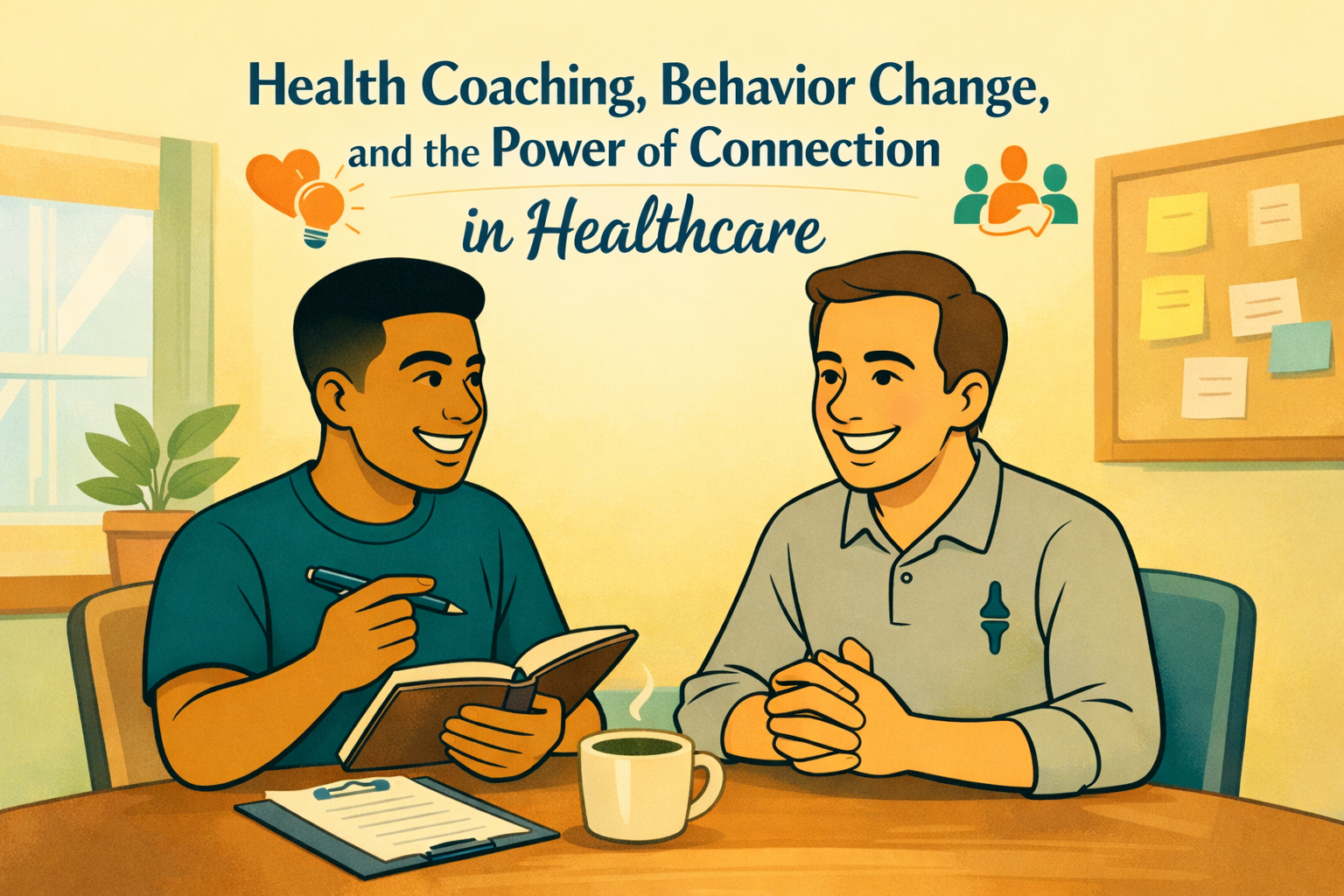
✨ Too Long Didn’t Read (TL;DR) / Summary
Health behavior change is not about willpower — it’s about readiness, relationship, and support.
The Transtheoretical Model reminds us that patients move through stages of change — they don’t flip a switch.
Health coaching works best when it’s patient-centered, goal-driven, and grounded in relationship.
Physical therapists are uniquely positioned to facilitate sustainable health behavior change — but training and consistency matter.
Interpersonal strategies (peer support, shared learning) may sustain physical activity better than intrapersonal strategies alone.
Cognitive behavioral therapy (CBT) offers evidence-based tools to reduce pain, improve function, and strengthen coping skills.
At The Joint Connection Company, we believe this: behavior change happens through conversation, not command.And when providers shift from “expert mode” to partnership, patients regain control of their health.
🧾 Behavioral Change: General Information
Understanding Behavior Change: It’s a Process, Not a Personality Trait
In their landmark paper, Prochaska and Velicer introduced the Transtheoretical Model (TTM) — outlining six stages of change:
precontemplation, contemplation, preparation, action, maintenance, and termination.
A powerful rule of thumb from their research:
40% of at-risk individuals are in precontemplation
40% in contemplation
20% in preparation
That means most patients walking into your clinic are not ready for action yet.
And that’s okay.
Instead of pushing change, we can explore it.
“Would you like to make a plan to change this?”
Not: “You need to do this.”
That subtle shift creates autonomy.
What Is Health Coaching — Really?
Health coaching has been inconsistently defined over the years. But a systematic review by Wolever et al established an emerging consensus²:
Health and wellness coaching is:
Patient-centered
Based on behavior change theory
Focused on self-determined goals
Rooted in an ongoing helping relationship
It includes:
Goal-setting
Self-discovery
Accountability
Behavior self-monitoring
In other words: coaching is collaborative, not prescriptive.
Does Health Coaching Delivered by Physical Therapists Work?
The answer? It depends — but there’s promise.
A systematic review by Rethorn and Pettitt found mixed results overall, but 64% of included trials showed positive outcomes across behavioral, physiological, and psychological domains.
Some patients improved:
Physical activity levels
Self-efficacy
Quality of life
Functional capacity
But variability in training, treatment fidelity, and coaching definitions limits conclusions.
The takeaway? Skill matters. Structure matters. Clarity matters.
Interpersonal vs. Intrapersonal Strategies: What Sustains Change?
A 2024 randomized clinical trial by McMahon et al found that interpersonal behavior change strategies (peer sharing, social comparison, group learning) significantly improved physical activity in older adults — sustained for 12 months.
Intrapersonal strategies (goal setting alone) did not produce significant long-term change.
Translation:
Behavior change may stick better when it’s social, relational, and supported.
Humans are wired for connection.
Cognitive Behavioral Therapy (CBT) in Physical Therapy
CBT focuses on the connection between thoughts, feelings, and behaviors.
It helps patients:
Reduce catastrophizing
Increase activity pacing
Improve coping strategies
Build self-efficacy
Large meta-analyses show CBT produces modest but consistent improvements in quality of life across physical and mental health conditions.⁶
For chronic pain, CBT reduces pain intensity and disability.
Yet a nationwide survey found that while PTs use some CBT-related techniques (like pacing), many cite barriers including:
Lack of training
Time constraints
Reimbursement concerns
Interest is high. Infrastructure is lagging.
Why This Matters Beyond Pain
Midlife cognitive and physical activity have been associated with reduced dementia risk decades later.
Behavior change today impacts brain health tomorrow.
Physical therapists aren’t just rehabilitation specialists. They are, as Maxwell describes, “abilitation specialists” — capable of promoting health before disability begins.
👩⚕️ For Providers 👨⚕️
Moving from Expert to Partner
Many clinicians were trained in an expert-driven model:
“I tell. You comply.”
But research and lived experience show that sustainable change requires:
Autonomy
Readiness assessment
Motivational interviewing
Social support
Empathic communication
Instead of:
“You need to exercise more.”
Try:
“What would moving more allow you to get back to?”
Practical Clinical Shifts
Assess stage of change before prescribing.
Ask permission before advising.
Explore pros and cons collaboratively.
Use peer group formats when possible.
Integrate CBT-informed language:
“What’s the thought that shows up when pain flares?”
“What might a more balanced thought sound like?”
Follow up. Maintenance requires reinforcement.
A Reflective Question for Clinicians
When a patient doesn’t follow through, do you assume:
Noncompliance?
Or do you ask:
What stage are they in?
What barrier is unspoken?
What belief is driving avoidance?
What social determinant is at play?
Behavior change isn’t resistance.
It’s information.
📂 Supplemental Information / Citations
Prochaska JO, Velicer WF. The transtheoretical model of health behavior change. Am J Health Promot.1997;12(1):38-48. doi:10.4278/0890-1171-12.1.38
Wolever RQ, Simmons LA, Sforzo GA, et al. A systematic review of the literature on health and wellness coaching. Glob Adv Health Med. 2013;2(4):38-57. doi:10.7453/gahmj.2013.042
Rethorn ZD, Pettitt CD. What is the effect of health coaching delivered by physical therapists? Phys Ther.2019;99(10):1354-1370. doi:10.1093/ptj/pzz098
McMahon SK, Lewis BA, Guan W, et al. Effect of intrapersonal and interpersonal behavior change strategies on physical activity among older adults. JAMA Netw Open. 2024;7(2):e240298. doi:10.1001/jamanetworkopen.2024.0298
Beissner K, Henderson CR Jr, Papaleontiou M, et al. Physical therapists’ use of cognitive-behavioral therapy for older adults with chronic pain. Phys Ther. 2009;89(5):456-469. doi:10.2522/ptj.20080163
Fordham B, Sugavanam T, Edwards K, et al. The evidence for cognitive behavioural therapy in any condition: a meta-review. Psychol Med. 2021;51(1):21-29. doi:10.1017/S0033291720005292
Stallard P. Evidence-based practice in cognitive-behavioural therapy. Arch Dis Child. 2022;107(2):109-113. doi:10.1136/archdischild-2020-321249
Beissner K, Henderson CR Jr, Papaleontiou M, et al. Physical therapists’ use of CBT for older adults with chronic pain. Phys Ther. 2009;89(5):456-469.
News Now Staff. Can cognitive and physical activity in midlife reduce the risk of dementia in later years? American Physical Therapy Association. February 25, 2019.
Maxwell J. PTs are “abilitation specialists.” American Physical Therapy Association. December 12, 2018.
This content drafted, researched, edited, and generated by:
McKinley Pollock, PT, DPT
McKinley Pollock, PT, DPT, OCS, CSCS is a physical therapist with a background in orthopedics and sports rehabilitation. Dr. Pollock earned his doctorate of physical therapy from Campbell University in 2021, is a board-certified orthopedic clinical specialist (OCS), and certified strength and conditioning specialist (CSCS). Dr. Pollock enjoys combining lessons learned from his DPT training and research, translating these into clinical practice. His passions include promoting relationships between patients & clinicians to promote clinical effectiveness, satisfaction, and efficiency, the implementation of primary preventative medicine into clinical practice, and leadership and education development.
© 2026 The Joint Connection Company. All rights reserved.
The content on this website, including all text, graphics, and materials, is the exclusive property of The Joint Connection Company and is protected by applicable copyright and intellectual property laws. No part of this site may be reproduced, distributed, or used without prior written permission.