

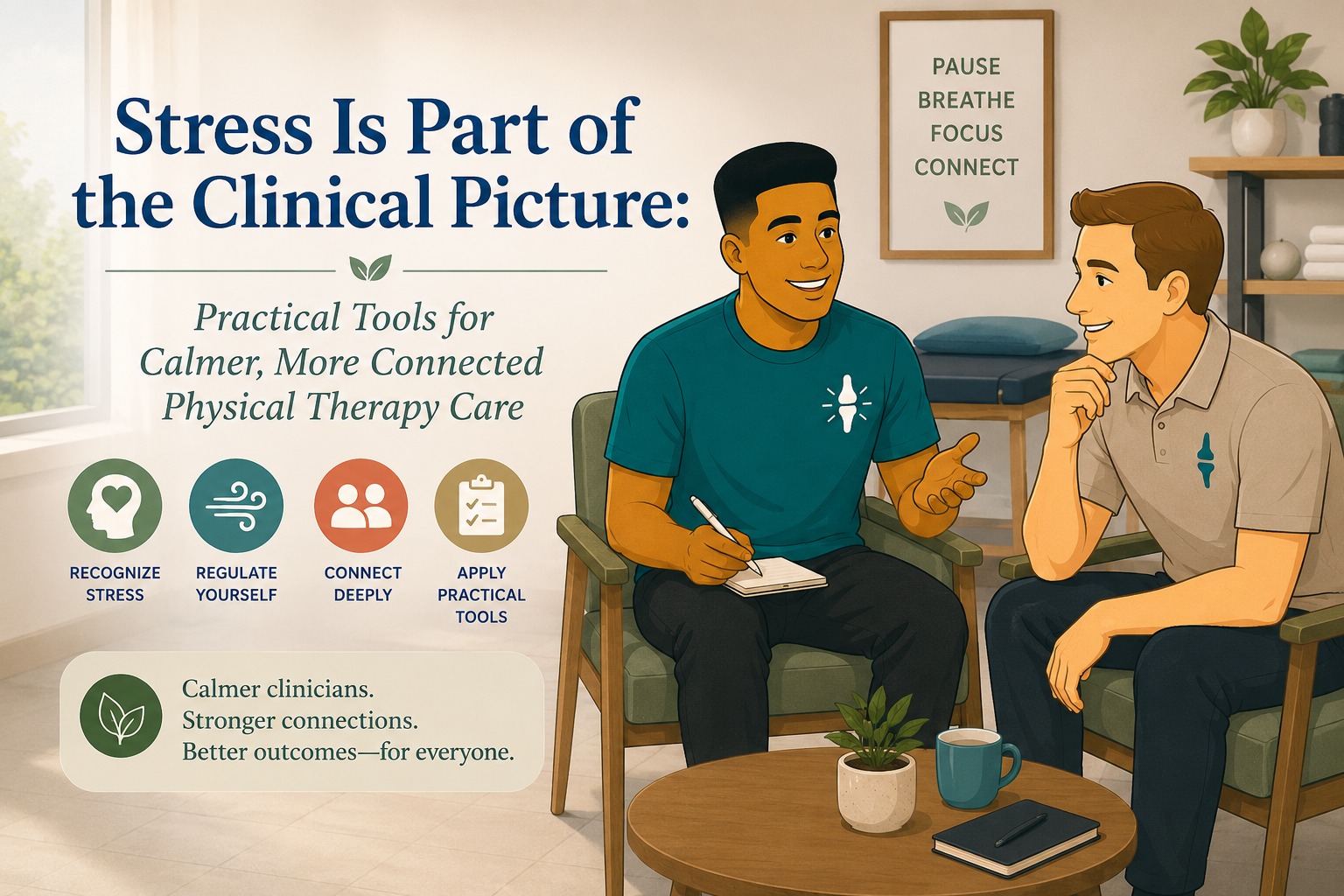
Stress can affect pain, sleep, muscle tension, confidence, and participation in rehabilitation. For physical therapists, stress management is not about telling patients to “relax.” It is about listening, building trust, and choosing practical strategies that support movement and function.
✨ Too Long Didn’t Read (TL;DR) / Summary
Physical therapists may support stress management through:
Individualized exercise
Gentle yoga or meditative movement
Mindfulness and grounding
Relaxed breathing
Pacing and sleep-supportive routines
Pain education
CBT-informed communication
These strategies should remain connected to physical therapy goals and the therapist’s training, competence, and state practice act. Formal cognitive behavioral therapy should be provided by an appropriately qualified mental health professional.
For chronic low back pain, mindfulness-based stress reduction and cognitive behavioral therapy have improved pain-related function compared with usual care. However, no single approach works for every patient.
The most important starting point may be a simple question: “What feels hardest about your recovery right now?”
🧾 General Information
Stress and Musculoskeletal Pain
Stress may contribute to poor sleep, protective muscle tension, fear of movement, fatigue, reduced activity, and difficulty following a home program.
This does not mean the patient’s pain is “all in their head.” Pain is real, and stress may be one of several factors influencing the experience.
A helpful explanation is:
“Your symptoms are real. Pain can be influenced by the tissues, nervous system, sleep, stress, and previous experiences. Would it be okay if we explored which factors may be affecting you?”
Exercise and Movement
Exercise can support physical health, confidence, and stress management. The best program is one the patient can understand, tolerate, and repeat.
Options may include:
Short walks
Gentle strengthening
Mobility work
Graded exposure to feared movements
Enjoyable recreational activity
Planned recovery instead of complete avoidance
Ask:
“What kind of movement leaves you feeling better instead of punished?”
Yoga
Yoga may combine movement, balance, breathing, attention, and relaxation. It may help some patients with stress, pain, function, and general wellness.
Use modified, chair-based, wall-supported, or standing options when appropriate. Yoga should not be treated as a test of flexibility or as a replacement for medical care.
Mindfulness and Grounding
Mindfulness involves noticing the present moment with less judgment. A brief grounding practice may help before a painful or feared activity.
For example:
“Notice your feet on the floor and the support beneath you. Keep your eyes open or closed—whichever feels safer.”
Mindfulness should be optional. Some people may feel more anxious or uncomfortable when focusing inward.
CBT-Informed Care
Formal Cognitive Behavioral Therapy (CBT) is psychotherapy. Physical therapists should not present themselves as providing psychotherapy unless they are separately qualified and legally authorized.
Within scope, PTs may use CBT-informed strategies such as:
Exploring beliefs about movement
Setting graded goals
Addressing avoidance
Reinforcing successful movement experiences
Building confidence through achievable tasks
For example:
Patient: “Bending will damage my back.”
PT: “Would you be open to testing a small, supported version of that movement while we monitor your response?”
Breathing, Pacing, and Sleep
Relaxed breathing may help patients reduce unnecessary tension during movement. Avoid forcing deep breathing, especially if it causes dizziness or anxiety.
Pacing may help patients avoid the cycle of doing too much on a good day and recovering for several days afterward.
Physical therapists may also discuss basic sleep-supportive routines when sleep affects pain, fatigue, or participation. Persistent insomnia, suspected sleep apnea, or severe daytime sleepiness should be referred to an appropriate provider.
When to Refer
Refer to a physician, nurse practitioner, or physician assistant when symptoms are worsening, medically concerning, outside the expected pattern, or not progressing as expected.
Refer to a mental health professional when anxiety, depression, trauma symptoms, panic, or emotional distress significantly interfere with daily life or rehabilitation.
Consult a pharmacist when medication timing, sedation, dizziness, interactions, or fall risk may be affecting care.
For immediate danger or a medical emergency, follow emergency procedures. In the United States, call or text 988 for a mental health crisis and call 911 for immediate danger.
👩⚕️ For Providers 👨⚕️
Stress-management strategies should be:
Connected to a physical therapy goal
Supported by clinical reasoning
Within the therapist’s competence
Permitted by state law
Explained clearly
Used with patient consent
Monitored and documented
APTA describes scope as including professional scope, jurisdictional scope, and personal competence. Physical therapists should review their state practice act, licensing-board guidance, employer policies, and payer requirements.
A brief clinical check-in may include:
“Would it be okay if I asked about stress and sleep?”
“How are they affecting your movement or home program?”
Choose one practical strategy.
Confirm what feels realistic before the next visit.
Document why the strategy was relevant to function, what was performed, the patient’s response, and whether referral was recommended.
The goal is not to solve every source of stress.
The goal is to help the patient feel heard, supported, and safe enough to participate in care.
📂 Supplemental Information / Citations
Joyce CT, Chernofsky A, Lodi S, et al. Do physical therapy and yoga improve pain and disability through psychological mechanisms? A causal mediation analysis of adults with chronic low back pain. J Orthop Sports Phys Ther. 2022;52(7):470-483. doi:10.2519/jospt.2022.10813
Wu Y, Johnson BT, Acabchuk RL, et al. Yoga as antihypertensive lifestyle therapy: a systematic review and meta-analysis. Mayo Clin Proc. 2019;94(3):432-446. doi:10.1016/j.mayocp.2018.09.023
Lenze EJ, Voegtle M, Miller JP, et al. Effects of mindfulness training and exercise on cognitive function in older adults: a randomized clinical trial. JAMA. 2022;328(22):2218-2229. doi:10.1001/jama.2022.21680
Tatta J, Willgens AM, Palombaro KM. Mindfulness and acceptance-based interventions in physical therapist practice: the time is now. Phys Ther. 2022;102(3). doi:10.1093/ptj/pzab293
Flynn DM. Chronic musculoskeletal pain: nonpharmacologic, noninvasive treatments. Am Fam Physician. 2020;102(8):465-477.
Cherkin DC, Sherman KJ, Balderson BH, et al. Effect of mindfulness-based stress reduction vs cognitive behavioral therapy or usual care on back pain and functional limitations in adults with chronic low back pain: a randomized clinical trial. JAMA. 2016;315(12):1240-1249. doi:10.1001/jama.2016.2323
Marris D, Theophanous K, Cabezon P, Dunlap Z, Donaldson M. The impact of combining pain education strategies with physical therapy interventions for patients with chronic pain: a systematic review and meta-analysis of randomized controlled trials. Physiother Theory Pract. 2021;37(4):461-472. doi:10.1080/09593985.2019.1633714
Harrison SL, Lee A, Janaudis-Ferreira T, Goldstein RS, Brooks D. Mindfulness in people with a respiratory diagnosis: a systematic review. Patient Educ Couns. 2016;99(3):348-355. doi:10.1016/j.pec.2015.10.013
American Physical Therapy Association. Scope of Practice. APTA website. Accessed July 20, 2026.
This content drafted, researched, edited, and generated by:
McKinley Pollock, PT, DPT
McKinley Pollock, PT, DPT, OCS, CSCS is a physical therapist with a background in orthopedics and sports rehabilitation. Dr. Pollock earned his doctorate of physical therapy from Campbell University in 2021, is a board-certified orthopedic clinical specialist (OCS), and certified strength and conditioning specialist (CSCS). Dr. Pollock enjoys combining lessons learned from his DPT training and research, translating these into clinical practice. His passions include promoting relationships between patients & clinicians to promote clinical effectiveness, satisfaction, and efficiency, the implementation of primary preventative medicine into clinical practice, and leadership and education development.
© 2026 The Joint Connection Company. All rights reserved.
The content on this website, including all text, graphics, and materials, is the exclusive property of The Joint Connection Company and is protected by applicable copyright and intellectual property laws. No part of this site may be reproduced, distributed, or used without prior written permission.