

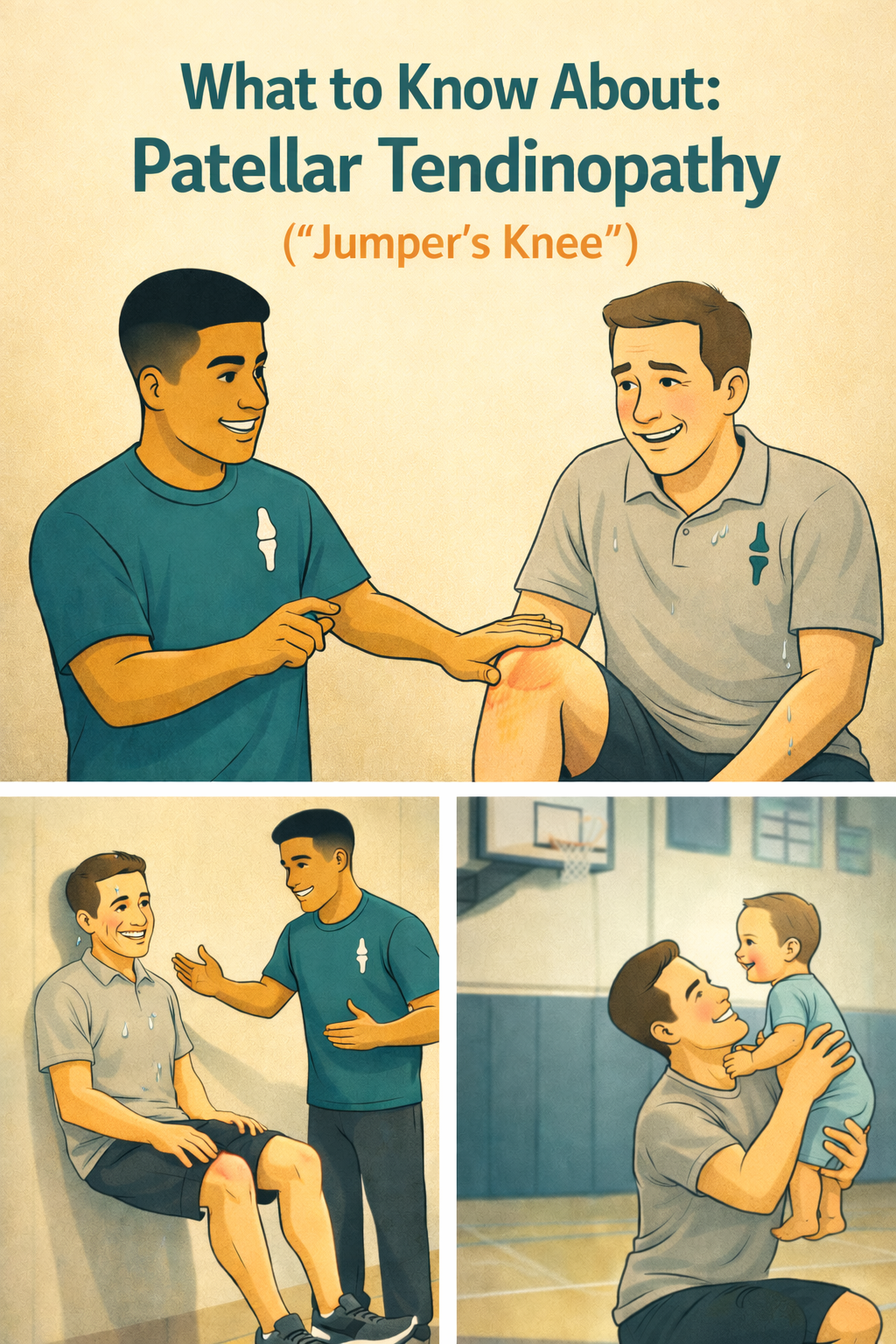
What to Know About: Patellar Tendinopathy (“Jumper’s Knee”)
✨ Too Long Didn’t Read (TLDR) / Summary
What is it?
Patellar tendinopathy is a tendon pain condition most often felt at the inferior pole of the patella (top of the patellar tendon) and tends to flare with knee-extensor loading, especially jumping/landing or “springy” movements.
Common symptoms:
Localized pain at the patellar tendon (often the inferior pole) that increases with activities like squats, stairs, jumping, or change-of-direction.
Pain can be more diffuse around/behind the kneecap ; however, be mindful, as this pain-pattern can be indicative of other conditions as well.
Many people report stiffness and reduced tolerance to training volume. Some may say that the knee will “warm up, then hurt later on after I’m done.”
Recovery window (realistic):
Tendon rehab is often measured in months, not days. Many cases require gradual, progressive loading; timelines can stretch to 6+ months depending on irritability, baseline strength, and sport demands.
Chronic symptoms are common in tendon conditions and can last years without a structured plan.
Care focus:
Combine load management (reduce aggravating volume) with progressive tendon-loading centered on quadriceps strengthening.
Remember that pain severity + pain duration together can meaningfully impact quad function and self-reported ability—history matters.
Prevention & performance:
Across populations, knee extension strength is protective.
For older adults, quadriceps-dominant training improved functional movement and daily activities more than functional-only approaches.
🧾 Condition-Specific General Information
What’s happening in patellar tendinopathy?
Patellar tendinopathy is best understood as a load-related tendon pain condition specifically in the area of the patellar tendon. “Tendinopathy” is an umbrella term, as it capture when there are degenerative features (“tendinous”) as well as classic inflammation (“tendinitis”). This tendinopathy can become present in any tendon when it is asked to do more energy-storage and force transfer than it is currently conditioned to tolerate—think repeated jumping, sprinting, cutting, or rapid increases in training volume.
Key clinical “tells”:
Pain is often localized to the patellar tendon (commonly the inferior pole of the patella).
Pain ramps up with demand on the knee extensors (especially springy tasks that store/release energy like jumping or sprinting).
Imaging can help with differential diagnosis, but tendon changes can also exist in people without pain - thus, diagnosis is still largely clinical.
Why strength keeps showing up in the research
Adolescents: lower knee extension strength = higher subsequent knee injury incidence.
Older adults: quadriceps-dominant work improved ADLs like sit-to-stand and stairs, and improved movement screen performance.
Tendinopathy: progressive tendon-loading programs emphasize quadriceps capacity because quad contraction loads the patellar tendon.
Plain-language translation:
If the quad can’t share the load well, the knee (and tendon) often “pays the bill.”
Plain-language reminder for treatment: “If load got you into this mess, load will get you out.”
Don’t know what this means? Keep reading to find out!
👩⚕️ For Providers 👨⚕️
What to expect (and how to frame it)
Patients often arrive with a mix of fear and frustration:
“Is this tearing?”
“Do I need a scan?”
“Why does it feel better during the workout but worse later?”
“Why isn’t rest fixing it?”
This is where interpersonal connection changes the trajectory. Your words can reduce threat, improve adherence, and help them stay consistent through the long middle of rehab.
Set the tone early:
Validate: “This is common—and it’s really annoying.”
Normalize: “Tendon rehab is slower than muscle rehab.”
Empower and Encourage: “We’re going to build load tolerance step-by-step. We’ve got this.”
🔑 Key Education Points
1) Pain history matters
Ask both pain intensity and duration. Patients with longer-duration and more severe patellar tendon pain can show more pronounced quadriceps deficits and worse self-reported function.
Use this to justify pacing, graded exposure, and realistic expectations.
2) Diagnosis is clinical; imaging is a helper, not the decider
Patellar tendinopathy is defined by localized tendon pain + load-related aggravation patterns. Imaging can be useful for ruling out other issues but isn’t a perfect “pain detector.”
3) Exercise is the main intervention - Eccentric Training is helpful, but is it the full picture?
Progressive tendon-loading approaches are consistently supported, and they typically center on quadriceps strengthening.⁴⁻⁷
Progressive tendon-loading exercise therapy (PTLE) showed better clinical outcomes than eccentric-only therapy at 24 weeks in a randomized trial.⁷
4) Isometrics can help symptoms, but loading drives adaptation
Isometrics are often used for pain modulation in tendinopathy and can be a practical “tool” during irritable periods.
The broader evidence base supports pairing symptom tools with progressive loading over time.
5) Avoid common pitfalls - Prepare for these early!
The tendinopathy literature highlights predictable traps: unrealistic timelines, passive-only plans, failing to address isolated quad deficits, and not progressing energy-storage tasks appropriately.
❓ Potential Questions Your Patients May Ask + Potential Answers
“Is my tendon inflamed?”
It could be. Tendon pain can be caused by degeneration, excessive overload, classic inflammation, or a combination. Regardless, the goal is to build capacity and tolerance over time.
“Should I stop all activity?”
Usually not. We often modify volume and intensity, then rebuild with a structured loading plan so you keep moving while healing.
“Why does it feel warm during exercise, then hurt later?”
Tendons can feel temporarily better as the system warms up, but the 24-hour response tells us if the dose was too high. If a flare up happens, it’s actually very helpful - we’ll use that response to guide progressions.
“How long will this take?”
Many people improve over months with consistent progressive loading. In some cases, rehab can take 6+ months depending on irritability and sport demands.
“Do I need injections or passive treatments?”
Exercise-based rehab is the foundation. Passive treatments may be adjuncts, but they shouldn’t replace progressive loading.
“What are we actually strengthening—and why?”
Your quadriceps help control knee load and directly load the patellar tendon. We will strengthen most of the muscles of your lower leg to support your knee and building quad capacity is a key part of improving function and tendon tolerance.
🗓️ Patient Timeline (Typical Rehab Flow)
Week 0–2 (Calm it down + keep it moving):
Identify the biggest aggravators (jump volume, sprinting, deep knee flexion under load) and adjust.
Start tolerable strengthening (often heavy-slow or isometric strategies depending on irritability).
Weeks 2–8 (Build capacity):
Progress quadriceps strengthening and kinetic chain support.
Track symptoms with a simple scale (like numeric pain rating scale (NPRS) or visual analog scale (VAS)) and the 24-hour response.
Weeks 8–16+ (Energy-storage + return-to-sport build):
Gradually reintroduce plyometrics/landing/cutting only after strength base is established and irritability is controlled.
Keep strength work in-season (especially for adolescent athletes where knee strength may influence injury incidence).
Return to sport/work:
Gradual ramp in volume and intensity with objective markers + patient confidence.
🏃 Return-to-Sport / Function Readiness Checks (Examples)
(Use what fits your setting and sport demands.)
Single-leg squat quality + symptom response
Hop tests (single-leg hop for distance, timed hops)
Vertical jump or jump-landing tolerance (when appropriate)
Quadriceps strength benchmarking (dynamometry if available; consistent proxy tests if not)
Sport-specific graded exposure plan (practice dose → modified play → full participation)
🤝 Soft-Skills Focus (The Joint Connection Style)
Translate the “why”:
“We’re building quad capacity so your tendon doesn’t have to do hero work every rep.”
Reflect and validate the emotion:
“It makes sense you’re frustrated—this is the kind of injury that tests patience.”
Use shared language:
“We’re not chasing ‘no pain ever.’ We’re chasing ‘predictable pain that settles and function that grows.’”
Close with teach-back:
“How will you decide if you did too much this week?”
“What’s your plan if pain spikes 24 hours after training?”
📂 Supplemental Information / Citations
Kim S, Park J. Influence of severity and duration of anterior knee pain on quadriceps function and self-reported function. Journal of Athletic Training. 2022;57(8):771-779. PubMed
Rosen AB, Wellsandt E, Nicola M, Tao MA. Clinical management of patellar tendinopathy. J Athl Train. 2022;57(7):621-631. PubMed
Malliaras P, Cook J, Purdam C, Rio E. Patellar tendinopathy: Clinical diagnosis, load management, and advice for challenging case presentations. J Orthop Sports Phys Ther. 2015;45(11):887-898. PubMed
Figueroa D, Figueroa F, Calvo R. Patellar tendinopathy: Diagnosis and treatment. J Am Acad Orthop Surg. 2016;24(12):e184-e192. PubMed
Breda SJ, Oei EHG, Zwerver J, Visser E, Waarsing E, Krestin GP, de Vos RJ. Effectiveness of progressive tendon-loading exercise therapy in patients with patellar tendinopathy: a randomised clinical trial. Br J Sports Med. 2021;55(9):501-509. PubMed
Rich A, Cook JL, Hahne AJ, Rio EK, Ford J. Randomised, cross-over trial on the effect of isotonic and isometric exercise on pain and strength in proximal hamstring tendinopathy: trial protocol. BMJ Open Sport Exerc Med. 2021;7(1):e000954. PubMed
Followay B, Holland T, Rowley L. Effects of a quadricep-dominant vs. functional training program on activities of daily living, functional performance, and motor unit recruitment in older adults. Int J Exerc Sci. 2025;18(8):1096. PMC
This content drafted, researched, edited, and generated by:
Jackson Kojima, PT, DPT
Jackson Kojima, PT, DPT, OCS is a physical therapist with an extensive background in orthopedics, geriatrics, and sports rehabilitation. Dr. Kojima is a board-certified orthopedic clinical specialist (OCS) with a passion for post-operative rehabilitation and enjoys treating multi-factorial conditions like low back pain and generalized joint pain. Dr. Kojima earned his doctorate of physical therapy from Campbell University in 2021 and currently lives in Kernersville, NC.
© 2025 The Joint Connection Company. All rights reserved.
The content on this website, including all text, graphics, and materials, is the exclusive property of The Joint Connection Company and is protected by applicable copyright and intellectual property laws. No part of this site may be reproduced, distributed, or used without prior written permission.