

✨ Too Long Didn’t Read (TL;DR) / Summary
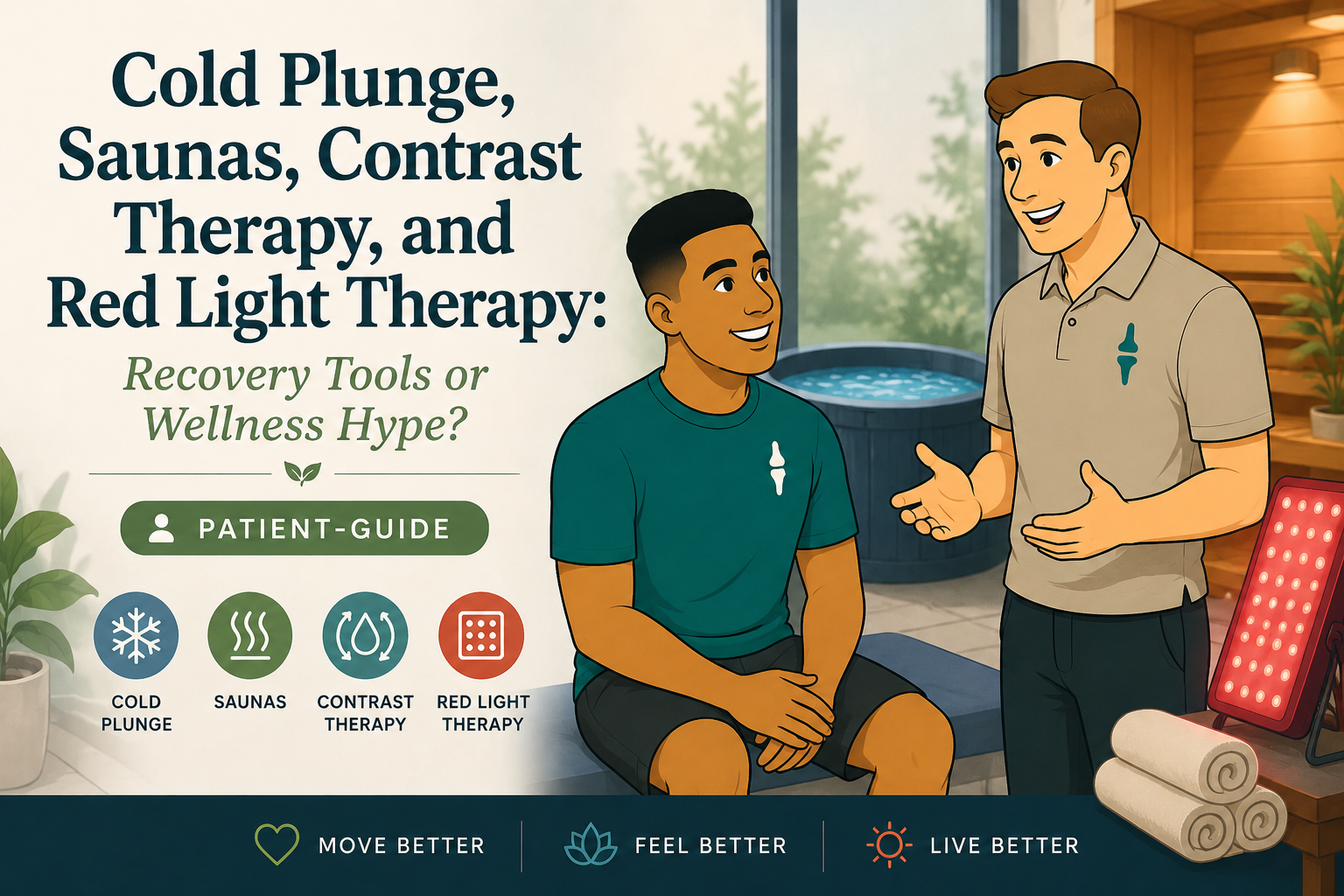
Cold plunges, saunas, contrast therapy, and red light therapy can be helpful recovery tools—but they are not magic fixes.
They may help with soreness, relaxation, recovery routines, and short-term symptom relief. But the foundation of recovery is still:
Sleep. Movement. Strength. Nutrition. Hydration. Load management. Good medical guidance from trusted providers.
Your provider can help you figure out:
Why you are sore
Whether your training load is too high
Whether your recovery plan matches your goals
Whether pain is normal soreness or something that needs care
Whether these tools are safe for your health history
In this post, we’ll talk about what exactly these recovery tools are and look at the evidence. The big message here:
Recovery tools can support your plan, but they should not replace the plan.
🧾 General Information
1. Cold Plunge
Cold plunge, also called cold-water immersion, usually means sitting or standing in cold water, often around 50–59°F (10-15°C).
People use it for:
Muscle soreness
CrossFit recovery
HYROX training recovery
Post-workout stiffness
Stress relief
Mental reset
Sleep routines
Cold plunge may help you feel less sore after hard training. That can be useful if you are doing frequent workouts or competitions.
But here is the catch:
If your main goal is building strength or muscle, research suggests that using cold plunge too often right after lifting may reduce some of the training adaptations you are working for.
So instead of asking, “Is cold plunge good or bad?” ask:
“What am I using it for?”
Cold plunge may be more useful after a competition, intense conditioning day, or soreness-heavy workout. It may be less ideal immediately after every strength training session if your goal is muscle growth.
Use caution with cold plunge if you have:
Heart disease
High blood pressure
Irregular heartbeat
History of fainting
Raynaud’s
Poor circulation
Diabetes with neuropathy
Pregnancy concerns
Medication concerns involving blood pressure or heart rate
Cold water can quickly raise heart rate, breathing rate, and blood pressure. Talk with your physician first if you have cardiovascular risk.
2. Sauna
Sauna therapy uses heat exposure to create a controlled stress response. Many people use it to relax, sweat, unwind, and feel recovered.
Sauna bathing has been associated with cardiovascular and wellness benefits in research, especially Finnish sauna studies. But much of this research is observational, meaning sauna use is linked with certain health outcomes but does not prove sauna alone caused them.
Sauna may be helpful for:
Relaxation
Stress management
Sleep routines
Recovery rituals
General wellness
Feeling less stiff
For many people, the biggest benefit is not “biohacking.” It is slowing down, breathing, and giving the nervous system a break.
Use caution with sauna if you have:
Uncontrolled blood pressure
Recent heart event
Kidney disease
Heat intolerance
Dizziness or fainting
Pregnancy concerns
Medications that affect hydration, sweating, or blood pressure
Do not use alcohol before or during sauna. Dizziness, nausea, confusion, chest pain, or feeling faint are signs to immediately stop and seek help.
3. Contrast Therapy
Contrast therapy usually means alternating between hot and cold exposure, such as sauna and cold plunge, or hot and cold water.
People use it for:
Muscle soreness
Heavy training weeks
Race or competition recovery
CrossFit soreness
HYROX-style conditioning recovery
General stiffness
Research suggests contrast therapy may help reduce delayed-onset muscle soreness (DOMS) compared with passive recovery, though effects may be modest and not always tied to better performance.
Plain English version:
Contrast therapy may help you feel better, but it may not automatically make you perform better.
That still matters. Feeling less sore can help you move more comfortably, sleep better, and return to normal activity.
Ask yourself:
Do I feel better after doing it?
Am I sleeping better?
Am I moving better the next day?
Is it helping me train consistently?
Am I using it instead of addressing pain, weakness, or poor programming?
4. Red Light Therapy / Photobiomodulation
Red light therapy is also called photobiomodulation, low-level light therapy, or low-level laser therapy. It uses red or near-infrared light to create biological effects in tissue.
Red light therapy marketing departments will say this can be used for:
Tendon pain
Muscle pain
Inflammation
Skin health
Workout recovery
Joint aches
Alternative medicine options
THE TRUTH: the evidence is still developing. For tendon problems, research suggests red light therapy may help pain and function, especially when combined with exercise-based rehab but more research is needed.
That part is important:
Red light therapy may help support recovery, but exercise-based rehab is still the main ingredient.
For example, if you have Achilles pain, tennis elbow, jumper’s knee, or shoulder tendinopathy, red light therapy alone is unlikely to solve the problem if your tendon is not being progressively loaded and strengthened.
Use caution with red light therapy if you have:
Active cancer
Suspicious skin lesions
Eye or retinal concerns
Photosensitive conditions
Photosensitizing medications
Pregnancy concerns
New or unexplained symptoms
Ask your physician or pharmacist if your medications increase light sensitivity.
💙 For Patients
Here is what to talk about with your physician, physical therapist, or pharmacist before adding these recovery tools.
Ask your physician:
“Is cold plunge safe with my heart history or blood pressure?”
“Is sauna safe with my medications?”
“Do I have any circulation issues that make cold exposure risky?”
“Is this pain normal soreness, or should we rule something else out?”
“Are there any reasons I should avoid heat, cold, or red light therapy?”
Ask your pharmacist:
“Do any of my medications affect heat tolerance, sweating, blood pressure, or hydration?”
“Do any of my medications make me sensitive to light?”
“Should I avoid sauna or red light therapy with these prescriptions?”
Ask your physical therapist:
“Why do I keep getting sore in the same area?”
“Is my training plan too much too soon?”
“Do I need mobility, strength, rest, or better programming?”
“Would cold plunge, sauna, contrast therapy, or red light therapy actually help my goal?”
“How do I know if my pain is something more than soreness?”
Physical therapy can help by connecting your recovery tools to your real life.
Not just:
“Do this because it feels good.”
But:
“Here is why your knee hurts during squats, here is how we build capacity, and here is where recovery tools may fit.”
That is the difference between chasing trends and building a plan.
Key Clinical Takeaways
Cold plunge may reduce soreness and improve perceived recovery.
Sauna may support relaxation, stress management, and wellness routines.
Contrast therapy may help soreness, but performance benefits are less clear.
Red light therapy may help some tendon pain when paired with exercise.
These tools should not replace sleep, strength training, nutrition, hydration, or medical care.
Talk to your physician before using heat or cold if you have heart, blood pressure, circulation, kidney, pregnancy, or medication concerns.
Talk to a physical therapist if pain keeps returning, limits exercise, or changes how you move.
📂 Supplemental Information / Citations
Cain T, Brinsley J, Bennett H, Nelson M, Maher C, Singh B. Effects of cold-water immersion on health and wellbeing: a systematic review and meta-analysis. PLoS One. 2025;20(1). doi:10.1371/journal.pone.0317615.
Kunutsor SK, Laukkanen JA. Does the combination of Finnish sauna bathing and other lifestyle factors confer additional health benefits? A review of the evidence. Mayo Clin Proc. 2023;98(6):915-926. doi:10.1016/j.mayocp.2023.01.008.
Patrick RP, Johnson TL. Sauna use as a lifestyle practice to extend healthspan. Exp Gerontol. 2021;154:111509. doi:10.1016/j.exger.2021.111509.
Tripodi N, Feehan J, Husaric M, Sidiroglou F, Apostolopoulos V. The effect of low-level red and near-infrared photobiomodulation on pain and function in tendinopathy: a systematic review and meta-analysis of randomized control trials. BMC Sports Sci Med Rehabil. 2021;13(1):91. doi:10.1186/s13102-021-00306-z.
American Physical Therapy Association. Physical therapists’ role in prevention, wellness, fitness, health promotion, and management of disease and disability. Published September 20, 2019.
American Physical Therapy Association. Scope of practice.
American Heart Association. You’re not a polar bear: the plunge into cold water comes with risks. Published December 9, 2022.
Cleveland Clinic. Red Light Therapy: Benefits, Side Effects & Uses. Published December 1, 2021. Accessed June 9, 2026. https://my.clevelandclinic.org/health/articles/22114-red-light-therapy
This content drafted, researched, edited, and generated by:
McKinley Pollock, PT, DPT
McKinley Pollock, PT, DPT, OCS, CSCS is a physical therapist with a background in orthopedics and sports rehabilitation. Dr. Pollock earned his doctorate of physical therapy from Campbell University in 2021, is a board-certified orthopedic clinical specialist (OCS), and certified strength and conditioning specialist (CSCS). Dr. Pollock enjoys combining lessons learned from his DPT training and research, translating these into clinical practice. His passions include promoting relationships between patients & clinicians to promote clinical effectiveness, satisfaction, and efficiency, the implementation of primary preventative medicine into clinical practice, and leadership and education development.
© 2026 The Joint Connection Company. All rights reserved.
The content on this website, including all text, graphics, and materials, is the exclusive property of The Joint Connection Company and is protected by applicable copyright and intellectual property laws. No part of this site may be reproduced, distributed, or used without prior written permission.