

Sleep: The Conversation We Shouldn’t Sleep On
A Patient-Friendly Guide to Sleep, Energy, Pain, and Better Conversations With Your Healthcare Team
Sleep is not “extra.” It is one of the ways your body repairs, resets, and prepares for the next day.
When sleep is off, life can feel harder. Pain may feel louder. Soreness may linger. Workouts may feel heavier. Your mood may dip. Your energy may disappear before lunch. You might even feel like you are doing “everything right” and still not recovering.
Here is the good news: sleep is something you can talk about with your healthcare team.
Your physician, physical therapist, occupational therapist, nurse practitioner, physician assistant, or other provider may not ask unless you bring it up. So this post is here to help you know what to say, what to track, and when sleep may need a closer look.
✨ Too Long Didn’t Read (TL;DR) / Summary
Sleep affects your pain, energy, mood, memory, immune health, heart health, metabolism, healing, and ability to move well. Adults generally need 7 or more hours of sleep per night, though sleep needs vary by age.
Poor sleep may look like trouble falling asleep, waking up often, feeling tired even after sleeping, daytime sleepiness, low energy, soreness that lingers, worse pain at night, or difficulty focusing.
A physical therapist can help with sleep-related barriers like pain, positioning, bed mobility, movement habits, soreness, and activity planning. A physician or sleep medicine provider can evaluate possible sleep disorders such as insomnia, sleep apnea, restless legs syndrome, or narcolepsy.
A simple question to ask your provider:
“Could my sleep be affecting my pain, energy, or recovery?”
🧾 General Information
What Is Sleep Health?
Sleep health is not just about how many hours you are in bed. It includes:
Sleep quantity: how much sleep you get.
Sleep quality: how restful and refreshing that sleep feels.
You may be in bed for 8 hours but still wake up exhausted. That matters.
According to the Center for Disease Control and Prevention (CDC), signs of poor sleep quality include trouble falling asleep, waking repeatedly during the night, and feeling sleepy or tired even after getting enough sleep.
Good sleep supports:
Getting sick less often
Healthy weight maintenance
Lower stress and improved mood
Heart health and metabolism
Lower risk of chronic conditions such as type 2 diabetes, heart disease, high blood pressure, and stroke
Better attention, memory, and daily performance
Lower risk of motor vehicle crashes and injuries
In everyday language:
Sleep helps your body heal, your brain focus, and your nervous system calm down.
How Much Sleep Do You Need?
The CDC lists these general sleep recommendations:
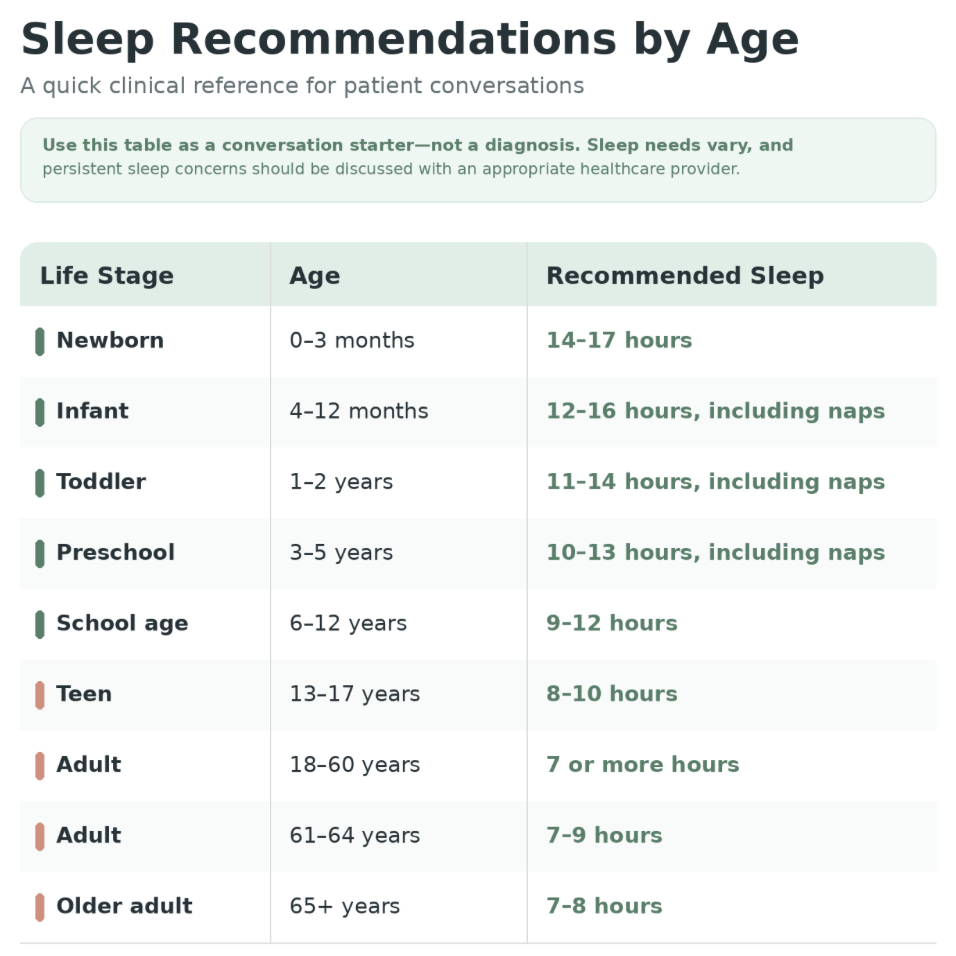
These numbers are a guide, not a personal diagnosis. Some people need more support because pain, stress, medications, medical conditions, shift work, parenting, caregiving, or sleep disorders may affect sleep.
Why Sleep Matters for Pain, Soreness, and Recovery
Sleep and pain have a two-way relationship.
Pain can make sleep harder. Poor sleep can make pain feel worse.
Research in physical therapy and sleep health has connected poor sleep with increased pain perception, reduced function, lower quality of life, anxiety, depression, attention problems, memory issues, reduced ability to learn new motor skills, and increased risk for accidents, injuries, and falls.
That means sleep can affect things like:
How sore you feel after exercise
How quickly you recover
How well you tolerate physical therapy
How well you remember exercises
How motivated you feel
How much pain you notice at night
How steady, alert, or coordinated you feel during the day
So if you are going to physical therapy and feel like you are “not progressing,” sleep may be part of the picture.
That does not mean your pain is “all in your head.” It means your body is a connected system.
Sleep, Fitness, and Low Energy
If your energy is low, it is easy to assume you are “out of shape” or “not trying hard enough.” Sometimes, though, your body may be under-recovered.
Sleep supports tissue repair, hormone regulation, immune function, cardiovascular health, cognition, and memory consolidation.
Exercise can also help sleep quality when it is matched to your body, your health, and your current tolerance.
For some people, movement during the day helps them sleep better at night. For others, intense exercise too late in the evening may feel overstimulating. The key is finding the right type, amount, and timing.
A physical therapist can help you answer:
“What kind of movement helps my body feel better instead of more wired, sore, or exhausted?”
Sleep Hygiene: Small Habits That Can Help
Sleep hygiene means habits that support better sleep. The CDC and American Physical Therapy Association (APTA) list several common strategies:
Go to bed and wake up around the same time each day
Keep your bedroom quiet, relaxing, dark, and cool
Turn off electronic devices at least 30 minutes before bed
Avoid caffeine in the afternoon or evening
Avoid large meals and alcohol close to bedtime
Exercise regularly
Build a calming bedtime routine
But real life is real life.
Maybe you work nights.
Maybe you share a room.
Maybe you have kids.
Maybe pain wakes you up.
Maybe your neighborhood is noisy.
Maybe stress follows you to bed.
So instead of trying to change everything at once, start with one small experiment.
Try one of these for a week:
Set your phone across the room.
Use a pillow to support a painful shoulder, hip, knee, or back.
Take 5 slow breaths before lying down.
Dim lights 30 minutes before bed.
Keep a simple sleep diary.
Ask your PT about sleep positioning.
Ask your physician if your symptoms could be a sleep disorder.
Small changes count.
💙 For Patients
What Should You Tell Your Physician?
Your physician or primary care provider should know if sleep is affecting your daily life, safety, pain, mood, or energy.
Bring up sleep if you notice:
Loud snoring
Gasping, choking, or pauses in breathing during sleep
Waking up with headaches
Feeling tired even after a full night in bed
Trouble falling asleep or staying asleep
Restless or uncomfortable legs at night
Falling asleep during the day
Drowsy driving
Worsening anxiety, depression, or stress around sleep
Sleep problems after starting or changing medications
Needing sleep medications often
Ongoing fatigue that does not make sense
The CDC recommends talking to a healthcare provider if you regularly have problems sleeping or notice symptoms of common sleep disorders.
You can say:
“I’m having trouble sleeping, and it is affecting my energy and daily life. Could we talk about possible causes?”
Or:
“My partner says I snore and sometimes gasp. Should I be evaluated for sleep apnea?”
Or:
“I wake up tired even when I sleep enough hours. What should we check?”
What Should You Tell Your Physical Therapist?
Physical therapists can help with movement, pain, positioning, mobility, exercise, and education related to sleep health. The APTA recognizes physical therapists as part of the healthcare team involved in screening for sleep dysfunction, educating patients on healthy sleep behaviors, addressing impairments that interfere with sleep, monitoring sleep quality and quantity when appropriate, and referring to sleep medicine professionals when needed.
Tell your PT if:
Pain wakes you up
You cannot find a comfortable sleeping position
You feel stiff every morning
Rolling in bed is painful
Getting in or out of bed is hard
Your exercises make you sore in a way that affects sleep
Fatigue keeps you from doing your home program
You feel more pain after poor sleep
You are afraid to move at night
Good questions to ask your PT:
“What sleeping position might reduce stress on this area?”
“Can you show me how to use pillows for support?”
“Could my exercise timing be affecting my sleep?”
“Should I adjust my home exercises if soreness is keeping me awake?”
“Can we work on bed mobility?”
“Do my symptoms sound like something I should discuss with my physician?”
Your PT should not replace your physician or diagnose a sleep disorder unless it is within their license and jurisdiction. But they can be an important part of the team.
What to Track Before Your Appointment
A sleep diary can help your provider understand what is happening. The CDC notes that a provider may ask you to track sleep habits, including bedtime, nighttime waking, morning wake time, naps, exercise, alcohol or caffeine intake, and medications.
For 1–2 weeks, write down:
What time you went to bed
What time you woke up
How many times you woke during the night
Whether pain woke you up
Your energy level in the morning
Your caffeine intake
Alcohol use, if applicable
Exercise or activity
Naps
Medications or supplements
Stress level
Screen use before bed
You do not need a fancy app. A notebook works.
Bring it to your appointment and say:
“I tracked my sleep because I wanted to see if it connects to my pain, soreness, or energy.”
That is useful information.
Sleep and Kids, Teens, and Students
Sleep matters for children and teens too. The CDC reports that children and adolescents who do not get enough sleep have higher risk for obesity, type 2 diabetes, poor mental health, injuries, attention problems, behavior problems, and poorer academic performance.
The CDC also notes that many students do not get enough sleep on school nights. In one study, about 6 out of 10 middle school students and about 7 out of 10 high school students reported insufficient sleep on school nights.
For parents and caregivers, helpful steps may include:
Setting regular bedtimes and wake times
Dimming lights in the evening
Creating a media curfew
Removing devices from the bedroom
Talking to a pediatrician if sleep problems persist
A simple family question:
“What is one thing we can change at night that helps everyone rest better?”
When Sleep Problems Are Not Just “Bad Habits”
Sometimes sleep hygiene is not enough.
You may be doing everything “right” and still not sleeping well. That does not mean you failed. It may mean something else needs attention.
Common sleep disorders include insomnia, restless legs syndrome, narcolepsy, and sleep apnea. These deserve appropriate medical evaluation.
Ask for help sooner if sleep problems are affecting safety, driving, work, school, mood, or daily function.
A helpful phrase:
“I’ve tried changing my routine, but I’m still struggling. What else should we consider?”
A Patient-Friendly Sleep Conversation Script
Use this at your next visit:
“I want to talk about sleep because I think it may be affecting my pain, energy, and recovery. I usually sleep about ___ hours. I wake up ___ times per night. I feel ___ in the morning. My biggest concern is ___. What should we look at next?”
This gives your provider a clear starting point.
What Your Healthcare Team May Recommend
Depending on your symptoms and provider type, your care team may discuss:
Sleep diary
Sleep hygiene strategies
Exercise timing or intensity changes
Pain management strategies
Pillow support or positioning
Bed mobility techniques
Stress management or relaxation routines
Medication review
Referral to sleep medicine
Sleep study, when appropriate
Mental health support if anxiety, depression, trauma, or stress are affecting sleep
The goal is not to make sleep perfect.
The goal is to help your body feel safer, calmer, and more supported.
Key Takeaways for Patients
Sleep can affect pain, healing, soreness, energy, mood, memory, fitness, and daily function.
Physical therapists can help with sleep-related movement barriers, positioning, pain, exercise planning, and referrals when needed.
Physicians and sleep medicine professionals can evaluate possible sleep disorders such as insomnia, sleep apnea, restless legs syndrome, and narcolepsy.
If sleep is affecting your life, bring it up. You are not being dramatic. You are giving your healthcare team important information.
📂 Supplemental Information / Citations
Wojciechowski M. A good night’s sleep: PTs’ role in patients’ sleep health. APTA Magazine. Published May 2021. Accessed June 1, 2026. https://www.apta.org/apta-magazine/archive/2021/05/01/a-good-nights-sleep-pts-role-in-patients-sleep-health
American Physical Therapy Association. Role of the physical therapist and APTA in sleep health. Published August 20, 2020. Accessed June 1, 2026. https://www.apta.org/apta-and-you/leadership-and-governance/policies/role-pt-apta-sleep-health
American Physical Therapy Association. Let’s talk about sleep. Published October 28, 2021. Accessed June 1, 2026. https://www.apta.org/fit-for-practice/restoration/lets-talk-about-sleep
Centers for Disease Control and Prevention. About sleep. Published May 15, 2024. Accessed June 1, 2026. https://www.cdc.gov/sleep/about/index.html
Baranwal N, Yu PK, Siegel NS. Sleep physiology, pathophysiology, and sleep hygiene. Prog Cardiovasc Dis. 2023;77:59-69. doi:10.1016/j.pcad.2023.02.005
Calvo S, González C, Lapuente-Hernández D, Cuenca-Zaldívar JN, Herrero P, Gil-Calvo M. Are physical therapy interventions effective in improving sleep in people with chronic pain? A systematic review and multivariate meta-analysis. Sleep Med. 2023;111:70-81. doi:10.1016/j.sleep.2023.09.008
Navarro-Ledesma S, Hamed-Hamed D, Gonzalez-Muñoz A, Pruimboom L. Impact of physical therapy techniques and common interventions on sleep quality in patients with chronic pain: a systematic review. Sleep Med Rev. 2024;76:101937. doi:10.1016/j.smrv.2024.101937
Coren S. Sleep health and its assessment and management in physical therapy practice: the evidence. Physiother Theory Pract. 2009;25(5-6):442-452. doi:10.1080/09593980902835351
Centers for Disease Control and Prevention. Sleep and health. Published July 2, 2024. Accessed June 1, 2026. https://www.cdc.gov/physical-activity-education/staying-healthy/sleep.html
This content drafted, researched, edited, and generated by:
McKinley Pollock, PT, DPT
McKinley Pollock, PT, DPT, OCS, CSCS is a physical therapist with a background in orthopedics and sports rehabilitation. Dr. Pollock earned his doctorate of physical therapy from Campbell University in 2021, is a board-certified orthopedic clinical specialist (OCS), and certified strength and conditioning specialist (CSCS). Dr. Pollock enjoys combining lessons learned from his DPT training and research, translating these into clinical practice. His passions include promoting relationships between patients & clinicians to promote clinical effectiveness, satisfaction, and efficiency, the implementation of primary preventative medicine into clinical practice, and leadership and education development.
© 2026 The Joint Connection Company. All rights reserved.
The content on this website, including all text, graphics, and materials, is the exclusive property of The Joint Connection Company and is protected by applicable copyright and intellectual property laws. No part of this site may be reproduced, distributed, or used without prior written permission.