

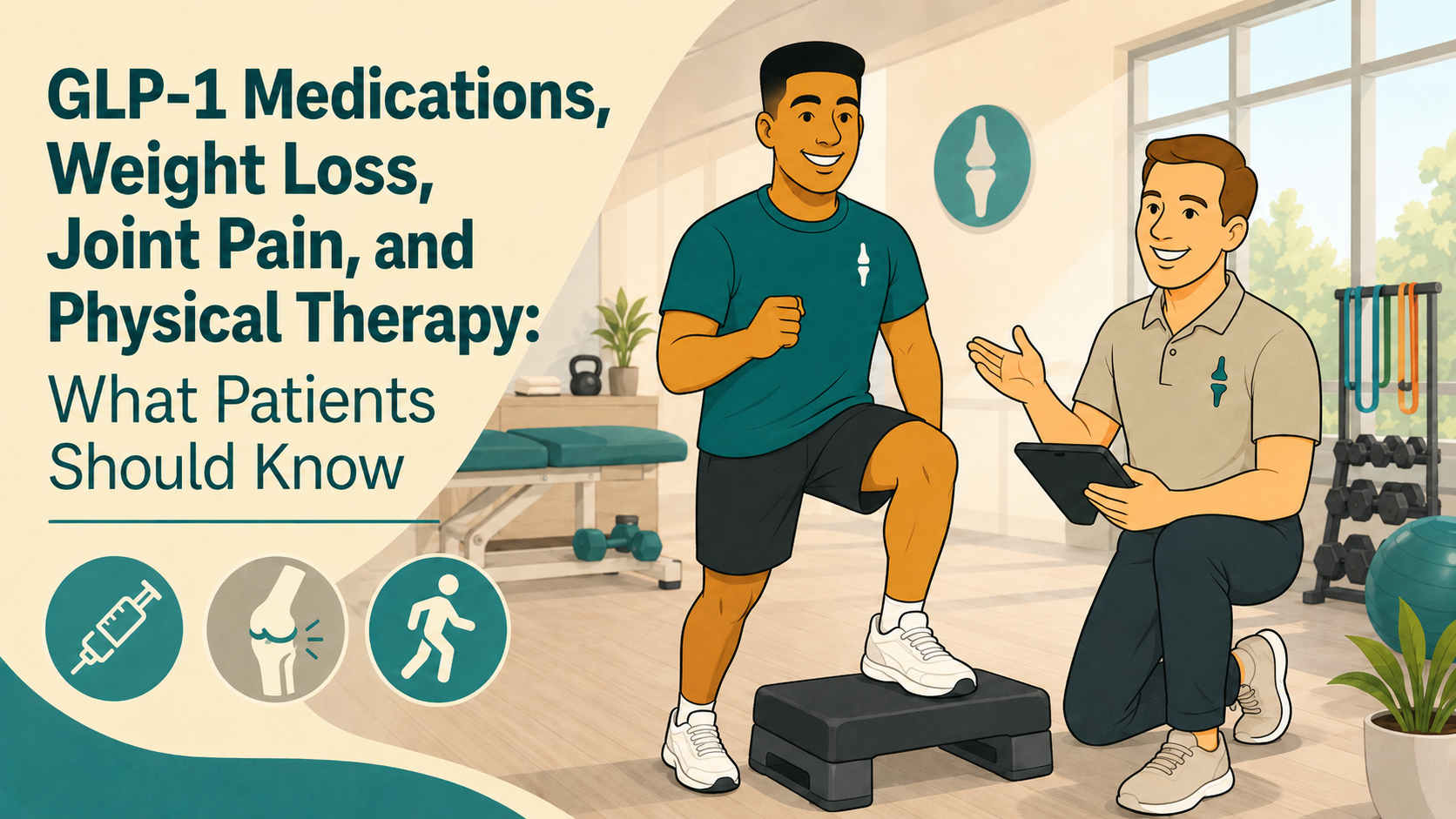
Illustration of two providers in a physical therapy clinic demonstrating exercise support for patients taking GLP-1 medications.
Clinical Notes for Readers
This article is for educational purposes only. It is not medical advice and should not replace care from your physician, prescribing provider, pharmacist, registered dietitian, or physical therapist.
Physical therapists do not prescribe or manage GLP-1 medications. They can help with movement, strength, joint pain, function, exercise planning, activity progression, and communication with the rest of your healthcare team when appropriate. APTA describes physical therapist scope of practice as involving professional, jurisdictional, and personal components, and nutrition-related PT practice should remain within applicable law and personal competence.
Patients are encouraged to follow up with their healthcare providers for further information and questions as necessary. We have provided some potential questions you may have below; however, this article was written by a physical therapist within the scope of physical therapy and is for educational purposes only and should not be taken as medical advice. Now… Let’s begin!
Introduction:
GLP-1 medications are everywhere right now.
You may have heard of medications like Wegovy, Ozempic, Mounjaro, or Zepbound. Maybe your doctor mentioned them. Maybe a friend is taking one. Maybe you are taking one yourself. Maybe you are curious, nervous, excited, skeptical, or all of the above.
And honestly? That makes sense.
These medications can be a big deal for many people. They can affect appetite, blood sugar, weight, energy, digestion, and sometimes even how your body feels when you move. For some people, weight loss may help reduce joint pain and improve walking, stairs, or daily activity. For others, the process may come with fatigue, nausea, weakness, dizziness, or uncertainty about how to exercise safely.
That is where physical therapy can help.
Not because physical therapists prescribe these medications. We do not.
Not because physical therapists should tell you whether to take them, stop them, or change your dose. We should not.
But because physical therapists are movement experts. We help people build strength, improve function, manage pain, exercise safely, and feel more confident in their bodies.
GLP-1 medications may change your weight.
Physical therapy can help you protect and build the body that carries you through your life.
✨ Too Long Didn’t Read (TL;DR) / Summary
GLP-1 medications, including medicines such as Wegovy, Ozempic, Mounjaro, and Zepbound, are used for conditions such as obesity, weight management, and type 2 diabetes. They can help some people lose a significant amount of weight and may also improve blood sugar and certain heart or kidney-related health risks in specific populations.
Weight loss from GLP-1 medications usually comes mostly from body fat, but some loss of lean mass or fat-free mass can also happen. That does not automatically mean these medications cause frailty, but it does mean that strength, nutrition, exercise, and function matter.
Physical therapy can help people taking GLP-1 medications by improving strength, balance, joint pain, walking tolerance, exercise confidence, and long-term movement habits. PTs can also help you track what your body can do, not just what the scale says.
Physical therapists do not manage your medication, dosing, or side effects. Those questions should go to your prescribing provider or pharmacist. But your PT can help you notice symptoms that may affect exercise safety and communicate with the rest of your healthcare team when needed.
A good care team may include your physician, physical therapist, pharmacist, registered dietitian, mental health professional, and other providers depending on your needs. The goal is not just weight loss. The goal is helping you feel stronger, safer, more capable, and more connected to your body.
🧾 General Information
What are GLP-1 medications?
GLP-1 medications are a class of medications that work with hormone pathways involved in appetite, blood sugar, fullness, and digestion. GLP-1 stands for glucagon-like peptide-1, which is a hormone your body naturally uses to help regulate blood sugar and appetite.
Some medications, like semaglutide, work through the GLP-1 receptor. Semaglutide is the active ingredient in medications such as Ozempic and Wegovy. Other medications, like tirzepatide, work through both GLP-1 and GIP pathways. Tirzepatide is the active ingredient in medications such as Mounjaro and Zepbound.
These medications were first used for type 2 diabetes and are now also commonly discussed in weight management and obesity care.
Why are people talking about them so much?
Because for many people, these medications can lead to meaningful weight loss.
Recent medical reviews describe average weight loss of approximately 15% to 25% over 1 to 1.5 years with certain GLP-1–based anti-obesity medications. Other research has shown that these medications may also improve blood sugar control and reduce certain cardiovascular risks in some groups of patients.
That is important.
But there is another side of the story that does not always get enough attention:
What happens to your strength, joints, movement, energy, and daily life while your body is changing?
That is where physical therapy enters the conversation.
“If I lose weight, will my joint pain get better?”
For many people, weight loss may help reduce stress on joints, especially in areas like the knees, hips, feet, ankles, and back.
If you have knee osteoarthritis, hip pain, back pain, plantar fasciitis, or general joint stiffness and you are either overweight or obese, losing weight may reduce some of the mechanical load your joints experience during walking, stairs, squatting, or standing. Weight loss, including weight loss associated with GLP-1 medications, may improve knee pain, stiffness, quality of life, and physical function in some people with obesity and knee osteoarthritis.
But weight loss is not the same thing as strength.
And less weight on a joint does not automatically mean the joint knows how to move well, tolerate exercise, or handle daily life.
That is why physical therapy can be helpful.
A physical therapist can help you figure out:
Why your knee, hip, back, shoulder, or ankle hurts
Which movements are safe to start with
How to build strength without flaring pain
How to walk, squat, climb stairs, lift, or exercise more comfortably
How to progress without doing too much too soon
How to stay active even if you are dealing with nausea, fatigue, or low energy
Weight loss may open the door.
Physical therapy can help you walk through it.
“Will GLP-1 medications make me lose muscle?”
This is one of the biggest questions people are asking.
The short answer: You may lose some lean mass during weight loss, but that does not automatically mean you are becoming weak or frail.
When people lose weight intentionally, a lot of the weight lost usually comes from fat mass. But some may also come from fat-free mass, which includes skeletal muscle, water, organs, and other tissues. Skeletal muscle is only one part of fat-free mass.
This matters because social media often turns the topic into a scare headline:
“GLP-1s melt your muscle!”
“Ozempic causes frailty!”
“You’ll lose all your strength!”
The research is more balanced than that.
Conte and colleagues explain that while fat-free mass loss can occur with weight loss, the reduction in fat mass is usually greater than the reduction in fat-free mass. In many people, function and mobility can improve after weight loss, even if some lean mass is lost.
That said, muscle still matters. A lot.
The better question is not just, “Did I lose muscle?”
The better questions are:
Am I getting weaker?
Am I more tired than usual?
Can I climb stairs?
Can I get off the floor?
Can I carry groceries?
Can I walk farther?
Can I exercise safely?
Am I eating enough to support my activity?
Do I feel more capable in my daily life?
That is the physical therapy conversation.
Why strength training matters if you are taking a GLP-1 medication
If you are losing weight, especially quickly, your body needs a plan to protect strength and function.
Exercise, especially resistance training, may help reduce the proportion of weight loss that comes from fat-free mass. Patients using GLP-1 medications may benefit from resistance training, aerobic exercise, long-term activity support, and gradual loading, especially when energy levels fluctuate during dose changes.
This does not mean you need to become a bodybuilder.
It means your body needs regular signals that say:
“Keep this strength.”
“Use these muscles.”
“Support these joints.”
“Stay capable.”
Strength training may include:
Sit-to-stands
Step-ups
Wall push-ups
Resistance bands
Dumbbells
Machines
Squats to a chair
Rows
Carries
Balance exercises
Core strengthening
Hip and knee strengthening
The right starting point depends on your body, your pain, your medical history, your confidence, and your current activity level.
A physical therapist can help you start where you are instead of where the internet says you “should” be.
Why cardio still matters
Strength training is important, but it is not the whole story.
Aerobic exercise, like walking, biking, rowing, swimming, or using an elliptical, can support heart health, blood sugar regulation, endurance, energy, and long-term weight maintenance.
Each exercise-related care plan for a patient taking GLP-1 medications should include both aerobic and resistance training, while also considering joint status, load tolerance, muscle function, and overall health.
A practical starting point might look like:
5–10 minutes of walking after meals
Short walking intervals with breaks
Cycling if walking hurts
Pool walking if joints are sensitive
Light rowing if tolerated
Gradual step-count goals
“Conversational pace” activity where you can still talk
You do not need to crush yourself.
You need to build a routine your body can repeat.
What if exercise feels harder after starting the medication?
This can happen.
Some people experience nausea, constipation, diarrhea, vomiting, fatigue, lower appetite, dizziness, or lower energy when starting or increasing a GLP-1 medication. These symptoms can affect how you feel during exercise.
That does not mean you are failing.
It means your plan may need to be adjusted.
Your PT may help by changing:
Exercise intensity
Session length
Rest breaks
Positions used during exercise
Balance challenges
Walking distance
Strength-training volume
Timing of exercise
How quickly you progress
For example, if you are nauseated or under-fueled, your PT may avoid a long, intense workout and instead focus on gentle movement, breathing, mobility, light strengthening, or education that day.
The goal is not “push through everything.”
The goal is “move wisely.”
What physical therapy can help with if you are taking a GLP-1 medication
Physical therapy may help if you are taking Wegovy, Ozempic, Mounjaro, Zepbound, or another GLP-1 medication and you are dealing with:
Knee pain
Hip pain
Back pain
Foot or ankle pain
Balance concerns
Weakness
Low endurance
Fear of exercise
Pain with walking
Pain with stairs
Difficulty getting off the floor
Difficulty getting out of a chair
Muscle loss concerns
Starting exercise after a long break
Returning to the gym
Building a safe strength program
Staying active while managing fatigue or nausea
A physical therapist can also help you track progress in ways that are more useful than the scale.
That may include:
How many times you can stand from a chair in 30 seconds
How fast you walk
How far you can walk in 6 minutes
How well you balance
How many stairs you can climb
How much weight you can safely lift
How your pain changes over time
How confident you feel moving your body
The scale can tell you weight.
Physical therapy can help you measure ability.
💙 For Patients
What should I tell my physical therapist?
Tell your PT if you are taking or recently stopped a GLP-1 or weight-loss medication.
You can say:
“I’m taking a GLP-1 medication for weight loss or diabetes, and I want to make sure I’m exercising safely.”
Helpful information to share includes:
The name of the medication
When you started it
Whether your dose recently changed
Whether your doctor knows you are taking it
Whether you got it from a physician, clinic, online platform, or another source
Any side effects you are having
Any recent major weight change
Any dizziness, nausea, vomiting, constipation, diarrhea, fatigue, or appetite changes
Any history of diabetes, low blood sugar, gallbladder issues, pancreatitis, kidney problems, or upcoming procedures
This does not mean your PT will manage the medication.
It helps your PT make safer decisions about exercise.
What should I ask my physician or prescribing provider?
Here are practical questions to bring to your physician, nurse practitioner, physician assistant, or prescribing clinician:
What is the main reason I am taking this medication?
Weight management? Type 2 diabetes? Cardiovascular risk? Another reason?What benefits should I realistically expect?
Ask what changes they hope to see in weight, blood sugar, labs, symptoms, or overall health.What side effects should I expect, and what side effects are not normal?
Common side effects can include nausea, vomiting, diarrhea, constipation, and appetite changes.What symptoms should make me call you right away?
Ask specifically about severe abdominal pain, persistent vomiting, dehydration, allergic reactions, gallbladder symptoms, pancreatitis concerns, or low blood sugar symptoms.Do I need lab monitoring?
This may depend on your medical history, diabetes status, kidney function, and other medications.What should I do if I cannot eat or drink normally?
This is important because dehydration and low intake can affect exercise safety.What should I do before surgery, anesthesia, endoscopy, or colonoscopy?
GLP-1 medications can affect gastric emptying, and guidance may vary depending on your medication, symptoms, procedure, and medical team.What happens if I stop taking it?
Weight regain can happen after stopping GLP-1 medications, so it is important to discuss long-term planning.Should I work with a registered dietitian?
This may be especially helpful if you are struggling with protein intake, nausea, food avoidance, diabetes, a history of disordered eating, or uncertainty about how to eat while losing weight.Is physical therapy appropriate for me right now?
If you have pain, weakness, balance issues, difficulty exercising, or fear of injury, the answer may be yes.
What should I ask my pharmacist?
Pharmacists are incredibly helpful for medication questions.
Ask your pharmacist:
How should I take this medication?
What side effects are common?
What side effects are urgent?
Could this interact with my other medications?
What if I miss a dose?
What if I am vomiting or cannot keep fluids down?
What should I know if I take insulin or another diabetes medication?
How should the medication be stored?
How do I know if the medication source is legitimate?
The FDA has warned about unapproved GLP-1 products marketed for weight loss, including some products sold directly to consumers. Patients should be cautious about medication source and should use medications only under appropriate medical supervision.
What should I ask my physical therapist?
Ask your PT questions like:
Can you help me build a strength program while I am losing weight?
How do I exercise if I feel nauseated or tired?
How do I protect my knees, hips, back, or feet while becoming more active?
What should I do if I feel weaker?
How do I know if I am doing too much too soon?
Can you help me safely return to the gym?
What exercises should I avoid right now?
How should we track progress besides weight?
Can you communicate with my physician if something seems concerning?
Your PT should help you feel more capable, not judged.
When should I contact a medical provider?
Contact your prescribing provider, physician, pharmacist, urgent care, or emergency services as appropriate if you experience:
Severe or persistent vomiting
Signs of dehydration
Fainting or near-fainting
Severe abdominal pain
Severe abdominal pain with nausea or vomiting
Symptoms that may suggest gallbladder problems
Symptoms that may suggest pancreatitis
Confusion or severe weakness
Inability to tolerate food or fluids
Repeated low blood sugar symptoms, especially if you take insulin or other diabetes medications
Hives, facial swelling, throat tightness, or trouble breathing
Pregnancy, planned pregnancy, or questions about fertility and medication safety
Upcoming surgery, endoscopy, colonoscopy, or anesthesia without clear medication instructions
Rapid functional decline or major unexplained weakness
Your PT can help identify when something seems outside the normal movement-and-exercise lane, but medication-specific decisions belong with your medical team.
What if I have a complicated relationship with weight?
This matters.
For some people, weight loss feels exciting and empowering. For others, it brings up stress, shame, pressure, fear, or old patterns with food and body image.
You deserve care that does not reduce your worth to a number on a scale.
Healthcare providers should avoid automatically praising body changes because weight loss does not always tell the full story. A person may be losing weight because of nausea, low intake, illness, stress, or unhealthy behaviors.
A better healthcare conversation sounds like:
How are you feeling?
Are you eating enough to support your day?
Are you getting stronger?
Are you able to do more?
Are you feeling safe in your body?
Are your goals being supported?
Do you feel like your care team is listening?
That is the kind of conversation patients deserve.
What might a PT plan look like?
While a physical therapist will not manage your medication, they are trained to manage and promote your movement. A physical therapy plan for someone taking a GLP-1 medication may include:
1. Strength training
To support muscle, joints, balance, and daily function.
2. Aerobic activity
To improve endurance, heart health, energy, and long-term health habits.
3. Joint-friendly movement
Especially if you have knee pain, hip pain, back pain, foot pain, arthritis, or previous injuries.
4. Balance and fall prevention
Especially if you feel dizzy, weak, deconditioned, or unsteady.
5. Education about pacing
So you do not go from “no exercise” to “too much too soon.”
6. Progress tracking
Using function-based measures like walking distance, sit-to-stand ability, stair tolerance, strength, and confidence.
7. Team communication
Your PT may recommend that you follow up with your physician, pharmacist, or registered dietitian if symptoms suggest the need for additional support.
A simple starting framework
This is not medical advice, and your plan should be individualized, but a general starting point may include:
Strength training: 2 days per week
Cardio: short walks or low-impact activity several days per week
Mobility: gentle movement on stiff or sore days
Balance: simple balance work if you feel unsteady
Recovery: rest days, hydration, sleep, and symptom monitoring
Nutrition support: general awareness plus referral to a registered dietitian when needed
Physical therapy can help personalize this so it fits your joints, schedule, health history, symptoms, and goals.
Conclusion: What is the Big Takeaway?
A GLP-1 medication may help change your weight or blood sugar.
But physical therapy can help answer the question:
What do you want your body to be able to do with that change?
Maybe you want to:
Walk without knee pain
Get back to the gym
Climb stairs without avoiding them
Keep up with your kids
Play with your grandkids
Travel with less pain
Get off the floor
Carry groceries
Improve balance
Feel strong again
Feel less afraid of exercise
Build a routine that actually lasts
That is the real goal.
Not just a smaller body.
A more capable life.
📂 Supplemental Information / Citations
Conte C, Hall KD, Klein S. Is weight loss-induced muscle mass loss clinically relevant? JAMA. 2024;332(1):9-10. doi:10.1001/jama.2024.6586.
Drucker DJ. Efficacy and safety of GLP-1 medicines for type 2 diabetes and obesity. Diabetes Care. 2024;47(11):1873-1888. doi:10.2337/dci24-0003.
Stefanakis K, Kokkorakis M, Mantzoros CS. The impact of weight loss on fat-free mass, muscle, bone and hematopoiesis health: implications for emerging pharmacotherapies aiming at fat reduction and lean mass preservation. Metabolism.2024;161:156057. doi:10.1016/j.metabol.2024.156057.
Mulcahy J, DeLaRosby A, Norwood T. Transforming care: implications of glucagon-like peptide-1 receptor agonists on physical therapist practice. Physical Therapy. 2025;105(6):pzaf061. doi:10.1093/ptj/pzaf061.
Rosen CJ, Ingelfinger JR. GLP-1 receptor agonists. N Engl J Med. 2026;394(13):1313-1324. doi:10.1056/NEJMra2500106.
American Physical Therapy Association. Role of the Physical Therapist and APTA in Diet and Nutrition. Published September 20, 2019. Accessed May 23, 2026.
American Physical Therapy Association. Considerations Related to the PT’s Role in Nutrition and Diet. Accessed May 23, 2026.
American Physical Therapy Association. Scope of Practice. Accessed May 23, 2026.
North Carolina Board of Physical Therapy Examiners. Scope of Practice. Accessed May 23, 2026.
U.S. Food and Drug Administration. FDA’s concerns with unapproved GLP-1 drugs used for weight loss. Published February 4, 2026. Accessed May 23, 2026.
American Physical Therapy Association. Weighty Matters. APTA Magazine.
This content drafted, researched, edited, and generated by:
McKinley Pollock, PT, DPT
McKinley Pollock, PT, DPT, OCS, CSCS is a physical therapist with a background in orthopedics and sports rehabilitation. Dr. Pollock earned his doctorate of physical therapy from Campbell University in 2021, is a board-certified orthopedic clinical specialist (OCS), and certified strength and conditioning specialist (CSCS). Dr. Pollock enjoys combining lessons learned from his DPT training and research, translating these into clinical practice. His passions include promoting relationships between patients & clinicians to promote clinical effectiveness, satisfaction, and efficiency, the implementation of primary preventative medicine into clinical practice, and leadership and education development.
© 2026 The Joint Connection Company. All rights reserved.
The content on this website, including all text, graphics, and materials, is the exclusive property of The Joint Connection Company and is protected by applicable copyright and intellectual property laws. No part of this site may be reproduced, distributed, or used without prior written permission.