

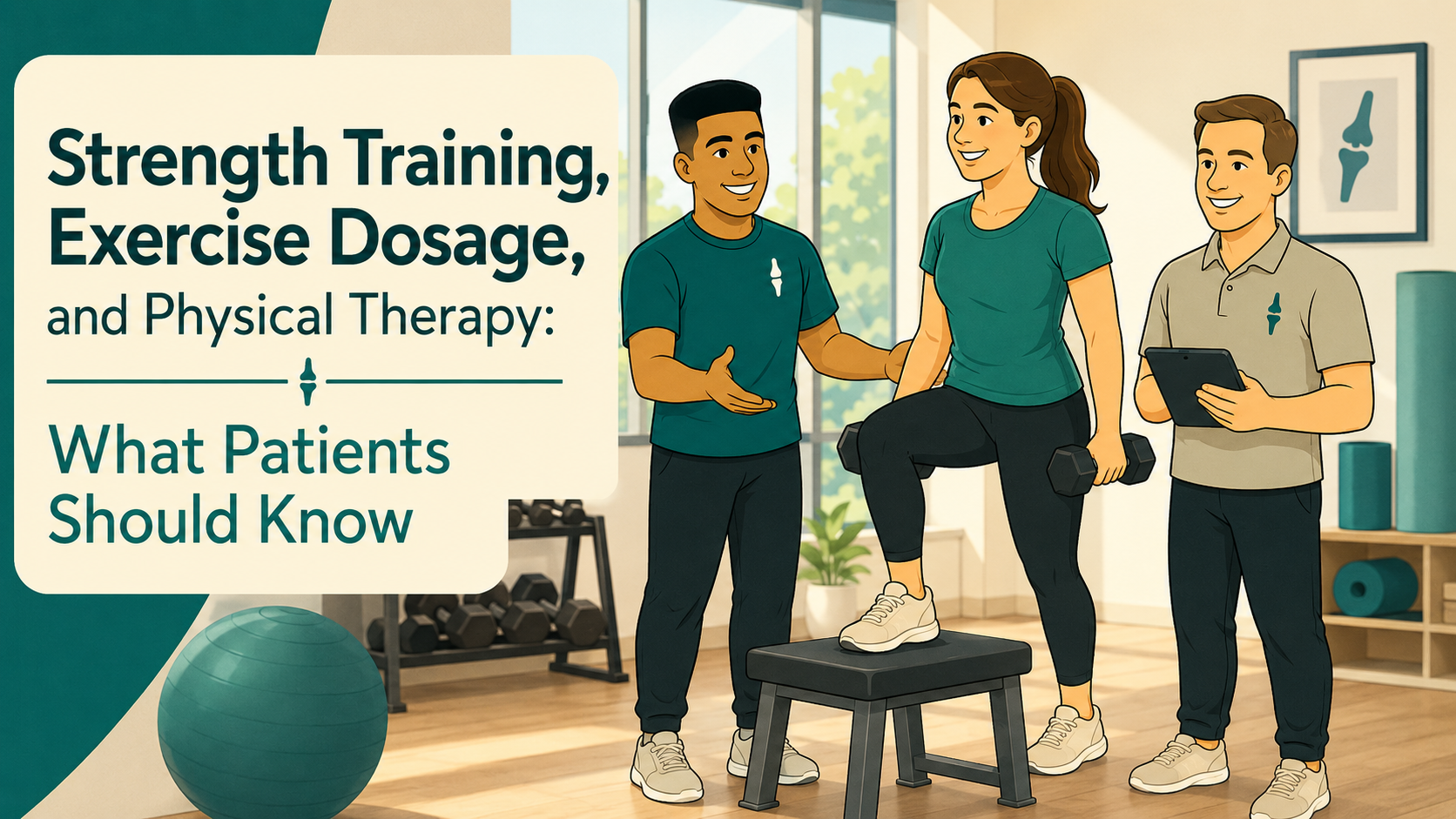
Illustration of two healthcare providers working with a female patient in a bright physical therapy gym. The patient is performing a step-up exercise while holding dumbbells, with one provider offering guidance and the other holding a tablet. The image includes the title “Strength Training, Exercise Dosage, and Physical Therapy: What Patients Should Know,” emphasizing patient-centered strength training, exercise education, and collaborative care.
✨ Too Long Didn’t Read (TL;DR) / Summary
Exercise is one of the most powerful tools we have for health, strength, confidence, mobility, and long-term wellness.
But here is the part people do not always hear:
Exercise works best when it is dosed appropriately for you.
That means your plan should match your:
Current fitness level
Health history
Symptoms
Goals
Confidence
Strength
Schedule
Access to equipment
Recovery ability
Life outside the clinic or gym
In other words, exercise prescription is not just “go work out.”
It is more like saying:
What kind of exercise? How much? How hard? How often? For what goal? And how do we safely progress it?
For strength training, different goals usually require different approaches. A few common examples include:
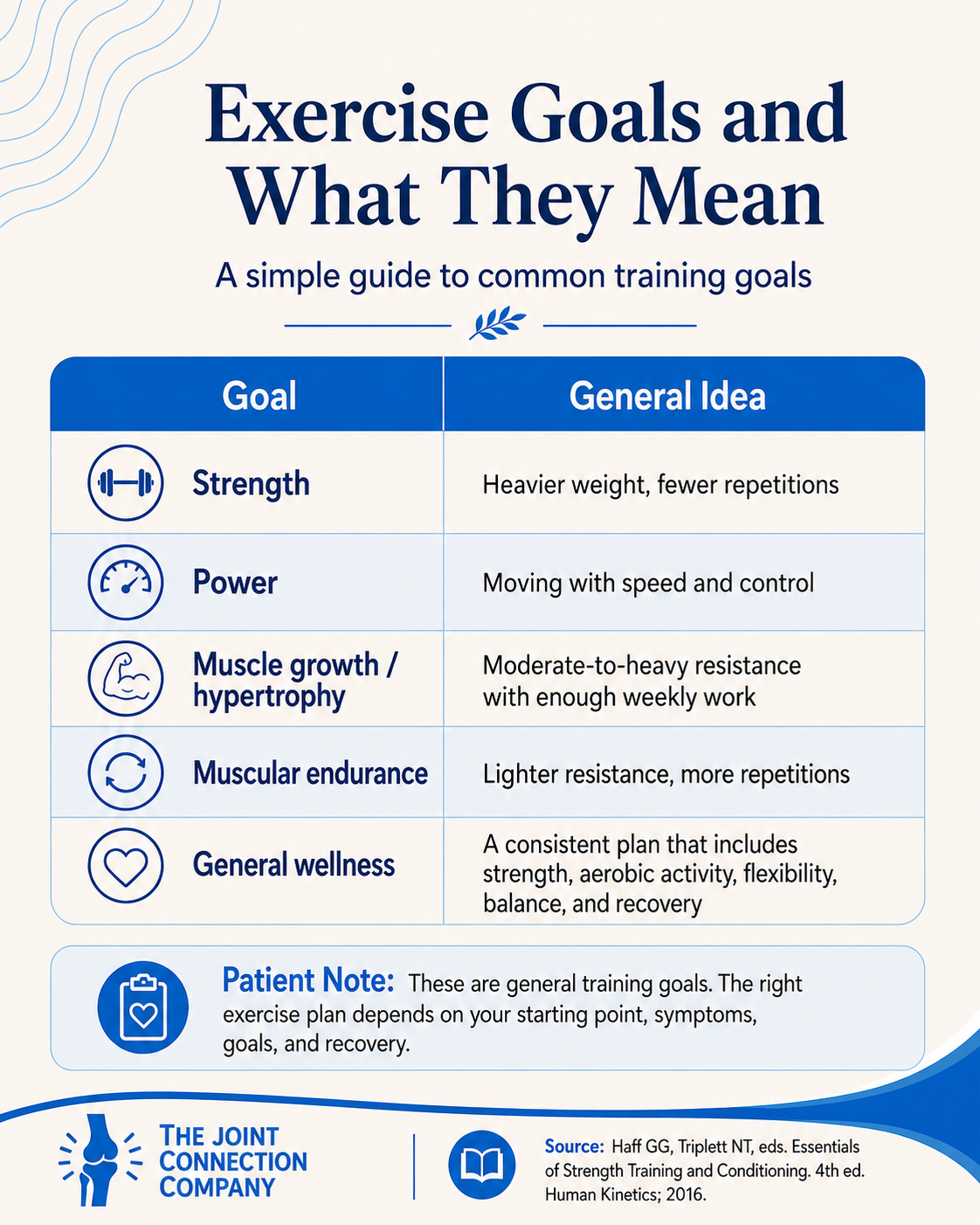
The most important takeaway:
The “best” exercise plan is not always the fanciest one. It is the one you understand, feel safe doing, can stick with, and can gradually build over time.
That is where your healthcare team can help.
🧾 General Information
Exercise Is Medicine — But the Dose Still Matters
Most people have heard some version of this advice:
“Exercise more.”
“Be active.”
“Strength train.”
“Stretch.”
“Lose weight.”
“Go for walks.”
“Join a gym.”
All of that may be well-intended.
But it is also vague.
For many people, the problem is not knowing that exercise is good. The problem is knowing where to start and how to do it safely.
That is where exercise prescription becomes helpful.
A good exercise plan considers four major things, often called the FITT principle:
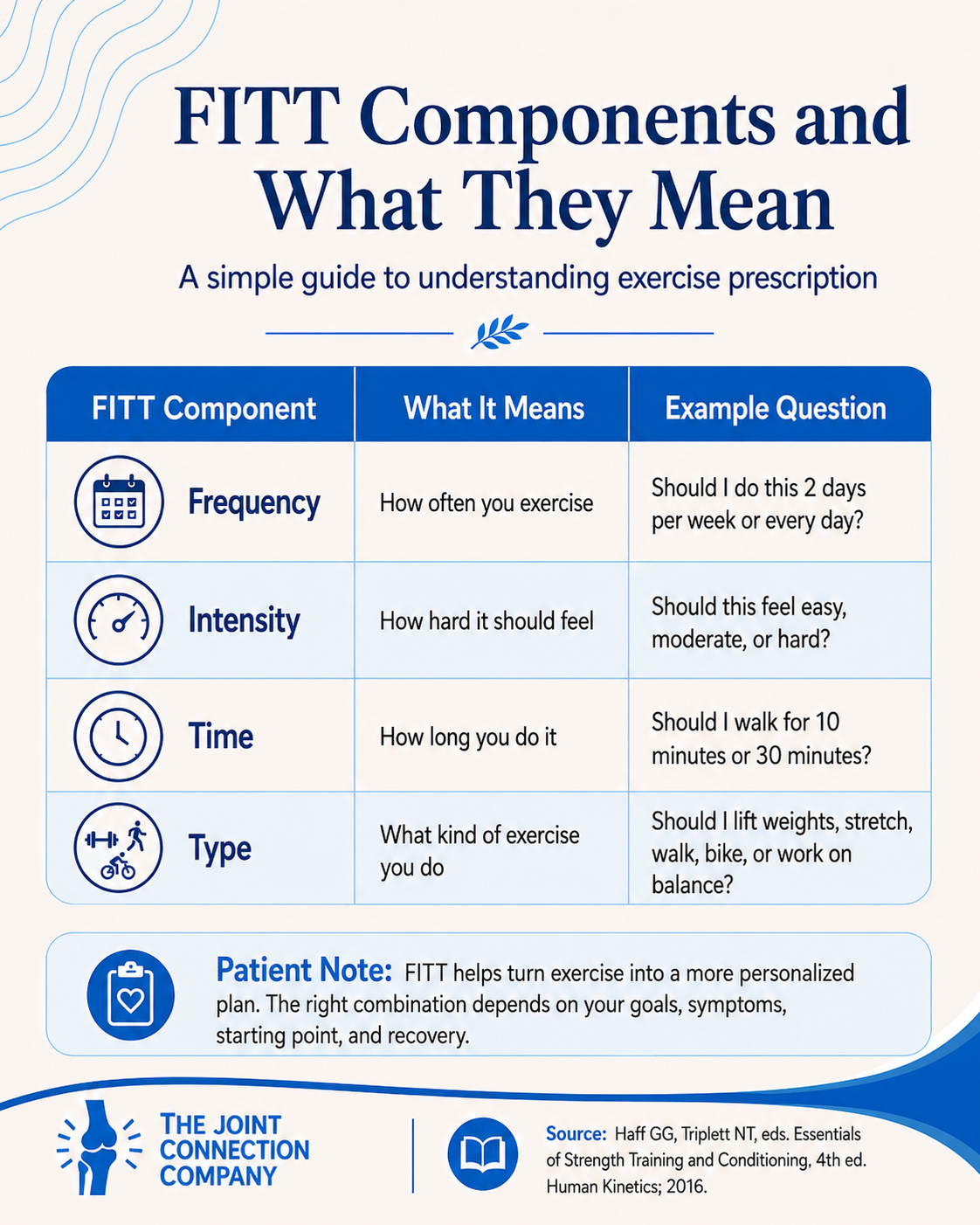
This matters because exercise is not one-size-fits-all.
A person recovering from surgery, someone starting weightlifting for the first time, a runner with knee pain, an older adult working on balance, and a person managing chronic fatigue may all benefit from exercise.
But they may need very different starting points.
The Body Responds to Load
One of the most important ideas in physical therapy and exercise science is that the body responds to the stress we place on it.
This is sometimes called mechanotherapy.
That is a fancy word, but the idea is simple:
The right amount of movement and loading can help tissues adapt.
Khan and Scott describe how mechanical loading can influence tissue repair and remodeling through a process called mechanotransduction. In everyday language, this means your muscles, tendons, bones, cartilage, and other tissues can respond to the physical demands placed on them.
A simple way to say it:
Your body listens to load.
When the load is appropriate, your body may respond by becoming:
Stronger
More tolerant
More resilient
Better coordinated
More confident with movement
This can matter for many concerns, including:
Tendon pain
Muscle strains
Osteoarthritis
Bone health
Post-surgical recovery
Deconditioning
Chronic pain
Balance problems
Fear of movement
General weakness
Loss of confidence
But the word appropriate is important.
Too little challenge may not create enough change.
Too much challenge may flare symptoms, increase fear, or exceed your current capacity.
That is why a physical therapist, physician, or other healthcare provider may help you find the “just right” starting point.
Not too easy.
Not reckless.
Challenging enough to help you improve.
Strength Training Is Not Just for Athletes
Strength training is not only for bodybuilders, powerlifters, or people who love the gym.
Strength training can help with everyday life.
It can support your ability to:
Climb stairs
Carry groceries
Get off the floor
Lift children or grandchildren
Improve balance
Reduce fall risk
Support bone health
Manage joint pain
Improve confidence
Return to hobbies
Stay independent
Build long-term resilience
Resistance training can include:
Dumbbells
Kettlebells
Machines
Resistance bands
Bodyweight exercises
Cable machines
Household items
Weighted backpacks
Sit-to-stands
Step-ups
Carries
Squats, hinges, pushes, pulls, and lunges
You do not need to begin with a complicated gym routine.
For some people, a great starting point may be:
Sitting and standing from a chair
Wall push-ups
Step-ups
Carrying light weights
Resistance band rows
Heel raises
Gentle balance exercises
Short walks
Mobility work
The right starting point depends on you.
Different Goals Need Different Exercise Dosages
Not all strength training is designed to do the same thing.
If your goal is to get stronger, your program may look different than someone training for endurance, muscle size, balance, or return to sport.
A general resistance training framework from strength and conditioning principles includes:
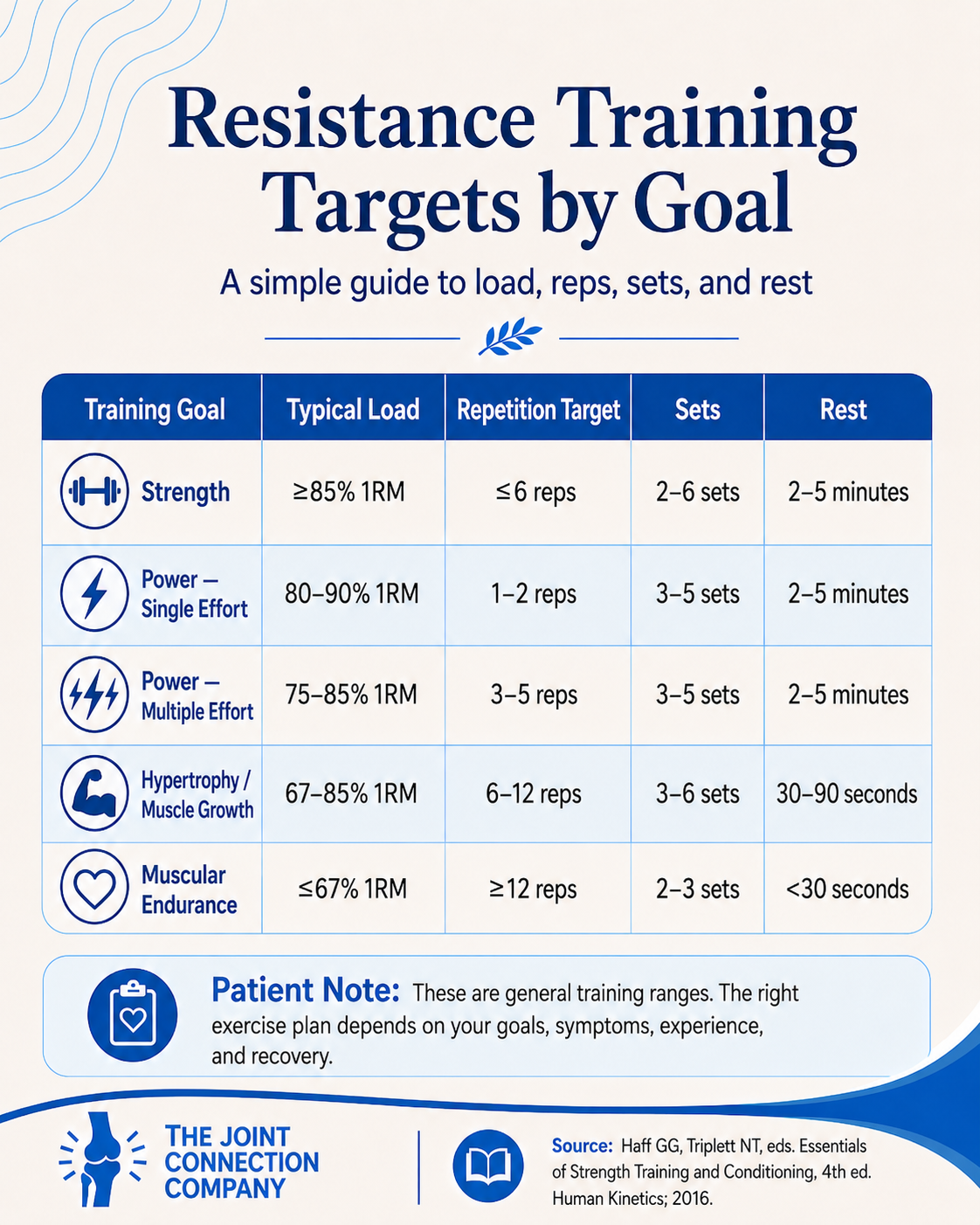
Now, before your eyes glaze over, let’s translate that.
What Is 1RM?
1RM stands for one-repetition maximum.
It means the most weight you could lift one time with good form.
For example, if the heaviest weight you could safely lift one time on a leg press was 100 pounds, that would be your 1RM for that exercise.
But here is the good news:
Most people do not need to test a true 1RM to start exercising safely.
Your provider may estimate your strength using safer options, such as:
A lighter weight for more repetitions
How hard the exercise feels
Your technique
Your symptoms
Your confidence
Your recovery afterward
Functional tests like sit-to-stand, step-ups, walking, balance, or lifting tasks
The number is not the point.
The point is finding a safe, useful dose.
Strength, Power, Hypertrophy, and Endurance: What Do These Actually Mean?
Let’s make these terms easier.
Strength
Strength means your ability to produce force.
In real life, strength helps you:
Stand up from a low chair
Lift a suitcase
Carry groceries
Climb stairs
Push yourself up from the floor
Feel more capable during daily tasks
Strength training usually involves heavier resistance and fewer repetitions.
But “heavy” is relative.
Heavy for one person might be a barbell.
Heavy for another person might be a 5-pound dumbbell.
Heavy for someone else might be standing up from a chair without using their hands.
Your starting point still counts.
Power
Power means producing force quickly.
Power matters when you need to react, step, catch yourself, climb, jump, or move with speed.
In daily life, power can help with:
Preventing falls
Quickly stepping off a curb
Getting up from a chair with confidence
Returning to sports
Climbing stairs more easily
Reacting when you lose balance
Power training should be approached thoughtfully.
It is not just “move fast and hope for the best.”
It usually requires a foundation of good technique, appropriate strength, and a safe progression.
Hypertrophy
Hypertrophy means building or maintaining muscle size.
This matters for:
Aging well
Metabolic health
Joint support
Strength potential
Body composition
Physical independence
Recovery from injury or surgery
You do not need to be chasing a bodybuilding goal to benefit from muscle growth.
For many patients, maintaining or rebuilding muscle is a major part of staying healthy.
Muscular Endurance
Muscular endurance means your muscles can keep working over time.
This can help with:
Walking longer distances
Standing for work
Doing yardwork
Playing with kids
Repeated lifting
Household chores
Hiking
Recreational activities
Endurance training often uses lighter loads and more repetitions.
This can be a great entry point for many people, especially if heavier lifting feels intimidating at first.
Flexibility and Mobility Still Matter
Strength training gets a lot of attention, but flexibility and mobility can also be important parts of a well-rounded plan.
Flexibility work may help improve range of motion, reduce stiffness, and support better movement options. The provided exercise prescription material notes that stretching at least 2–3 days per week, especially when tissues are warm, can help improve range of motion over time.
Flexibility exercises may include:
Static stretching
Dynamic stretching
Gentle mobility drills
Yoga-inspired movements
Sport-specific warm-ups
Range-of-motion exercises
A practical way to think about it:
Mobility helps you access movement. Strength helps you control it.
For example, improving hip mobility may help you squat more comfortably.
Improving shoulder mobility may help you reach overhead.
But mobility without strength and control may not fully solve the problem.
That is why many people need both.
Cardio Still Counts, Too
Exercise prescription is not only about weights.
A complete health-focused plan may include:
Aerobic exercise
Strength training
Flexibility
Balance
Coordination
Recovery
Lifestyle support
General aerobic exercise can include:
Walking
Cycling
Swimming
Dancing
Hiking
Rowing
Elliptical training
Water aerobics
Recreational sports
The American College of Sports Medicine (ACSM) still states that common public health recommendations include at least 150 minutes per week of moderate-intensity aerobic activity or 75 minutes per week of vigorous-intensity activity, often spread across several days.
A simple way to judge intensity is the talk test:
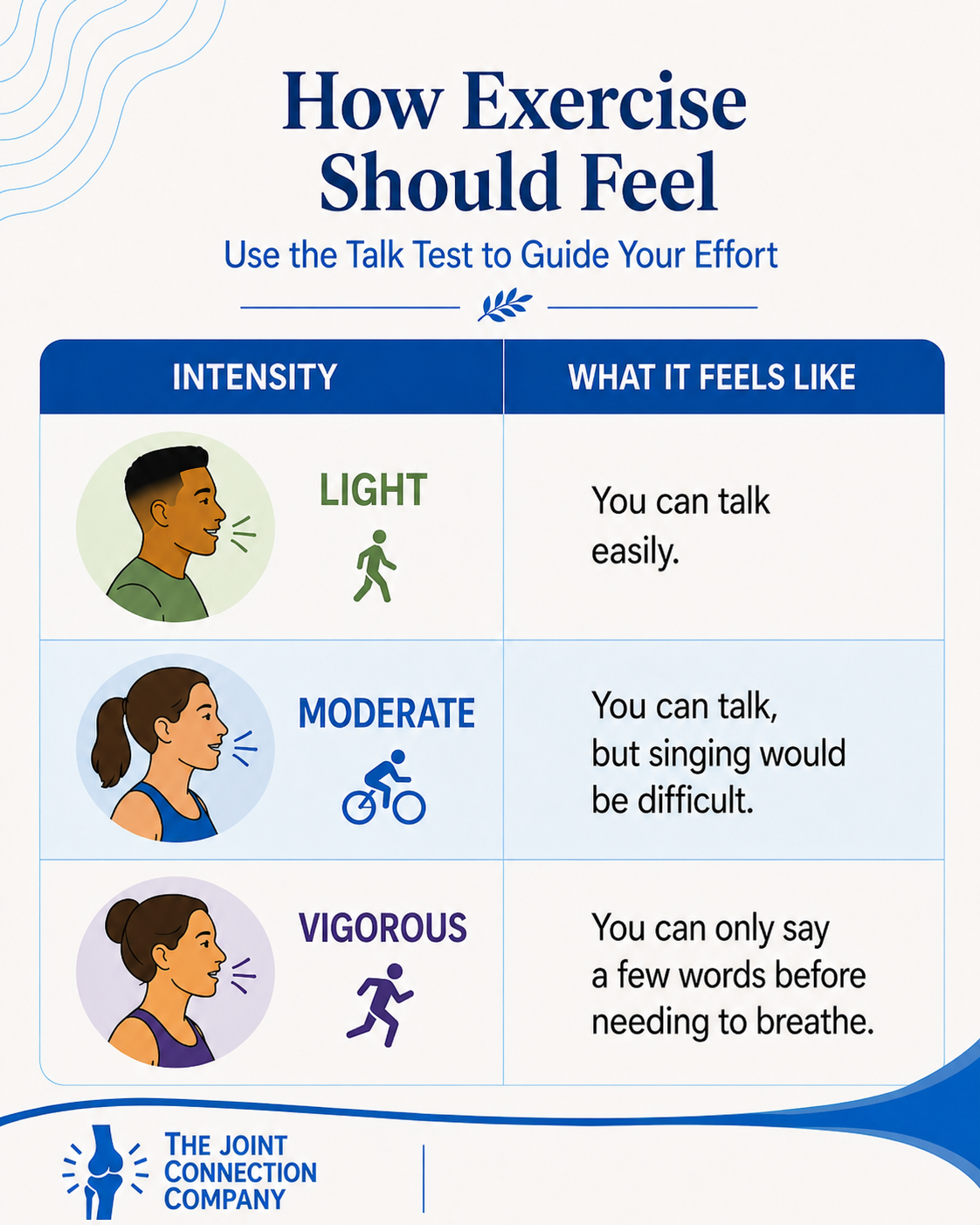
For many people, walking is one of the best starting points.
Not because it is fancy.
Because it is accessible, scalable, and useful.
Beginners, Intermediate Exercisers, and Advanced Exercisers Need Different Plans
Two people can have the same diagnosis and need very different exercise plans.
Why?
Because training history matters.
A beginner should not always train like an advanced athlete.
A simple framework includes:
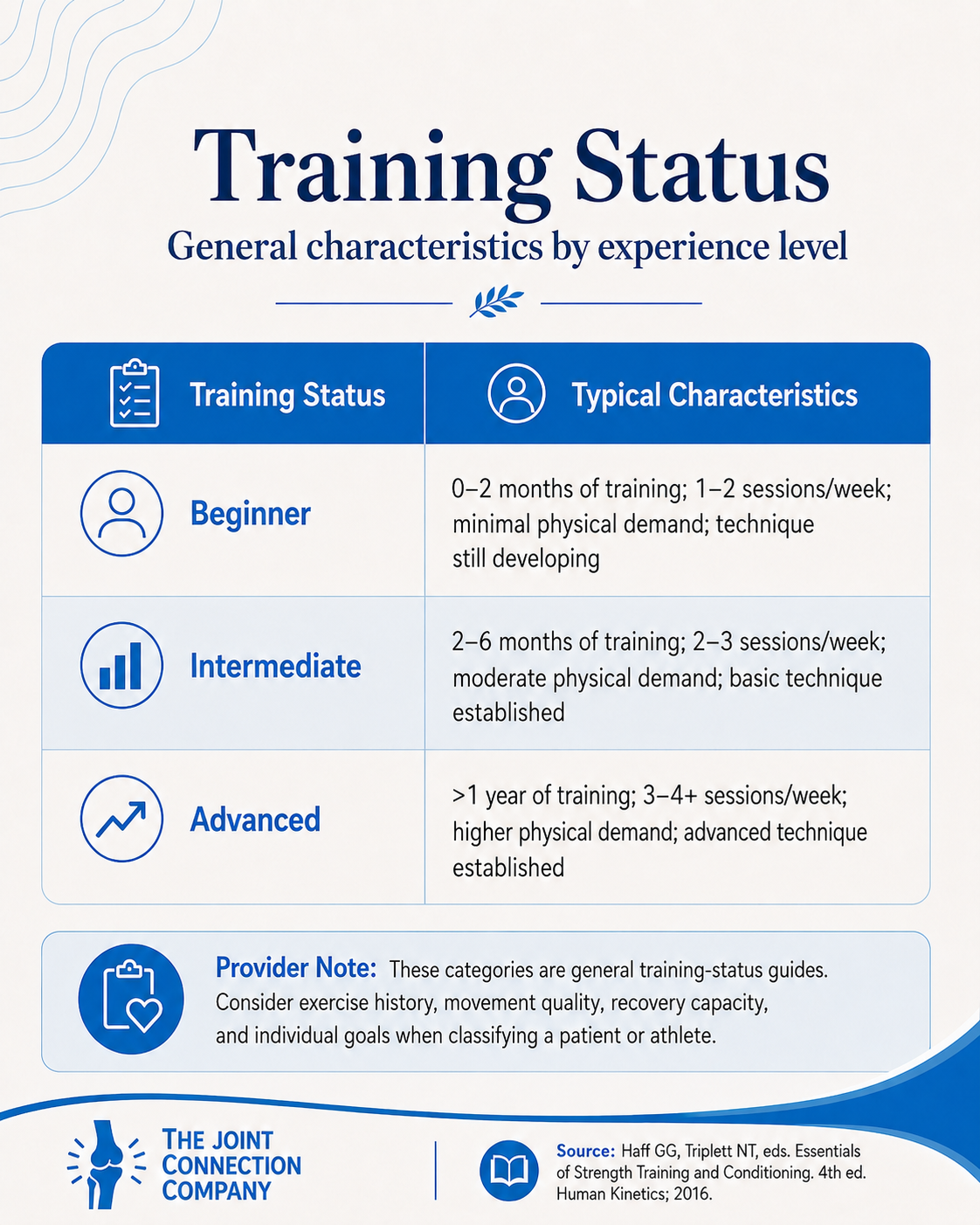
This is important because your plan should match your current starting point.
A beginner may need:
More instruction
Lighter loads
Fewer exercises
More rest
More confidence-building
More focus on technique
An intermediate exerciser may need:
More structure
Gradual progression
Specific goals
Symptom monitoring
Better weekly planning
An advanced exerciser may need:
More precise loading
More recovery planning
More advanced progressions
Sport-specific or performance-specific programming
None of these categories are “better.”
They are just different places to start.
Progression Does Not Always Mean “Add More Weight”
When people think about getting stronger, they often think the only option is to keep adding weight.
Adding weight is one form of progression.
But it is not the only one.
You can also progress by changing:
Repetitions
Sets
Speed
Tempo
Range of motion
Rest time
Balance challenge
Exercise difficulty
Weekly frequency
Total weekly volume
Control
Coordination
Confidence
Symptom tolerance
Sometimes progress looks like:
Same weight, better form.
Same exercise, less pain.
Same movement, more confidence.
Same walk, less fatigue.
Same stairs, fewer symptoms.
Same task, better recovery the next day.
That counts.
Your body does not only adapt to weight.
It adapts to the full challenge.
How Much Should You Increase Weight?
A common progression framework from strength and conditioning suggests:
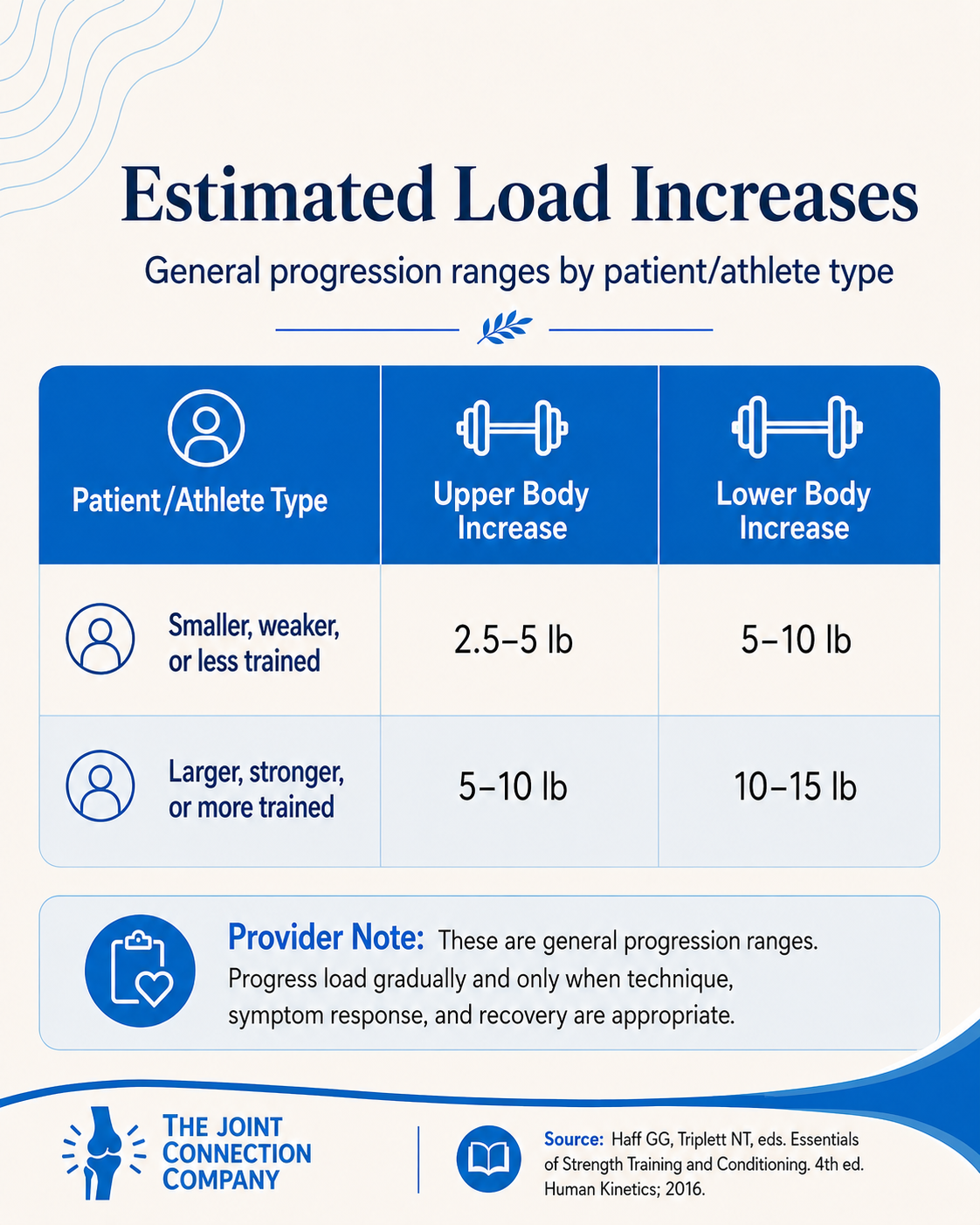
These are general ranges, not strict rules.
You should not increase weight just because a chart says you can.
A safer question is:
Can I complete the current exercise with good control, acceptable symptoms, and good recovery afterward?
If yes, progression may be appropriate.
If no, your body may need more time at the current level.
That is not failure.
That is smart training.
What About Pain During Exercise?
This is one of the biggest questions people have:
“Is it okay if it hurts?”
The honest answer is:
It depends.
Some discomfort during exercise may be acceptable, especially when rebuilding capacity after injury or dealing with long-term pain.
But not all pain should be ignored.
You should talk with your healthcare provider about:
What symptoms are expected
What symptoms are not expected
Whether discomfort should stay mild, moderate, or be avoided
How long soreness should last
Whether symptoms should return to baseline after exercise
What to do if pain increases
When to stop an exercise
When to seek medical care
A helpful distinction:
Hurt does not always mean harm, but pain is still information.
The goal is not to push through everything.
The goal is to learn how to interpret your body with the help of a trusted provider.
Exercise Is Also About Confidence
Exercise prescription is not only physical.
It is also emotional and behavioral.
Lucini and Pagani emphasize that exercise prescription is only successful if the person actually performs the exercise and it leads to meaningful improvement.
That means the plan has to work in real life.
A good plan should consider:
Your schedule
Your motivation
Your fears
Your past experiences
Your energy level
Your access to equipment
Your support system
Your personal goals
Your confidence
Your symptoms
Your follow-up plan
This is why a provider simply saying, “You need to exercise more,” is usually not enough.
Most people need more than advice.
They need a plan.
They need clarity.
They need encouragement.
They need follow-up.
They need someone to help them adjust when life gets messy.
Because life will get messy.
💙 For Providers
What Should You Talk to Your Physician or Physical Therapist About?
When you see your physician, physical therapist, or another healthcare provider, you do not have to know all the technical exercise terms.
You just need to know what to ask.
Here are helpful questions to bring to your visit.
1. “What type of exercise is safest for me to start with?”
This is especially important if you have:
Heart disease
Diabetes
High blood pressure
Dizziness
Shortness of breath
Osteoporosis or osteopenia
Recent surgery
A history of falls
Chest pain with activity
Joint pain
A neurological condition
A new or worsening symptom
A long period of inactivity
Your provider may recommend starting with light or moderate activity before progressing.
They may also suggest medical screening or additional evaluation before higher-intensity exercise.
This does not mean exercise is unsafe.
It means the plan should match your health status.
2. “Should I be doing strength training?”
For many people, the answer is yes.
Resistance training can support strength, function, joint health, bone health, metabolism, independence, and confidence.
But the details matter.
Ask:
How many days per week should I strength train?
What exercises should I start with?
Should I use machines, bands, dumbbells, or bodyweight?
How heavy should it feel?
How many sets and reps should I do?
Should I train through discomfort?
How do I know when to progress?
A simple starting goal for many adults is resistance training at least 2 days per week, but your plan should be individualized.
3. “How hard should exercise feel?”
This is a great question.
Exercise should usually feel like it has a purpose, but it should not feel chaotic or scary.
Your provider may use:
A 0–10 effort scale
Repetitions in reserve
The talk test
Heart rate
Symptom response
Recovery the next day
Movement quality
For strength training, you might ask:
“Should I finish each set feeling like I could do a few more reps, or should I be going to fatigue?”
Importantly, training to complete failure is not always necessary for strength or muscle growth.
That can be reassuring for patients who worry that exercise only “counts” if it is miserable.
It does not.
4. “What symptoms are okay, and what symptoms are warning signs?”
This question is huge.
Ask your provider to explain:
What pain level is acceptable during exercise?
Should symptoms return to baseline afterward?
How long is soreness okay?
What should I do if symptoms flare?
When should I stop immediately?
When should I call you or another provider?
This helps reduce fear and confusion.
It also helps you avoid the two most common mistakes:
Stopping all exercise because of normal effort or mild soreness
Pushing too hard through symptoms that should be modified
The goal is the middle path:
Challenge with confidence. Progress with awareness.
5. “How do I know when to increase weight?”
A general rule:
Increase difficulty when you can complete your current exercise with:
Good control
Acceptable symptoms
Good confidence
Good recovery afterward
Your provider may increase the challenge by adding weight, but they may also adjust reps, sets, tempo, range of motion, or balance demands.
Remember:
Progression is not always more weight.
Sometimes the best next step is better movement.
6. “What if I do not have access to a gym?”
You can still exercise.
Ask your provider about options using:
Bodyweight
Bands
Chairs
Stairs
Household items
Wall push-ups
Floor or bed exercises
Walking programs
Backpack carries
Home balance drills
A good plan should fit your life.
If the plan requires equipment you do not have, time you do not have, or confidence you do not feel, tell your provider.
That is not complaining.
That is useful information.
7. “How should I warm up?”
Warm-ups do not need to be complicated.
Depending on your goals, your warm-up may include:
Easy walking
Gentle cycling
Dynamic stretching
Light versions of the exercise
Mobility drills
Practice sets
Breathing and pacing
Dynamic movements before exercise can help prepare your body for activity.
Long static stretching may be more useful after exercise or during dedicated flexibility sessions, depending on the goal.
Ask your provider what makes sense for you.
8. “How should flexibility fit into my plan?”
Flexibility can be helpful, but stretching is not always the whole answer.
Ask:
What areas need more mobility?
Should I stretch daily or a few times per week?
Should I stretch before or after exercise?
Do I need strength through the new range of motion?
Is my stiffness actually weakness, guarding, pain, or limited joint motion?
A practical reminder:
Stretching may help you access range. Strength helps you use it.
9. “What is the smallest plan that would still help me?”
This may be the most underrated question.
If you are overwhelmed, busy, tired, or unsure where to start, ask your provider:
“What is the minimum effective dose for me right now?”
That might be:
5–10 minutes of walking
Two strength exercises
One balance drill
A short mobility routine
Two exercise days per week
One supervised session plus home practice
A gradual return-to-gym plan
Small does not mean pointless.
Small can be the start of consistent.
And consistent is where results begin.
10. “How will we measure progress?”
Progress is not only pain reduction.
You and your provider may track:
Strength
Balance
Walking tolerance
Stairs
Lifting ability
Confidence
Range of motion
Symptom frequency
Recovery time
Sleep
Energy
Daily function
Return to hobbies
Quality of life
Ask your provider:
“What should we expect to improve, and how will we know it is working?”
That turns exercise from a vague recommendation into a meaningful plan.
A Simple Patient-Friendly Exercise Conversation Script
You can bring this to your appointment:
“I want to be more active, but I am not sure what is safe or where to start. Can we talk about what type of exercise makes sense for me, how hard it should feel, what symptoms are okay, and how I should progress over time?”
Or:
“I want to start strength training. Can you help me understand what exercises I should do, how many sets and reps, how much weight to use, and when to increase it?”
Or:
“I am worried exercise might make my pain worse. Can you help me understand the difference between normal soreness, acceptable discomfort, and warning signs?”
These are excellent questions.
And they deserve clear answers.
Patient Takeaways
1. Exercise is powerful, but dosage matters.
The right plan should match your body, goals, health history, and confidence.
2. Strength training is not just for athletes.
It can help with daily life, aging, joint support, balance, independence, and wellness.
3. Your body adapts to appropriate challenge.
The right amount of load can help tissues become stronger and more tolerant over time.
4. Progression does not always mean heavier weights.
Progress can also mean better form, more confidence, less pain, better recovery, more range of motion, or improved function.
5. Consistency beats perfection.
The best exercise plan is one you understand and can actually do.
6. Ask better questions.
Your provider can help you understand what to do, how hard to work, what symptoms are okay, and when to progress.
📂 Supplemental Information / Citations
Haff GG, Triplett NT, eds. Essentials of Strength Training and Conditioning. 4th ed. Human Kinetics; 2016.
Currier BS, D’Souza AC, Singh MAF, et al. American College of Sports Medicine position stand: resistance training prescription for muscle function, hypertrophy, and physical performance in healthy adults—an overview of reviews. Med Sci Sports Exerc. 2026;58(4):851-872. doi:10.1249/MSS.0000000000003897
Khan KM, Scott A. Mechanotherapy: how physical therapists’ prescription of exercise promotes tissue repair. Br J Sports Med. 2009;43(4):247-252. doi:10.1136/bjsm.2008.054239
Wood L, Ash G. Exercise prescription and patient outcomes. BMC Prim Care. 2025;26(1):233. doi:10.1186/s12875-025-02953-4
Lucini D, Pagani M. Exercise prescription to foster health and well-being: a behavioral approach to transform barriers into opportunities. Int J Environ Res Public Health. 2021;18(3):968. doi:10.3390/ijerph18030968
American Physical Therapy Association. Scope of Practice. Accessed May 25, 2026.
This content drafted, researched, edited, and generated by:
Jackson Kojima, PT, DPT
Jackson Kojima, PT, DPT, OCS is a physical therapist with an extensive background in orthopedics, geriatrics, and sports rehabilitation. Dr. Kojima is a board-certified orthopedic clinical specialist (OCS) with a passion for post-operative rehabilitation and enjoys treating multi-factorial conditions like low back pain and generalized joint pain. Dr. Kojima earned his doctorate of physical therapy from Campbell University in 2021 and currently practices in Greenville, SC.
McKinley Pollock, PT, DPT
McKinley Pollock, PT, DPT, OCS, CSCS is a physical therapist with a background in orthopedics and sports rehabilitation. Dr. Pollock earned his doctorate of physical therapy from Campbell University in 2021, is a board-certified orthopedic clinical specialist (OCS), and certified strength and conditioning specialist (CSCS). Dr. Pollock enjoys combining lessons learned from his DPT training and research, translating these into clinical practice. His passions include promoting relationships between patients & clinicians to promote clinical effectiveness, satisfaction, and efficiency, the implementation of primary preventative medicine into clinical practice, and leadership and education development.
© 2026 The Joint Connection Company. All rights reserved.
The content on this website, including all text, graphics, and materials, is the exclusive property of The Joint Connection Company and is protected by applicable copyright and intellectual property laws. No part of this site may be reproduced, distributed, or used without prior written permission.