

✨ Too Long Didn’t Read (TL;DR) / Summary
POTS stands for Postural Orthostatic Tachycardia Syndrome. It can cause symptoms like dizziness, racing heart, fatigue, brain fog, weakness, nausea, shakiness, and feeling worse when standing, showering, exercising, or being in the heat.
POTS is related to upright posture. Symptoms often show up or worsen when standing, walking, exercising upright, or waiting in line, and may improve when lying down.
Dizziness and a racing heart do not automatically mean POTS. Dehydration, anemia, thyroid issues, medication effects, heart rhythm problems, blood pressure changes, infection, deconditioning, and other conditions can look similar.
Hypermobility can be part of the conversation, but it is not the whole story. Some people have both POTS-like symptoms and hypermobility, but being hyper-flexible does not automatically mean you have POTS or Ehlers-Danlos syndrome.
You deserve a thoughtful evaluation. Your symptoms are real. A good healthcare team should help you understand what happens when you stand, whether your heart rate or blood pressure changes, what else should be ruled out, and what kind of movement or physical therapy may be safe for you.
🧾 Condition-Specific General Information
What is POTS?
POTS stands for Postural Orthostatic Tachycardia Syndrome.
Let’s break that down:
Postural = related to body position
Orthostatic = related to being upright
Tachycardia = increased heart rate
Syndrome = a collection of signs and symptoms, not one single disease with one single cause
POTS is generally described as a type of orthostatic intolerance, where symptoms occur or worsen when someone is upright and are associated with an excessive increase in heart rate without a significant drop in blood pressure.
In many clinical descriptions, POTS involves a heart rate increase of at least 30 beats per minute in adults, or at least 40 beats per minute in adolescents, within about 10 minutes of standing or head-up tilt, without orthostatic hypotension.
That sounds simple; however, in real life, it is rarely that simple.
Heart rate can change because of hydration, heat, medications, illness, stress, pain, sleep, caffeine, anxiety, blood volume, deconditioning, infection, hormones, and many other factors.
That is why POTS should not be diagnosed from one reading, one symptom, or one episode.
A better way to think about it is:
“Do my symptoms and vital signs show a consistent pattern when I move upright — and have other causes been considered?”
That is the conversation worth having.
POTS is not “just dizziness”
Dizziness can come from many places.
It can come from the cardiovascular system, vestibular system, nervous system, medications, hydration status, blood pressure changes, anxiety, migraine, neck-related issues, inner ear disorders, anemia, blood sugar changes, or other medical conditions.
POTS is one possible explanation for dizziness, especially when dizziness is strongly related to upright posture.
But POTS is not just dizziness.
POTS can involve multiple body systems, which is one reason it can feel so confusing and overwhelming. Patients may report symptoms involving the heart, brain, gut, muscles, sleep, temperature regulation, and energy levels.
You may feel like you are trying to explain ten different symptoms at once:
“I get dizzy when I stand, my heart races, I feel exhausted, my brain feels foggy, my stomach is weird, showers wipe me out, and sometimes I feel like my legs forgot how to be legs.”
That may sound dramatic.
But for many people with orthostatic intolerance, it is very real.
The challenge is that these symptoms can overlap with many other conditions. That is why the goal is not to slap a label on it as quickly as possible. The goal is to understand the pattern.
Common POTS symptoms patients may notice
People with POTS or POTS-like orthostatic intolerance may experience:
Lightheadedness
Dizziness
Racing heartbeat
Palpitations
Feeling faint
Near-fainting
Fatigue and Weakness
Exercise intolerance
Brain fog
Headaches or migraines
GI distressing (nausea, bloating, diarrhea, constipation, abdominal pain, etc.)
Shakiness
Shortness of breath
Chest discomfort
Sleep disturbance
Muscle fatigue or pain
Symptoms that worsen with standing, heat, dehydration, illness, or prolonged upright posture
Some people also report that symptoms are worse in the morning, after a hot shower, after standing in line, during stressful weeks, after illness, or after long periods of reduced activity.
A very common patient story may sound like this:
“I used to be active. Then I got sick, injured, overwhelmed, or had to rest more. Now standing feels harder, exercise feels impossible, and I do not know how to get back.”
That cycle is important.
And it is not a character flaw.
Symptoms alone do not diagnose POTS
This part is important, and it is not meant to be dismissive.
Symptoms alone are not enough to diagnose POTS.
That does not mean your symptoms are fake.
It means your symptoms deserve a careful evaluation.
A racing heart and dizziness can happen for many reasons. Some are relatively manageable. Others need medical attention. Some conditions that can look like POTS include:
Dehydration or low blood volume
Medication side effects
Anemia
Thyroid disease
Infection or illness
Orthostatic hypotension
Vasovagal syncope
Cardiac rhythm abnormalities
Pulmonary conditions
Deconditioning after illness, bedrest, surgery, or prolonged inactivity
Migraine or vestibular disorders
Autoimmune or inflammatory conditions
Connective tissue disorders or hypermobility-related concerns
Gastrointestinal conditions
Pelvic pain or bladder-related conditions
Anxiety or panic symptoms, which may coexist but should not be assumed to be the cause
This is why a good provider should not say:
“It is probably just anxiety.”
A better response is:
“Your symptoms are real. Let’s look at your heart rate, blood pressure, position changes, medical history, medications, activity tolerance, and whether anything else needs to be ruled out.”
That kind of response protects both the patient’s dignity and the provider’s clinical reasoning.
Why standing can feel so hard
When a person stands up, gravity pulls blood downward toward the lower body. In a healthy response, the body adjusts by changing blood vessel tone, heart rate, and circulation so the brain and body continue getting enough blood flow.
For people with orthostatic intolerance, this upright adjustment may not feel smooth.
The body may respond with symptoms like:
Dizziness
Racing heart
Feeling weak
Brain fog
Shakiness
Nausea
Heavy legs
Feeling like you need to sit or lie down
In POTS, the heart rate response to standing is exaggerated, but blood pressure does not show the significant drop seen in orthostatic hypotension.
That distinction matters because different problems require different treatment strategies.
This is why checking both heart rate and blood pressure matters. Heart rate alone does not tell the whole story.
What is an active stand test?
An active stand test is one way clinicians may screen for orthostatic changes.
A common version looks something like this:
You lie quietly for several minutes.
Your resting heart rate and blood pressure are measured.
You stand up and remain standing.
Your heart rate and blood pressure are checked at intervals, often around 1, 3, 5, and 10 minutes.
Your symptoms are tracked along the way.
This can help your provider see whether your symptoms match changes in heart rate and blood pressure.
But this is not something to use as a do-it-yourself diagnosis.
Why?
Because results can be affected by many different things, including:
Hydration
Salt intake
Time of day
Heat
Recent meals
Caffeine
Medications
Sleep
Illness
Anxiety
Pain
Measurement error
The active stand test is helpful, but it is one piece of the puzzle.
Not the whole puzzle. Not the puzzle box. Just one piece. You need more for the full picture.
Where hypermobility fits into the conversation
Many people searching for POTS are also searching for terms like:
Hypermobility
Hypermobile
Hypermobility spectrum disorder
hEDS
Ehlers-Danlos syndrome
Flexibility
Loose joints
Joint instability
“Why am I so bendy and dizzy?”
There is a reason these topics often appear together.
POTS and hypermobility-related conditions can co-occur in some people. Some patients with hypermobile Ehlers-Danlos syndrome or hypermobility spectrum disorder may also report dizziness, fatigue, exercise intolerance, pain, joint instability, headaches, gastrointestinal symptoms, and autonomic-type symptoms.
But the relationship is still complex.
Being flexible does not automatically mean you have POTS.
Having POTS does not automatically mean you have Ehlers-Danlos syndrome.
And having both does not mean every symptom comes from one diagnosis.
Some theories suggest that connective tissue differences may influence blood vessel behavior, venous pooling, or joint-related limitations, but the research is still developing and not every proposed explanation is proven.
For patients, the practical takeaway is this:
“If I am hypermobile and I also get dizzy, fatigued, or symptomatic when standing, I should tell my healthcare team about both.”
That helps your team think more clearly about your full picture.
What hypermobility may change about exercise
If you are hypermobile, exercise programming may need to be more individualized.
Some people with hypermobility-related conditions have:
Joint instability
Frequent sprains or subluxations
Widespread pain
Muscle fatigue
Poor tolerance to high-impact exercise
Difficulty knowing where their joints are in space
Fear of movement because movement has hurt before
That does not mean exercise is bad.
It means the entry point matters and must be individualized.
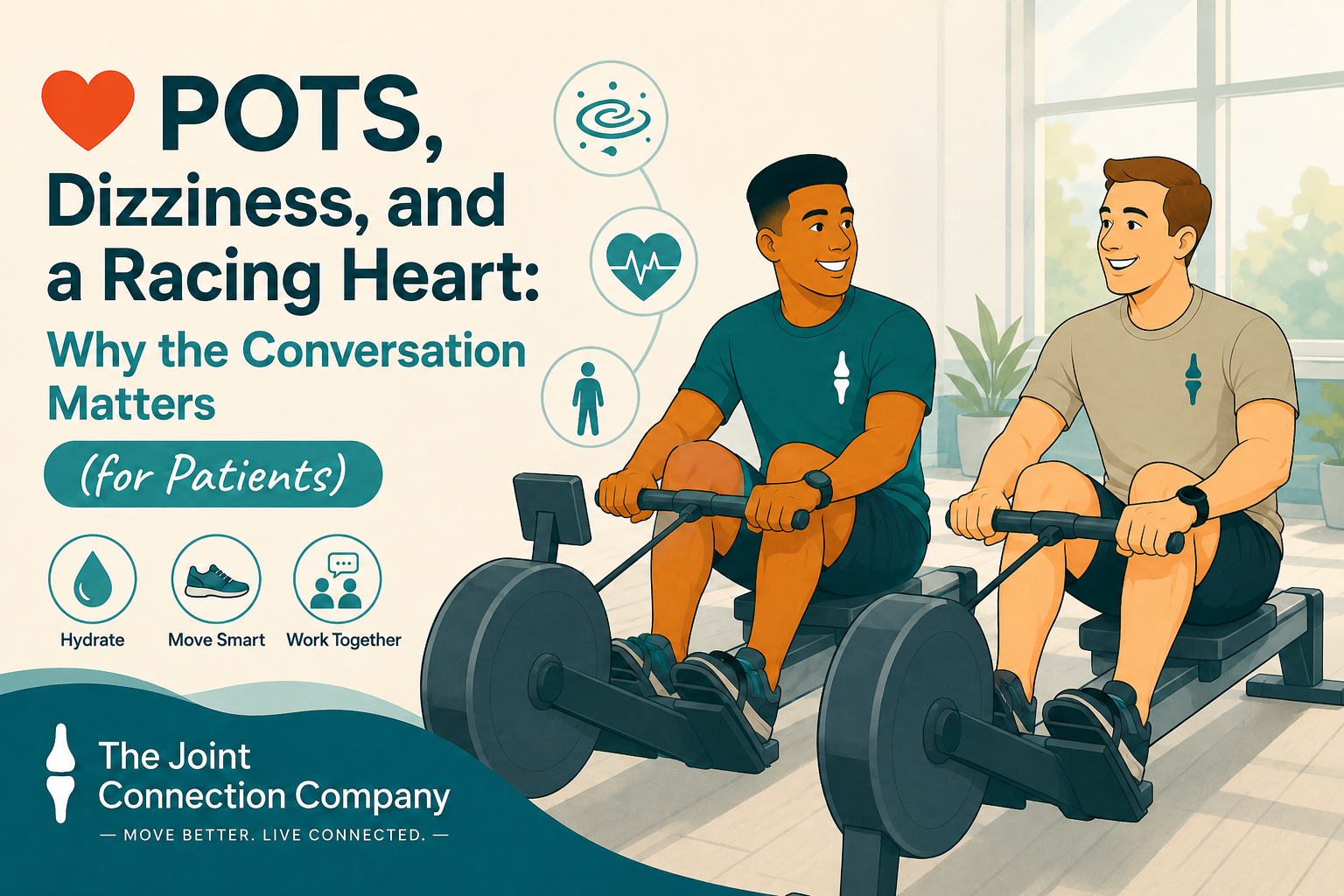
Research discussing POTS and hypermobility notes that people with both POTS and hypermobility-related concerns may need to start with lower-load, non-weight-bearing or supported options, such as swimming, rowing, recumbent biking, or carefully dosed strengthening.
For some people, braces or supports may be considered for joint protection during activity, especially if joint instability is limiting participation.
A helpful exercise plan for someone with POTS and hypermobility may focus on:
Joint control
Strength
Gradual conditioning
Low-impact cardio
Trunk and hip strength
Lower extremity strength
Pacing
Recovery
Position changes
Symptom monitoring
Confidence rebuilding
This is one reason physical therapy (PT) can be helpful. Not because PT “fixes POTS” with one magical exercise.
Because PT can help match movement to the person in front of them.
Why “just exercise” is not enough
Exercise is commonly recommended as part of POTS management, and research supports structured, progressive exercise for many people with POTS. However, many people with POTS have exercise intolerance. Some patients cannot tolerate standard exercise programs, especially if they have severe symptoms, fatigue, hypermobility, pain, or other additional conditions.
One 2024 review emphasized that although exercise is often recommended, many patients with POTS — particularly those with severe orthostatic intolerance and fatigue — are unable to complete or sustain rigorous programs. The authors highlight the importance of individualized, accessible, and symptom-aware exercise approaches.
That is a big deal.
It means the issue is not simply motivation.
It may be dosage.
It may be position.
It may be recovery.
It may be comorbidities.
It may be that the plan was too aggressive, too upright, too soon.
A better message is:
“Your body may need a more strategic entry point. We can start where your system can succeed, then build from there.”
The cycle that can be hard to break
For many people with POTS or POTS-like symptoms, the cycle looks like this:
Symptoms make activity harder.
You feel dizzy, weak, tired, nauseous, foggy, or like your heart is racing.
Activity decreases.
You stop doing things that provoke symptoms. This makes sense. Nobody wants to feel awful on purpose.
Fitness and blood volume may decline.
With less movement, the body may lose some conditioning and tolerance for upright activity.^2,3
Standing and movement feel even harder.
Now the same activities feel more difficult than before.
Confidence drops.
You may start avoiding showers, stairs, errands, school, exercise, or social plans.
The cycle continues.
This is not laziness.
This is physiology, fear, frustration, and lived experience all tangled together.
The goal is not to shame someone out of the cycle.
The goal is to help them find a safe way back in.
What exercise may look like early on
Early exercise for POTS is often not glamorous.
It may not look like bootcamp.
It may not look like a fitness influencer’s morning routine.
It may look like:
3 minutes on a recumbent bike
Gentle floor exercises
Seated strengthening
Supine bridges
Side-lying hip work
Breathing drills
Short bouts of rowing
Pool walking
A few carefully paced resistance exercises
Rest breaks before symptoms spiral
Tracking recovery the next day
That counts.
Small steps are still steps.
For many patients, early programs may begin with recumbent or horizontal exercise, such as recumbent biking, rowing, or swimming, because these positions reduce the upright stress that often triggers symptoms.
As tolerance improves, a provider may gradually progress duration, intensity, resistance training, and eventually more upright activities.
This progression must be individualized - especially if someone also has hypermobility, pain, fatigue, Long COVID-related symptoms, migraine, gastrointestinal issues, or other medical considerations.
What physical therapy can help with
Physical therapists should stay within their professional scope and state practice laws. A PT is not there to diagnose every medical cause of dizziness or prescribe medications. But PTs can play an important role in the bigger care team.
A physical therapist may help with:
Screening vital signs
Monitoring heart rate and blood pressure responses
Recognizing referral signs
Exercise tolerance testing within scope
Safe movement planning
Recumbent or semi-recumbent conditioning
Strength training
Balance and functional movement
Hypermobility-related joint control
Pacing strategies
Education on symptom patterns
Gradual return to school, work, exercise, recreation, and daily life
Communication with physicians or other providers when needed
PT can be especially useful when the question is:
“How do I move again without constantly crashing?”
That is a very physical therapy question.
What treatment may include beyond exercise
Treatment for POTS is often multidisciplinary and may include both non-pharmacologic and pharmacologic strategies depending on the person.
Common non-pharmacologic strategies patients may discuss with their medical team include:
Hydration strategies
Salt intake guidance, when medically appropriate
Compression garments
Avoiding excessive heat
Avoiding prolonged standing
Smaller, more frequent meals if symptoms worsen after eating
Recumbent or semi-recumbent exercise
Resistance training
Physical counter-maneuvers, such as leg crossing, muscle tensing, or squatting when symptoms begin
Sleep and recovery strategies
Pacing
Managing comorbid conditions
Referral to cardiology, neurology, primary care, gastroenterology, vestibular therapy, behavioral health, or other specialists when appropriate
Important note: Do not make major changes to salt intake, fluid intake, compression use, supplements, or medications without talking to your healthcare team, especially if you have kidney disease, high blood pressure, heart disease, pregnancy, eating disorder history, medication interactions, or other medical considerations.
💙 For Patients - What to Expect, What to Ask Your Provider, and More
What should I tell my doctor or physical therapist?
When you go to your appointment, try to bring a clear story.
You do not need perfect medical language.
You need useful details.
Consider telling your provider:
When symptoms started
Whether symptoms came after illness, surgery, injury, pregnancy, concussion, COVID, stress, or a period of bedrest
What happens when you stand
How long it takes symptoms to appear
What makes symptoms better
Whether lying down helps
Whether you faint or nearly faint
Whether your heart rhythm feels regular or irregular
Whether symptoms are worse in the morning
Whether heat, showers, meals, dehydration, or standing in line make symptoms worse
Whether you have headaches, GI symptoms, bladder symptoms, pain, fatigue, or brain fog
Whether you are hypermobile or have joint instability
Whether you have frequent sprains, subluxations, dislocations, or widespread pain
What medications and supplements you take
How exercise feels during, immediately after, and the next day
A great sentence to use is:
“I am not trying to self-diagnose, but I am noticing a pattern with standing, heart rate, dizziness, fatigue, and activity tolerance. Can we look at whether this could be orthostatic intolerance or something else?”
That is clear, respectful, and clinically useful.
Questions to ask your physician
Bring these to your appointment:
“Could my symptoms be related to changes in heart rate or blood pressure when I stand?”
“Should we check orthostatic vital signs or consider an active stand test?”
“Does my blood pressure drop when I stand?”
“Are there conditions we should rule out, such as anemia, thyroid issues, dehydration, medication effects, infection, or heart rhythm problems?”
“Do you think I should have an ECG, labs, Holter monitor, or other testing based on my symptoms?”
“Could this be POTS, orthostatic hypotension, vasovagal syncope, inappropriate sinus tachycardia, vestibular dysfunction, migraine, or something else?”
“Does my hypermobility or joint instability change what we should consider?”
“Would referral to cardiology, neurology, rheumatology, gastroenterology, or another specialist be appropriate?”
“Are there hydration, sodium, compression, or medication strategies that are safe for me?”
“What symptoms would mean I need urgent care?”
Questions to ask your physical therapist
If you are seeing a physical therapist, consider asking:
“Can we monitor my heart rate and blood pressure during position changes and exercise?”
“Can we start with recumbent or supported exercise if standing exercise makes me symptomatic?”
“How should I know whether symptoms are acceptable or whether I need to stop?”
“How should I pace exercise so I do not crash later?”
“Can we build a plan that considers both POTS-like symptoms and hypermobility?”
“Can we work on joint stability, strength, and conditioning together?”
“How do I progress from floor or seated exercise to upright activity?”
“What should I track between visits?”
“When should we communicate with my doctor?”
“What is the plan if I flare?”
A good PT plan should feel like a collaboration, not a punishment.
If you are hypermobile, these questions may be helpful as well
If you are very flexible, have joint instability, or suspect hypermobility spectrum disorder or hypermobile Ehlers-Danlos syndrome, consider asking:
“Do I show signs of generalized joint hypermobility?”
“Could my joint symptoms and dizziness be related, separate, or overlapping?”
“Are my joints stable enough for this exercise, or do we need to modify it?”
“Should we prioritize strength and control before stretching?”
“Are there exercises I should avoid because of joint instability?”
“Would braces, taping, compression, or supportive equipment be appropriate?”
“How do we build strength without flaring pain or symptoms?”
A key point for hypermobile patients:
More stretching is not always the answer.
If your joints already move a lot, your body may need strength, control, coordination, and confidence, not a competition to see if you can fold yourself into a lawn chair.
Respectfully. Lovingly. But truly.
What to track before your appointment
You do not need a 47-tab spreadsheet.
But a simple symptom log can help.
Track your symptoms for 1–2 weeks, including:
Time of day
Position: lying, sitting, standing, walking
Heart rate (if available)
Blood pressure (if available)
Hydration (for the day)
Meals (for the day)
Heat exposure
Exercise or activity
Sleep
Medications
Menstrual cycle timing, if relevant
Symptom recovery time
Also note:
What helps?
What makes symptoms worse?
What activities are you avoiding?
What do you want to get back to?
That last question matters.
Your goal may not be “normalize heart rate.”
Your goal may be:
Take a shower without needing to lie down afterward
Walk across campus
Go grocery shopping
Return to work
Exercise without fear
Play with your kids
Go out with friends
Stop feeling like your body is unpredictable
Those are real goals.
Those are worth building toward.
When should you seek urgent medical care?
Seek urgent or emergency medical care if you have:
Severe or new chest pain
Fainting with injury
New shortness of breath at rest
New neurologic symptoms, such as facial droop, one-sided weakness, trouble speaking, or sudden severe headache
A heart rhythm that feels sudden, irregular, or severe
Symptoms after possible dehydration, infection, blood loss, or medication reaction
Severe worsening that feels unsafe
Fainting during exercise
New symptoms that are different from your usual pattern
When in doubt, get checked.
It is better to be safe than to try to “tough it out” through something that needs medical attention.
What a good care plan should feel like
A good care plan should not sound like:
“Everything is normal, so you are fine.”
It should sound like:
“It is reassuring that we are not seeing certain dangerous findings. Now let’s keep working to understand why you still feel this way.”
It should not sound like:
“You just need to exercise.”
It should sound like:
“We need the right kind of movement, at the right dose, in the right position, with the right recovery.”
It should not sound like:
“You are too complicated.”
It should sound like:
“There may be multiple pieces here. Let’s organize them.”
For many patients, the most healing sentence is not a diagnosis.
It is:
“I believe you. Let’s figure out the next step.”
Conclusion
POTS care is not just about heart rate.
It is about patterns.
About standing tolerance.
About blood pressure.
About symptoms.
About ruling out other causes.
About hypermobility when hypermobility is part of the picture.
About exercise that starts where your body actually is.
About providers who listen.
About patients feeling safe enough to ask better questions.
Most of all, it is about connection.
Because when patients and providers have better conversations, care gets clearer.
And when care gets clearer, the path forward feels a little less impossible.
Key Takeaways
POTS is a form of orthostatic intolerance involving symptoms that worsen upright and are associated with excessive heart rate increase without significant orthostatic hypotension.
Symptoms alone do not diagnose POTS. Other causes of dizziness, tachycardia, fatigue, and exercise intolerance should be considered.
POTS can overlap with hypermobility-related conditions, but hypermobility does not automatically mean someone has POTS or hEDS.
Active stand testing can help evaluate heart rate and blood pressure responses to standing, but it should be interpreted in clinical context.
Exercise can be helpful for many people with POTS, but programs should be individualized, especially for people with severe symptoms, fatigue, hypermobility, pain, or other comorbid conditions.
Physical therapists can help with screening, monitoring, education, exercise progression, strength, joint control, pacing, and referral collaboration within their professional scope and state practice laws.
📂 Supplemental Information / Citations
Olshansky B, Cannom D, Fedorowski A, et al. Postural Orthostatic Tachycardia Syndrome (POTS): a critical assessment. Prog Cardiovasc Dis. 2020;63(3):263-270. doi:10.1016/j.pcad.2020.03.010
Bryarly M, Phillips LT, Fu Q, Vernino S, Levine BD. Postural Orthostatic Tachycardia Syndrome: JACC Focus Seminar. J Am Coll Cardiol. 2019;73(10):1207-1228. doi:10.1016/j.jacc.2018.11.059
Fu Q, Levine BD. Exercise and non-pharmacological treatment of POTS. Auton Neurosci. 2018;215:20-27. doi:10.1016/j.autneu.2018.07.001
Sheldon RS, Grubb BP II, Olshansky B, et al. 2015 Heart Rhythm Society Expert Consensus Statement on the diagnosis and treatment of postural tachycardia syndrome, inappropriate sinus tachycardia, and vasovagal syncope. Heart Rhythm.2015;12(6):e41-e63. doi:10.1016/j.hrthm.2015.03.029
Trimble KZ, Switzer JN, Blitshteyn S. Exercise in Postural Orthostatic Tachycardia Syndrome: Focus on Individualized Exercise Approach. J Clin Med. 2024 Nov 9;13(22):6747. doi: 10.3390/jcm13226747. PMID: 39597891; PMCID: PMC11594886.
Ghazal M, Akkawi AR, Fancher A, Oundo E, Tanzeem H, Sajjad L, Briasoulis A. Pathophysiology and management of postural orthostatic tachycardia syndrome (POTS): A literature review. Curr Probl Cardiol. 2025 Mar;50(3):102977. doi: 10.1016/j.cpcardiol.2024.102977. Epub 2024 Dec 18. PMID: 39706392.
American Physical Therapy Association. Find a PT. ChoosePT. Accessed May 20, 2026. https://www.choosept.com/find-a-pt
North Carolina Board of Physical Therapy Examiners. Scope of Practice. Accessed May 20, 2026. https://www2.ncptboard.org/app/LandingPages/ScopeOfPracticeHome.php
This content drafted, researched, edited, and generated by:
McKinley Pollock, PT, DPT
McKinley Pollock, PT, DPT, OCS, CSCS is a physical therapist with a background in orthopedics and sports rehabilitation. Dr. Pollock earned his doctorate of physical therapy from Campbell University in 2021, is a board-certified orthopedic clinical specialist (OCS), and certified strength and conditioning specialist (CSCS). Dr. Pollock enjoys combining lessons learned from his DPT training and research, translating these into clinical practice. His passions include promoting relationships between patients & clinicians to promote clinical effectiveness, satisfaction, and efficiency, the implementation of primary preventative medicine into clinical practice, and leadership and education development.
© 2026 The Joint Connection Company. All rights reserved.
The content on this website, including all text, graphics, and materials, is the exclusive property of The Joint Connection Company and is protected by applicable copyright and intellectual property laws. No part of this site may be reproduced, distributed, or used without prior written permission.