

✨ Too Long Didn’t Read (TL;DR) / Summary
Hypermobility is not “just being flexible.”
For some people, flexible joints are painless and harmless. For others, hypermobility comes with pain, instability, fatigue, dizziness, digestive issues, anxiety, frequent injuries, or feeling like the body is hard to control.
Two common diagnoses are:
Hypermobile Ehlers-Danlos Syndrome (hEDS): a connective tissue condition diagnosed through clinical criteria. There is currently no single genetic test for hEDS.
Hypermobility Spectrum Disorder (HSD): symptomatic hypermobility that does not fully meet hEDS criteria but can still cause real pain, disability, and daily-life challenges.
The latest research supports care that is multidisciplinary, movement-based, patient-centered, and psychologically informed. In plain English: you need a team that listens, helps you move safely, teaches you how your body works, and supports your confidence—not just your joints.
🧾 Condition-Specific General Information
What Is Hypermobility (Really)?
Hypermobility means your joints move beyond what’s typical. Some people are flexible and feel great—but others experience:
Joint pain or frequent injuries
Feeling unstable or “loose”
Fatigue or low energy
Trouble coordinating movement
Conditions like hEDS and HSD sit on a spectrum—meaning symptoms can look very different from person to person.
Why It Feels Like More Than Just Your Joints
This is one of the most important things to understand:
Hypermobility affects connective tissue—and connective tissue is everywhere.
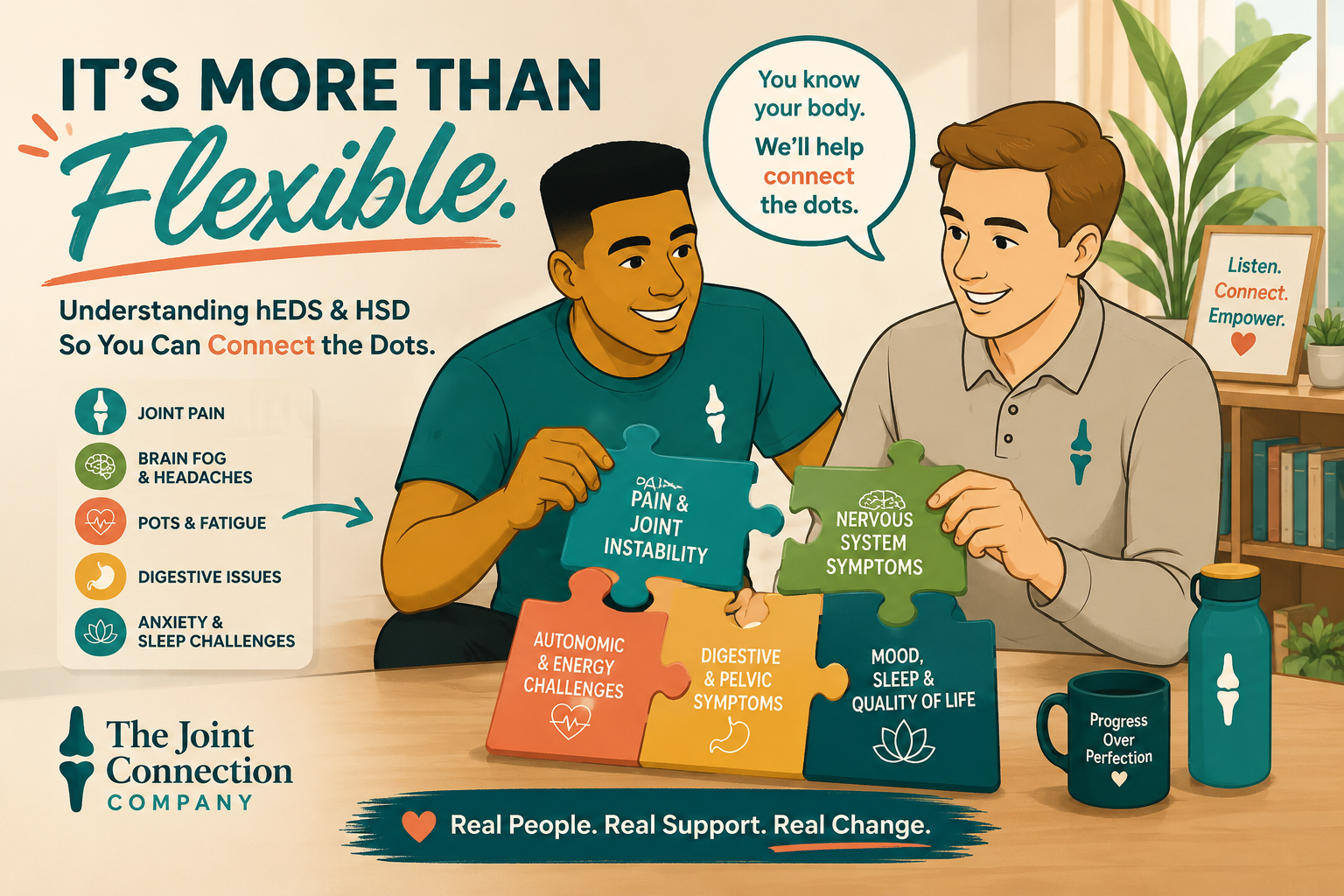
That’s why symptoms can show up in different systems:
🦴 Joints & Muscles: pain, dislocations, sprains
🧠 Nervous System: headaches, dizziness, “brain fog”
❤️ Heart & Circulation: POTS, fatigue, lightheadedness
🍽️ Digestive System: IBS, reflux, bloating
😴 Energy & Mood: fatigue, anxiety, sleep issues
Many patients don’t realize these are connected—and many providers don’t ask.
Why Getting a Diagnosis Can Take So Long
You’re not alone if you’ve felt dismissed or confused.
Many patients wait years (sometimes up to 10 years) for a diagnosis.
Common reasons:
Symptoms vary day-to-day
Tests often come back “normal”
There’s no single genetic test for hEDS
Conditions overlap with others
This is why your story matters just as much as any test.
Formally diagnosing hypermobile Ehlers-Danlos syndrome (hEDS) isn’t based on one test.
Instead, your provider looks at three main areas:
Are your joints unusually flexible?
Do you have other signs of connective tissue differences (skin, pain, family history, etc.)?
Have other similar conditions been ruled out?
👉 You must meet ALL three criteria to be diagnosed with hEDS.
🧾 The 3-Part Criteria (Explained Simply)
1️⃣ Criterion 1: Generalized Joint Hypermobility
This is usually assessed using something called the Beighton Score.
It looks at how flexible certain joints are:
Pinky fingers bending backward
Thumbs touching the forearm
Elbows and knees bending backward
Palms flat on the floor with straight knees
👉 The score is out of 9 points.
What matters for you:
Younger people need a higher score
Adults need a moderate score
Older adults need a slightly lower score
If your score is just below the cutoff, you can still meet this criterion if you answer “yes” to questions like:
Could you ever do the splits?
Were you very flexible as a child?
Have your joints dislocated easily?
👉 This matters because flexibility often decreases with age, injury, or pain.
2️⃣ Criterion 2: Additional Features (You Need Multiple)
This is where providers look beyond flexibility.
You must meet at least 2 out of 3 categories below:
A. Physical Features of Connective Tissue Differences
You may have several of these:
Soft or velvety skin
Mildly stretchy skin
Stretch marks (not explained by weight change)
Easy bruising
Small hernias
Pelvic organ prolapse
Dental crowding or high palate
Long limbs or “marfanoid” body shape
👉 You don’t need all of these—but multiple features matter.
B. Family History
A first-degree relative (parent, sibling, child) diagnosed with hEDS
👉 This matters because hEDS often runs in families.
C. Musculoskeletal Symptoms
At least one of the following:
Chronic joint or limb pain (usually >3 months)
Widespread pain
Recurrent joint dislocations or instability
👉 This is often the part patients relate to the most.
3️⃣ Criterion 3: Rule Out Other Conditions
This is a critical step.
Before diagnosing hEDS, providers must make sure symptoms are not better explained by something else, such as:
Other types of Ehlers-Danlos syndrome
Genetic connective tissue disorders (like Marfan or Loeys-Dietz)
Rheumatologic or autoimmune conditions
Neurological or muscular disorders
👉 This is why diagnosis can take time—it’s partly a process of careful exclusion.
💙 For Patients: What to Know, What to Ask, and How to Advocate for Yourself
This is where things shift—from understanding your condition…
to actually navigating your care.
🗣️ 1. How to Talk About Your Symptoms (Even If They Feel Random)
You don’t need to “organize” your symptoms perfectly.
Instead, try saying:
“My joints feel unstable or like they give out”
“I get tired way faster than I think I should”
“I have pain in multiple areas—not just one injury”
“I also have things like dizziness, gut issues, or anxiety—could they be related?”
👉 Why this matters:
Providers may not connect these dots unless you bring them up.
🧠 2. Questions to Ask Your Doctor or Physical Therapist
Bring these with you—you don’t have to remember everything.
About Diagnosis:
“Do my symptoms fit with hypermobility spectrum disorder or hEDS?”
“Can we assess my joint hypermobility (like the Beighton score)?”
“Are there other conditions we should rule out?”
About Symptoms:
“Could my fatigue, dizziness, or GI issues be related?”
“Should we screen for things like POTS or other comorbidities?”
About Treatment:
“What kind of physical therapy is best for hypermobility?”
“How do I exercise safely without making things worse?”
“What should I avoid?”
About Support:
“Would a multidisciplinary approach help me?”
“Should I see other specialists?”
🏃♀️ 3. Movement: Helpful—but It Has to Be Done Right
You may have been told:
“Just stretch more”
“Just strengthen more”
But here’s the truth:
How you move matters more than how much you move.
Helpful strategies:
Focus on control and stability, not extreme range
Start slow—progress gradually
Prioritize strength + balance (proprioception)
Choose lower-impact activities (walking, swimming, cycling)
Poorly guided exercise can increase pain—but the right kind improves it.
🧩 4. Understanding Your Pain (So It Stops Feeling Random)
Pain in hypermobility is real—but complex.
It can come from:
Joint instability and micro-injuries
Muscle overcompensation
Nervous system sensitivity
Fear of movement (which can make symptoms worse)
This is why treatment often includes:
Physical therapy
Education about pain
Sometimes psychological support
👉 This isn’t “in your head.”
It’s your body trying to protect you.
🧠 5. Your Care Should Be a Team Effort
The most effective care usually includes:
🩺 Primary care provider
🏋️ Physical therapist
🧠 Mental health support (if needed)
🧰 Specialists (cardiology, GI, etc.)
Multidisciplinary care improves outcomes and quality of life.
🛠️ 6. Everyday Strategies That Actually Help
From research and clinical guidelines:
Protect your joints (avoid locking out joints or “hanging” on ligaments - try to use your muscles to actively support your body as much as possible.)
Pace your activity (avoid “boom and bust” cycles)
Build a consistent sleep routine
Stay hydrated and support energy levels
Use supports when needed (braces, orthotics, tools)
Focus on what you can do—not just what hurts
Small, consistent changes matter more than big, unsustainable ones.
💬 7. The Most Important Thing: You Deserve to Be Heard
Many patients with hypermobility say the hardest part isn’t the pain—it’s not being believed.
You deserve:
To be listened to
To be taken seriously
To be part of your care decisions
And when that happens?
Everything changes.
Use the skills and questions above to be an advocate for yourself and, if you have any questions, don’t hesitate to reach out to us or use the comment section below!
📌 Key Reflection for You
What patterns have you noticed in your body over time?
What symptoms have you been told are “unrelated”?
What would it feel like to have a provider truly listen?
📂 Supplemental Information / Citations
Yew KS, Kamps-Schmitt KA, Borge R. Hypermobile Ehlers-Danlos syndrome and hypermobility spectrum disorders. Am Fam Physician. 2021;103(8):481-492.
Atwell K, Michael W, Dubey J, et al. Diagnosis and management of hypermobility spectrum disorders in primary care. J Am Board Fam Med. 2021;34(4):838-848.
Russek LN, Stott P, Simmonds J. Recognizing and effectively managing hypermobility-related conditions. Phys Ther. 2019;99(9):1189-1200.
Darnell SC, Shotwell C, Brown S, et al. Therapeutic Management of Hypermobility Spectrum Disorder, including Hypermobile Ehlers-Danlos Syndrome: Evidence-Based Clinical Care Guideline. Cincinnati Children’s Hospital Medical Center; 2025.
Brittain GM, Flanagan S, Foreman L, Teran-Wodzinski P. Physical therapy interventions in generalized hypermobility spectrum disorder and hypermobile Ehlers-Danlos syndrome: a scoping review. Disabil Rehabil. 2024;46(10):1936-1953.
Clark NL, Kainth GS, Johnson M, et al. Psychological interventions to improve pain, fatigue, anxiety, depression, and quality of life in individuals with hypermobility spectrum disorders and Ehlers-Danlos syndrome: a systematic review. Rheumatol Int. 2024;44(1):41-55.
The Ehlers-Danlos Society. hEDS diagnostic checklist. https://www.ehlers-danlos.com/wp-content/uploads/hEDS-Dx-Criteria-checklist-1-Fillable-form.pdf
This content drafted, researched, edited, and generated by:
McKinley Pollock, PT, DPT
McKinley Pollock, PT, DPT, OCS, CSCS is a physical therapist with a background in orthopedics and sports rehabilitation. Dr. Pollock earned his doctorate of physical therapy from Campbell University in 2021, is a board-certified orthopedic clinical specialist (OCS), and certified strength and conditioning specialist (CSCS). Dr. Pollock enjoys combining lessons learned from his DPT training and research, translating these into clinical practice. His passions include promoting relationships between patients & clinicians to promote clinical effectiveness, satisfaction, and efficiency, the implementation of primary preventative medicine into clinical practice, and leadership and education development.
© 2026 The Joint Connection Company. All rights reserved.
The content on this website, including all text, graphics, and materials, is the exclusive property of The Joint Connection Company and is protected by applicable copyright and intellectual property laws. No part of this site may be reproduced, distributed, or used without prior written permission.