

✨ Too Long Didn’t Read (TL;DR) / Summary
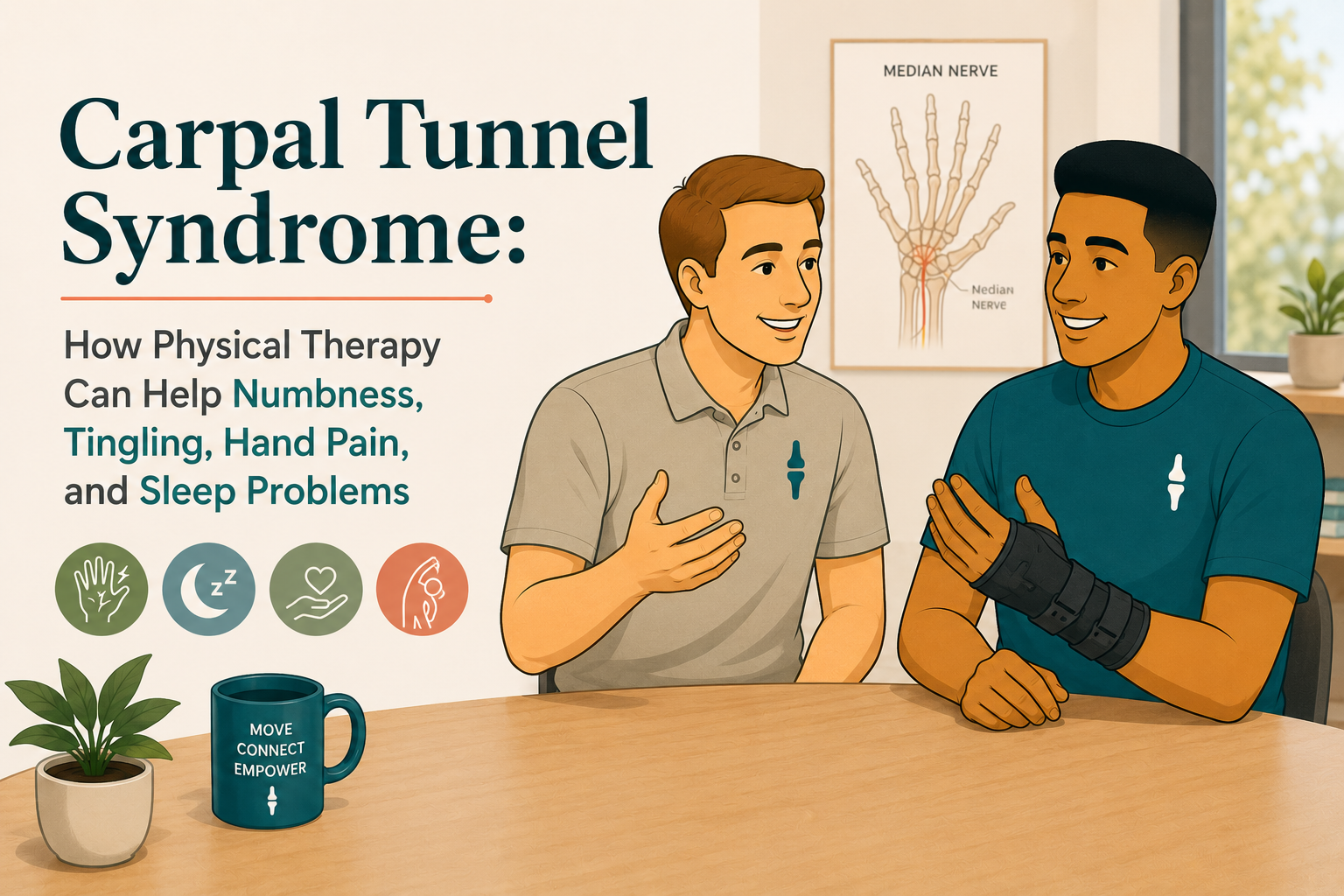
Carpal tunnel syndrome, often called CTS, happens when the median nerve gets irritated or compressed as it travels through a small space in your wrist called the carpal tunnel. This can cause numbness, tingling, burning, pain, weakness, or that frustrating “my hand fell asleep” feeling. Symptoms often show up in the thumb, index finger, middle finger, and sometimes part of the ring finger.
One of the most common complaints is numbness or tingling at night. Many people wake up shaking their hand, changing positions, or wondering why their hand keeps going numb while sleeping. Sleep symptoms are a big reason people seek care for CTS, and research shows sleep can improve after treatments like splinting or carpal tunnel release surgery.
For many people with mild to moderate CTS, physical therapy can help by identifying what is irritating the nerve, improving wrist and hand habits, recommending a properly positioned wrist brace, modifying work or sleep positions, and guiding safe exercise or symptom management strategies.
The most supported conservative option is usually a forearm-based wrist brace or orthosis that keeps the wrist close to neutral, especially at night. This matters because sleeping with the wrist bent can increase pressure around the median nerve.
A good rule of thumb: if you have progressive weakness, constant numbness, visible muscle shrinking near the thumb, worsening symptoms, or you are dropping things more often, it is time to talk with a physician, hand specialist, or qualified healthcare provider.
🧾 Condition-Specific General Information
What Is Carpal Tunnel Syndrome?
Carpal tunnel syndrome occurs when the median nerve is compressed or irritated at the wrist.
Think of the carpal tunnel like a narrow hallway. The median nerve and several tendons pass through that hallway. If pressure builds inside that space, the nerve may not glide or function normally. When nerves get irritated, they can create symptoms like numbness, tingling, burning, pain, weakness, or clumsiness.
Common symptoms include:
Numbness or tingling in the thumb, index finger, middle finger, or part of the ring finger
Hand pain or burning
Waking up at night with hand numbness
Shaking the hand to “wake it up”
Dropping objects
Trouble with buttons, jars, tools, phones, keyboards, or gripping
Weakness with pinching or gripping
Symptoms that feel worse with prolonged wrist bending
A more advanced sign is thenar atrophy, which means visible muscle loss near the base of the thumb. This is not something to “wait out.” Thenar atrophy can suggest more severe or long-standing median nerve compression and should be discussed with a physician or hand specialist as soon as possible.
Why Does My Hand Go Numb at Night?
Nighttime numbness is one of the most classic CTS complaints. Many people sleep with their wrists bent without realizing it. A bent wrist can increase pressure in the carpal tunnel, which may irritate the median nerve.
This is why a neutral wrist brace at night can be helpful for many people with mild to moderate CTS. The goal is not to immobilize your wrist for your entire life. The goal is to let the nerve calm down and relax while you sleep.
Is Typing Causing My Carpal Tunnel Syndrome?
The 2024 American Academy of Orthopedic Surgeons guideline summary states that, based on the available reliable evidence, there is no established association between high keyboard use and carpal tunnel syndrome.
But that does not mean typing, mouse use, or desk setup cannot aggravate your symptoms.
Keyboarding may not be the proven root cause for everyone, but your workstation can still matter if it increases symptoms. If your hand tingles every time you grip your mouse, rest your wrist on the desk edge, or type with your wrists bent upward, your PT can help you test simple changes.
Helpful modifications may include:
Keeping wrists closer to neutral
Avoiding long periods of wrist flexion or extension
Using a lighter keyboard touch
Trying a keyboard with reduced strike force if typing is painful
Alternating mouse hands
Using arrow keys, shortcuts, or touchscreens when helpful
Taking short movement breaks
Changing mouse position or style
Avoiding resting the wrist directly on a hard desk edge
The goal is to find what your nerve likes and dislikes.
Who Is More Likely to Get Carpal Tunnel Syndrome?
CTS is more common in women than men. It is especially common in women ages 40 to 49 and men ages 50 to 59.
Risk factors may include:
Age
Female sex
Obesity
Repetitive or forceful hand exertion
Jobs or tasks involving heavy gripping, pinching, or vibrating tools
The evidence is less clear or conflicting for some commonly discussed risk factors, including diabetes, alcohol use, smoking, pregnancy history, and physical activity.
Pregnancy-related CTS can happen, and symptoms may improve after delivery, but it is still worth discussing with a healthcare provider—especially if symptoms are intense, worsening, or affecting sleep and function.
How Can Physical Therapy Help Carpal Tunnel Syndrome?
Physical therapy for CTS is not just a few wrist exercises to solve the problem.
A thoughtful PT visit should include listening to your story, understanding your symptoms, screening for other possible causes, and building a plan that fits your life.
Your physical therapist may help with:
1. Figuring Out Whether Your Symptoms Fit CTS
Not all hand numbness is carpal tunnel syndrome.
A PT may ask:
Which fingers go numb?
Do symptoms wake you up?
Do you have neck pain?
Are symptoms constant or occasional?
Are you dropping things?
What activities trigger symptoms?
Do you have weakness?
Have symptoms changed over time?
Your PT may use tools like a hand symptom diagram, symptom questionnaires, and clinical tests to get more information.
They may also check sensation, grip or pinch ability, hand coordination, and the muscles near your thumb.
2. Helping You Find the Right Wrist Brace Position
For mild to moderate CTS, one of the most supported physical therapy recommendations is a wrist orthosis that keeps the wrist near neutral, especially at night.
This matters because not every brace is automatically helpful. A brace that holds your wrist too far bent up or down may not be ideal.
Ask your PT:
“Is my brace keeping my wrist in the right position?”
“Should I wear it only at night or during certain daytime activities too?”
“How long should I trial it before we reassess?”
“What symptoms mean I should stop wearing it and contact you?”
3. Improving Sleep Positions
If your hand goes numb while sleeping, your PT may help you problem-solve:
Wrist position
Elbow position
Pillow placement
Brace fit
How long symptoms last after waking
Whether symptoms are changing over time
A simple nighttime brace can be surprisingly helpful for the right person, but persistent or worsening nighttime numbness should be taken seriously.
4. Ergonomic and Activity Coaching
Your PT may help you modify activities that irritate symptoms, including:
Typing
Mouse use
Tool use
Driving
Lifting
Gripping
Phone use
Gaming
Hair styling
Cooking
Cleaning
Repetitive work tasks
PT should be more than “just stop doing activities that make your hand go numb” - PT should help you find a version of your activities that work for you.
5. Manual Therapy and Exercise
Some patients may benefit from manual therapy to the neck, shoulder, arm, wrist, or areas where the median nerve may be sensitive or restricted. The 2026 JOSPT guideline says manual therapy may help with short-term pain and function in mild to moderate CTS.
Exercise may also be used, especially when combined with bracing and stretching in the right patient.
This does not mean every CTS case needs the same exercises. In fact, some nerve symptoms can become irritated if exercises are too aggressive. And, sometimes, your nerve symptoms may not be coming from CTS. Your PT should match the plan to your symptoms, exam findings, and response.
6. Symptom-Relief Modalities
Some modalities may offer short-term symptom relief for certain patients, including laser therapy, shockwave therapy, interferential current, superficial heat, microwave diathermy, or shortwave diathermy.
However, the evidence for many nonoperative treatments is limited, and the AAOS guideline summary notes that many treatments do not show strong long-term improvement in patient-reported outcomes.
Also important: the 2026 guideline recommends against using corticosteroid iontophoresis, corticosteroid phonophoresis, or magnets for CTS management.
💙 For Patients
What Should I Ask My Physical Therapist?
Bring your questions. Seriously. A good clinical relationship is a conversation, not a lecture.
Ask your PT:
“Do my symptoms match carpal tunnel syndrome, or could this be coming from somewhere else?”
“Which fingers should I be paying attention to?”
“Do I have signs of weakness or sensory loss?”
“Do you see any muscle loss near my thumb?”
“What should I track between visits?”
“Is my wrist brace positioned correctly?”
“Should I wear my brace at night, during the day, or only during certain activities?”
“What work, keyboard, mouse, tool, or sleep changes should I try first?”
“How long should we try conservative care before discussing next steps?”
“What symptoms mean I should contact my physician?”
You should leave PT with a clearer understanding of what is happening, what you are trying, and how you will know whether it is working.
What Should I Ask My Physician?
A physician can help confirm the diagnosis, rule out other medical causes, discuss medications or injections, and refer for testing or surgical consultation when needed.
Ask your physician:
“Do my symptoms sound like carpal tunnel syndrome?”
“Could this numbness be coming from my neck, another nerve, diabetes, circulation, or something else?”
“Do I need nerve testing, such as EMG or nerve conduction studies?”
“How severe does this seem?”
“Would a corticosteroid injection be appropriate for short-term relief?”
“At what point should I consider a hand surgeon consultation?”
“Are NSAIDs or acetaminophen safe for me?”
“Could any of my medications or health conditions affect my symptoms?”
“If I have surgery, what should I expect afterward?”
Electrodiagnostic testing may be used to confirm CTS in atypical cases, rule out other causes, or estimate severity before surgery.
When Should I See a Physician or Hand Specialist?
Please do not ignore symptoms that are progressing.
Talk with a physician, hand specialist, or qualified healthcare provider if you have:
Constant numbness
Worsening numbness or tingling
Weakness
Dropping objects frequently
Visible muscle loss near the thumb
Symptoms that are not improving with conservative care
Severe pain
Symptoms in both hands that are worsening
Symptoms that do not match the usual CTS pattern
Hand symptoms with neck pain, balance problems, widespread numbness, or other nerve concerns
Severe CTS, especially with objective weakness or sensory deficits, may require surgical discussion.
Seek urgent medical care if hand symptoms occur with signs of stroke, sudden major weakness, chest pain, severe trauma, infection signs, or major circulation changes such as a cold, pale, or blue hand.
What About Medications?
Over-the-counter pain relievers like NSAIDs or acetaminophen have not shown clear benefit for CTS itself in the rapid evidence review cited here. That does not mean they are never appropriate for pain, but they are not considered a fix for median nerve compression.
Talk to a physician or pharmacist before taking medications if you:
Are pregnant
Take blood thinners
Have kidney disease
Have liver disease
Have stomach ulcers or reflux
Have heart disease or high blood pressure
Take multiple medications
Are unsure about safe dosing
Your pharmacist is an excellent resource for medication safety questions.
What About Steroid Injections?
Steroid injections may provide short-term symptom relief for some people. However, the AAOS guideline summary reports strong evidence that corticosteroid injection does not provide long-term improvement for CTS.
That means an injection may be part of a plan, but it should not be viewed as a guaranteed long-term solution.
A good question to ask:
“Is this injection meant to calm symptoms temporarily, help confirm the diagnosis, delay surgery, or support my rehab plan?”
What About Surgery?
Carpal tunnel release surgery is designed to reduce pressure on the median nerve. It may be recommended for severe CTS, especially when there is objective weakness, sensory loss, thenar atrophy, or symptoms that do not improve with conservative care.
The AAOS guideline summary reports strong evidence that mini-open and endoscopic carpal tunnel release have no difference in patient-reported outcomes. It also reports that local anesthesia alone can be used for carpal tunnel release and that routine supervised therapy after surgery should not automatically be prescribed for everyone.
That last point deserves context. It does not mean PT is never helpful after surgery. It means not every person needs routine formal therapy after carpal tunnel release. Some people may still benefit from PT or hand therapy if they have stiffness, scar sensitivity, weakness, swelling, fear of movement, delayed recovery, or difficulty returning to work or daily tasks.
Ask your surgeon:
“Which surgical approach do you recommend and why?”
“What signs would mean I need therapy after surgery?”
“When can I return to typing, lifting, driving, work, or exercise?”
“What pain control plan is safest for me?”
“What symptoms after surgery should I report right away?”
Can I Go Straight to Physical Therapy?
In many places, yes—but rules vary.
APTA reports that all 50 states, Washington, DC, and the US Virgin Islands have some form of direct access to physical therapist services, but the details and limitations vary by jurisdiction. APTA also describes physical therapist scope of practice as involving professional, jurisdictional, and personal components, meaning your PT must practice within the law, evidence, and their own training and competence.
That is why your PT may refer you to another provider when your symptoms require medical testing, medication guidance, imaging, surgical consultation, or evaluation outside physical therapy’s scope.
The Bottom Line
Carpal tunnel syndrome can be annoying, painful, confusing, and honestly pretty disruptive—especially when it keeps waking you up at night.
But you are not stuck guessing.
Physical therapy can help you understand whether your symptoms fit CTS, identify what may be irritating the median nerve, fit or adjust a wrist brace, improve sleep and work positions, modify activities, and decide when another provider should be involved.
The best care does not sound like, “Here is your brace, see you later.”
It sounds like:
“Let’s figure out what your hand is telling us, what matters most in your day, and what plan gives you the best chance to feel and function better.”
That is the connection we care about.
📂 Supplemental Information / Citations
Erickson M, Lawrence M, Stegink Jansen CW, et al. Hand pain and sensory deficits: carpal tunnel syndrome: revision 2026: clinical practice guidelines linked to the International Classification of Functioning, Disability and Health from APTA Orthopedics and APTA Hand and Upper Extremity Academies of the American Physical Therapy Association. J Orthop Sports Phys Ther. 2026;56(4):CPG1-CPG79. doi:10.2519/jospt.2026.0301
Wipperman J, Penny ML. Carpal tunnel syndrome: rapid evidence review. Am Fam Physician. 2024;110(1):52-57.
Shapiro LM, Kamal RN; Management of Carpal Tunnel Syndrome Work Group; American Academy of Orthopaedic Surgeons. American Academy of Orthopaedic Surgeons/ASSH clinical practice guideline summary management of carpal tunnel syndrome. J Am Acad Orthop Surg. 2025;33(7):e356-e366. doi:10.5435/JAAOS-D-24-01179
Warren JR, Link RC, Cheng AL, Sinclair MK, Sorensen AA. Carpal tunnel syndrome and sleep, a systematic review and meta-analysis. Hand Surg Rehabil. 2024;43(3):101698. doi:10.1016/j.hansur.2024.101698
American Physical Therapy Association. Scope of practice. Accessed June 20, 2026.
American Physical Therapy Association. Levels of patient access to physical therapist services in the U.S. Published September 4, 2024. Accessed June 20, 2026.
This content drafted, researched, edited, and generated by:
Jackson Kojima, PT, DPT
Jackson Kojima, PT, DPT, OCS is a physical therapist with an extensive background in orthopedics, geriatrics, and sports rehabilitation. Dr. Kojima is a board-certified orthopedic clinical specialist (OCS) with a passion for post-operative rehabilitation and enjoys treating multi-factorial conditions like low back pain and generalized joint pain. Dr. Kojima earned his doctorate of physical therapy from Campbell University in 2021 and currently practices in Greenville, SC.
© 2026 The Joint Connection Company. All rights reserved.
The content on this website, including all text, graphics, and materials, is the exclusive property of The Joint Connection Company and is protected by applicable copyright and intellectual property laws. No part of this site may be reproduced, distributed, or used without prior written permission.