

✨ Too Long Didn’t Read (TLDR) / Summary
Who needs it? Anyone living with a chronic condition (pain, diabetes, arthritis, asthma, heart disease, etc.) and wants clear, doable steps.
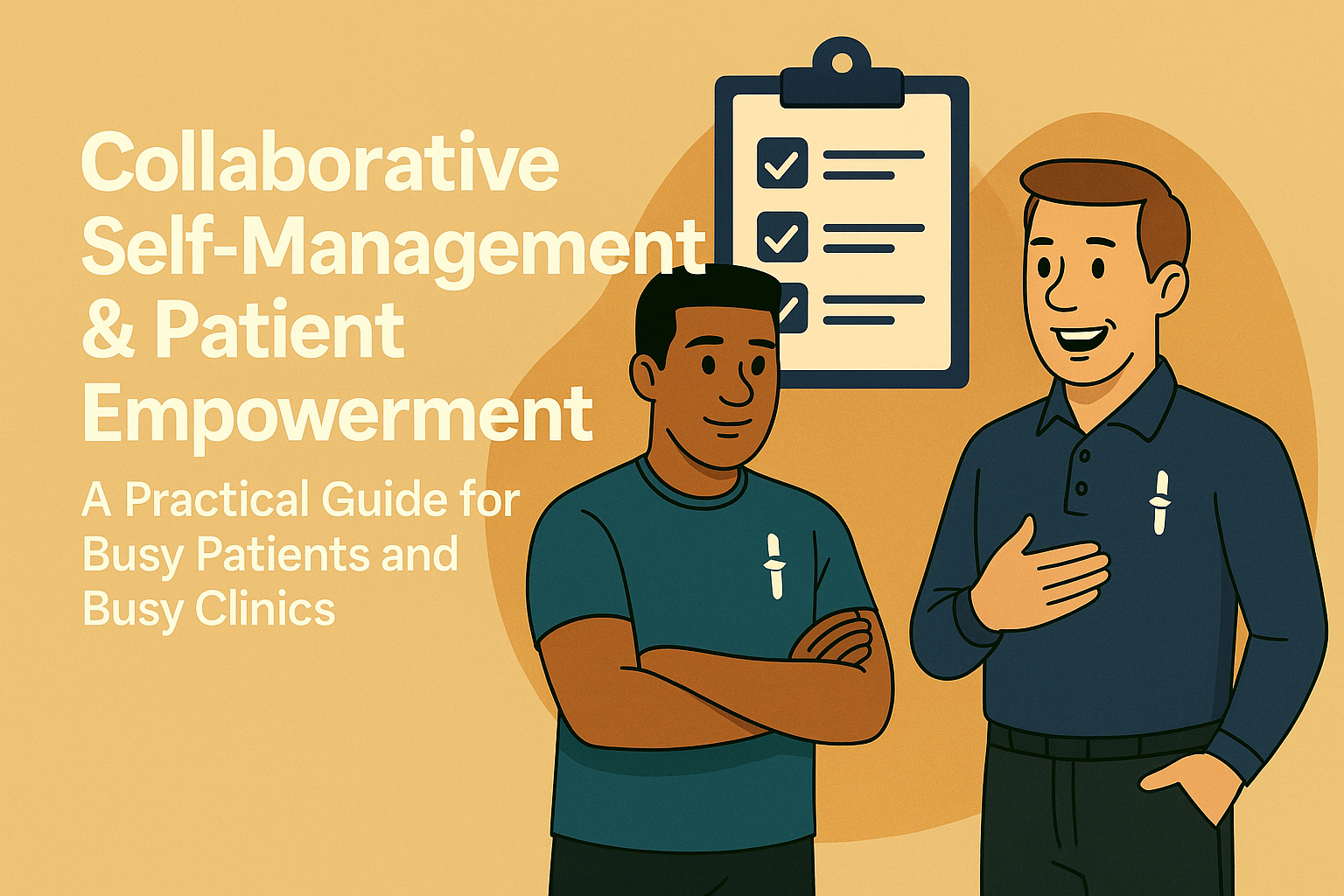
What is Collaborative Self-Management? Patients and providers co-create a simple plan with small steps, clear roles, and scheduled check-ins. Patients own the day-to-day; providers coach, troubleshoot, and cheerlead.
Why it matters: Done well, it boosts confidence and behavior change and can improve quality of life and care utilization—while strengthening trust and relationships in the clinical relationship.
Timeline:
Start with a 1-step, 1-week plan.
Check in at 1–2 weeks to assess progress and tackle any barriers/challenges noticed
Refine at 4–6 weeks and continue progressing
Reassess goals at 3 months and repeat!
Success keys: Start tiny → write it down → track simply → review together → adjust as needed.
🧾 What Exactly IS Collaborative Self-Management
Collaborative self-management is a partnership: you and your care team pick one specific action/habit to change, decide when/where/how you’ll do it and how you will track it, and plan a check-in to see what helped and what got in the way.
After the check in, talk about any adjustments that need to be made and then start the process all over again!
What the evidence shows (quick tour): Across chronic diseases, self-management programs can show up to moderate benefits for health behaviors, quality of life, and sometimes lower utilization of interventions like medications or hospital visits.
To be Honest (TBH): Evidence on the effectiveness of using only collaborative self-management is mixed. Some research in people with chronic pain demonstrated moderate positive results, while other research in people with diabetes didn’t show much improvement at all. This is why it’s ESSENTIAL for patients to talk with their providers to get a full, ONGOING plan with multiple interventions - not just trying to manage these conditions on their own after the first appointment.
Bottom line: Keep plans small, specific, and collaborative; schedule check-ins; and stay consistent. That’s where change sticks.
💙 For Patients
🏁 Getting Started This Week
1.) Choose one small action
Examples: Walk 10 minutes after dinner 3 days; practice deep breathing techniques 5 minutes before bed; prep one veggie snack
2.) Write it down - BE SPECIFIC! (what/when/where/how you’ll know you did it).
3.) Talk with your provider and start tracking
KEY: Make tracking simple. We recommend using one of the following strategies:
Use the “Notes” app on your phone
Keep a notecard with checkmarks with you
Tally your progress on the fridge
Use our free, downloadable Accountability Tracker
4.) Plan a check-in with your provider to discuss how to continue your progress or discuss what got in the way
We recommend planning to send an online message in 7–10 days after starting your habit to hold yourself accountable.
📈 Your Weekly Targets
Protect consistency: tiny steps beat heroic bursts.
Measure what matters: function, energy, sleep, or minutes active—not just symptoms.
Expect detours: WHEN life gets messy, doing something is better than nothing. Try to get back on track as quickly as you can and keep going!
Example: If your goal is to eat 3 vegetables per day, then 1 or 2 veggies is better than 0. Modify for the season of life you’re in but don’t give up!
Example: If your goal is to walk 15 minutes per day, try to break it into short, 5-minute bursts and see what you can get.
❓ Smart Questions to Ask Your Care Team
“What one thing can I do this week that would help my health the most based on what we’re talking about today?”
“How will we know this is working, and when should we adjust?”
“What do you recommend is the best way I track myself and hold myself accountable?”
“Can we schedule a quick check-in—or is messaging better for your team?”
“What should I do if I have a flare or a setback?” ; “What should I do if I don’t have time to accomplish my goal?”
🧠 Motivation & Daily Life
Pair the habit with something you already do (Example: Walk right after dinner so that eating dinner becomes the trigger to walk!).
Celebrate small wins out loud. You’ve earned it!!
If replies from your healthcare team are delayed (clinics are busy), keep tracking on your own; bring your notes to the next visit.
📂 Supplemental Downloads / Information
📄 Patient Handout: The Joint Connection’s FREE Habit and Accountability Tracker
📚 References
Allegrante JP, Wells MT, Peterson JC. Interventions to Support Behavioral Self-Management of Chronic Diseases. Annu Rev Public Health. 2019;40:127-146. doi:10.1146/annurev-publhealth-040218-044008. PMID: 30601717; PMCID: PMC6684026.
Asan O, Yu Z, Crotty BH. How clinician-patient communication affects trust in health information sources: Temporal trends from a national cross-sectional survey. PLoS One. 2021;16(2):e0247583. doi:10.1371/journal.pone.0247583. PMID: 33630952; PMCID: PMC7906335.
Dineen-Griffin S, Garcia-Cardenas V, Williams K, Benrimoj SI. Helping patients help themselves: A systematic review of self-management support strategies in primary health care practice. PLoS One. 2019;14(8):e0220116. doi:10.1371/journal.pone.0220116. PMID: 31369582; PMCID: PMC6675068.
Winkley K, Upsher R, Stahl D, et al. Psychological interventions to improve self-management of type 1 and type 2 diabetes: a systematic review. Health Technol Assess. 2020;24(28):1-232. doi:10.3310/hta24280. PMID: 32568666; PMCID: PMC7336224.
Uritani D, Koda H, Sugita S. Effects of self-management education programmes on self-efficacy for osteoarthritis of the knee: a systematic review of randomised controlled trials. BMC Musculoskelet Disord. 2021;22(1):515. doi:10.1186/s12891-021-04399-y. PMID: 34090406; PMCID: PMC8180097.
Vase L, Wager TD, Eccleston C. Opportunities for chronic pain self-management: core psychological principles and neurobiological underpinnings. Lancet. 2025;405(10491):1781-1790. doi:10.1016/S0140-6736(25)00404-0. PMID: 40382187.
Lozano P, Houtrow A. Supporting Self-Management in Children and Adolescents With Complex Chronic Conditions. Pediatrics. 2018;141(Suppl 3):S233-S241. doi:10.1542/peds.2017-1284H. PMID: 29496974.