

✨ Too Long Didn’t Read (TL;DR) / Summary
Hip impingement (also known as “Femoralacetabular Impingement Syndrome” or “FAIS”) is not just something that shows up on a scan — it’s a condition that depends on your symptoms, how your hip moves, and what shows up on imaging.
Many active people actually have “abnormal” hip shapes on imaging without any pain at all. So if your scan mentions something like a “cam” or “pincer,” it doesn’t automatically mean something is seriously wrong.
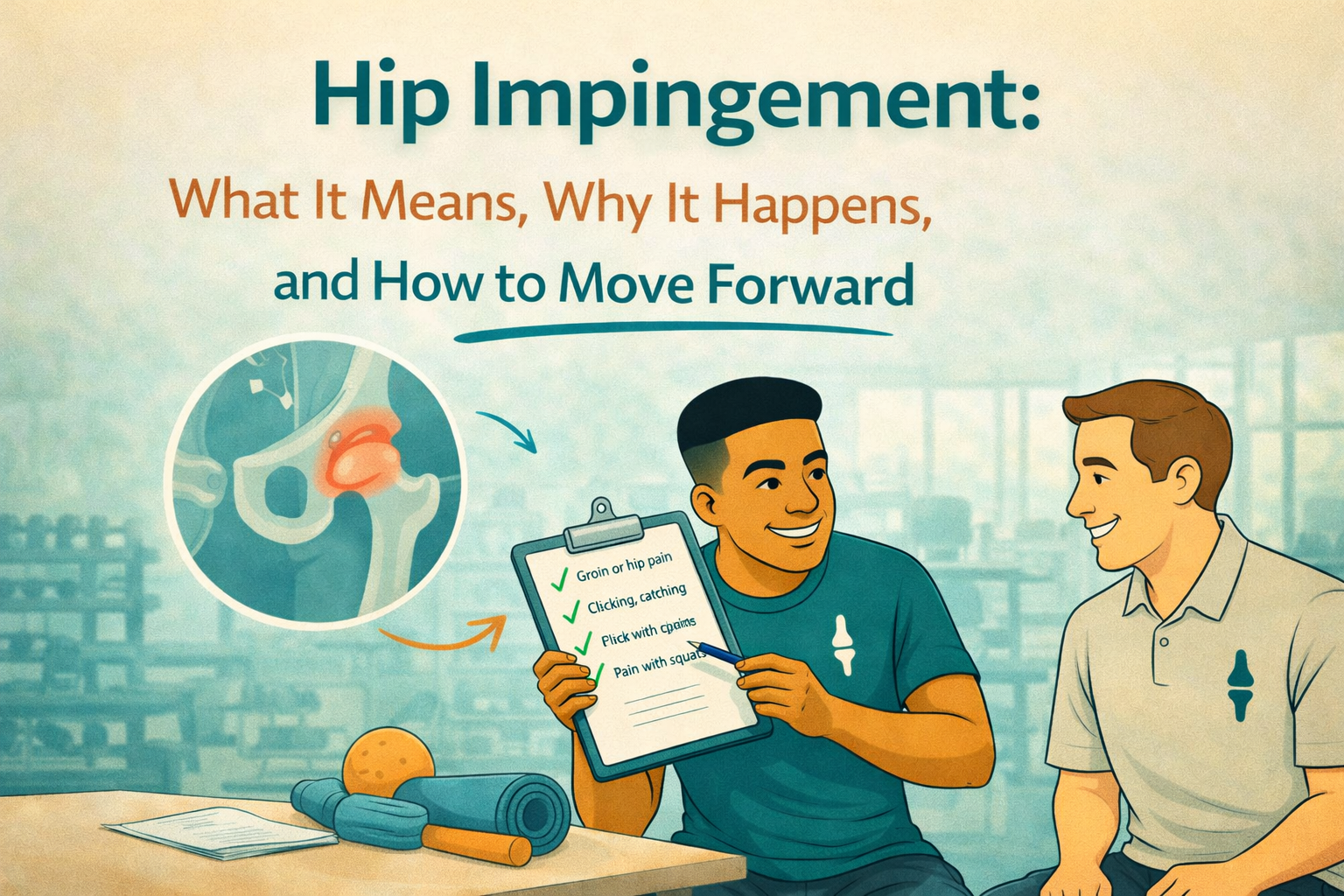
Common symptoms include:
Groin or front-of-hip pain
Stiffness or tightness
Clicking, catching, or pinching sensations
Pain with sitting, squatting, running, or pivoting
A feeling like your hip just doesn’t move smoothly
The good news?
Most people improve with a structured, active approach that includes:
✔️ Strengthening
✔️ Movement retraining
✔️ Activity modification (not stopping everything)
✔️ Clear guidance from a providerAnd most importantly:
You are not “damaged.” Your hip can improve with the right plan.
🧾 Condition-Specific General Information
What is hip impingement?
Hip impingement happens when the ball and socket of your hip don’t move together as smoothly as they should, especially during certain movements.
This can lead to irritation or pain — particularly with:
deep bending (like squats)
sitting for long periods
twisting or pivoting
running or sports
But here’s something really important:
👉 Hip impingement is not diagnosed from imaging alone.
To truly have hip impingement, there needs to be a combination of:
your symptoms
how your hip moves
what shows up on imaging
That means:
A “weird-looking” hip on a scan doesn’t always equal a painful hip.
Understanding “cam” and “pincer” (without the confusion)
You may hear these terms during your appointment:
Cam → a small extra bump on the ball of your hip
Pincer → extra coverage of the socket
Mixed → a combination of both
These are simply shape differences, not diagnoses by themselves.
In fact:
👉 Many people — especially athletes — have these shapes and never develop pain.
So the real question is not:
“Do I have a cam or pincer?”
It’s:
“Does this actually match my symptoms and movement?” and “Does it matter for what I’m feeling?”
Why hip pain can feel confusing
Hip pain doesn’t always follow a clean pattern.
People often describe:
groin pain
deep hip discomfort
stiffness
clicking or catching
pain with sitting or getting up
pain with squats, lunges, or sports
Sometimes it comes on suddenly.
Other times, it builds slowly over months.
And many patients say:
“I’ve seen multiple providers and still don’t have a clear answer.”
That experience is more common than you might think — and it’s exactly why clear communication matters so much in hip care.
What your provider is looking for
When you see a doctor or physical therapist, they’re not just looking at your hip — they’re trying to understand how your hip functions as part of your whole body.
They’ll often assess:
🔹 How your hip moves
Can it bend, rotate, and extend comfortably?
Are certain movements limited or painful?
🔹 Strength
Especially your glutes, hip rotators, and core
Weakness here can increase stress on the hip
🔹 Movement patterns
Squatting
Single-leg balance
Walking or running mechanics
Jumping and landing patterns
🔹 Your symptoms
What movements trigger pain?
What activities matter most to you?
This helps them build a plan that actually fits your life, not just your scan.
What about imaging (X-rays, MRI)?
Imaging can be helpful — but it doesn’t tell the whole story.
Many people have findings on MRI or X-ray that:
don’t cause pain
don’t limit function
That’s why a good provider will often say something like:
“This finding might be contributing, but we need to match it with your symptoms and movement.”
That’s a much more accurate and helpful way to understand your hip.
What recovery usually focuses on
Good news: One of the most effective approaches is non-surgical. And it should be attempted first.
This includes:
🔹 Strengthening
Focusing on:
glutes
hip muscles
core
🔹 Movement retraining
Improving how your hip moves during:
squats
walking
running
daily activities
🔹 Activity modification
This doesn’t mean stopping everything.
It means:
👉 Adjusting how much, how often, and how deep you move — temporarily
What about sports and running?
Activities like sprinting or deep squatting can put higher stress on the hip, especially in positions that bring the hip into deep flexion.
That doesn’t mean you can’t return to them.
It means:
👉 You may need a gradual, guided progression back into those movements.
💙 For Patients – What to Ask, What to Expect, and How to Advocate for Your Hip
If you’re dealing with hip pain, one of the most helpful things you can do is ask good questions.
Because the best care happens when it’s a conversation, not a guessing game.
Questions to ask your provider
“Do my symptoms actually match hip impingement (FAIS)?”
Not every hip pain is FAIS — clarity matters.
“What are my imaging results and how much does my imaging matter?”
This helps you understand whether findings are meaningful or just incidental.
“What movements should I temporarily modify?”
Instead of avoiding everything, you’ll learn what to adjust.
“What should I keep doing?”
This is just as important. Staying active (in the right way) helps recovery.
“What should progress look like?”
Knowing what improvement should feel like builds confidence.
“How will we measure progress?”
Pain alone isn’t the only marker — strength, movement, and function matter too.
“When would we consider other options like imaging or surgery?”
This helps you understand the bigger picture without jumping ahead too quickly.
A reassuring truth about hip impingement
Many people hear terms like:
“impingement”
“cam lesion”
“labral irritation”
…and assume something is seriously wrong.
But here’s the reality:
👉 Many people improve significantly with non-surgical care.
Even when surgery is considered, it’s usually after a well-guided rehab attempt.
The most important part of recovery
Recovery is not just about the hip joint.
It’s about:
Understanding what’s actually happening
Building strength and movement confidence
Working with a provider who listens and explains clearly
Your hip is adaptable.
And with the right plan, most people can get back to:
working
exercising
sports
everyday movement
with less pain and more confidence.
📂 Supplemental Information / Citations
Enseki KR, Bloom NJ, Harris-Hayes M, Cibulka MT, Disantis A, Di Stasi S, Malloy P, Clohisy JC, Martin RL, Beattie PF. Hip pain and movement dysfunction associated with nonarthritic hip joint pain: a revision. J Orthop Sports Phys Ther.2023;53(7):CPG1-CPG70. doi:10.2519/jospt.2023.0302
Mallets E, Turner A, Durbin J, Bader A, Murray L. Short-term outcomes of conservative treatment for femoroacetabular impingement: a systematic review and meta-analysis. Int J Sports Phys Ther. 2019;14(4):514-524. PMID:31440404 PMCID:PMC6670054
Gonçalves BAM, Saxby DJ, Meinders E, Barrett RS, Diamond LE. Hip contact forces during sprinting in femoroacetabular impingement syndrome. Med Sci Sports Exerc. 2024;56(3):402-410. doi:10.1249/MSS.0000000000003320
Trigg SD, Schroeder JD, Hulsopple C. Femoroacetabular impingement syndrome. Curr Sports Med Rep. 2020;19(9):360-366. doi:10.1249/JSR.0000000000000748
This content drafted, researched, edited, and generated by:
Jackson Kojima, PT, DPT
Jackson Kojima, PT, DPT, OCS is a physical therapist with an extensive background in orthopedics, geriatrics, and sports rehabilitation. Dr. Kojima is a board-certified orthopedic clinical specialist (OCS) with a passion for post-operative rehabilitation and enjoys treating multi-factorial conditions like low back pain and generalized joint pain. Dr. Kojima earned his doctorate of physical therapy from Campbell University in 2021 and currently practices in Greenville, SC.
© 2026 The Joint Connection Company. All rights reserved.
The content on this website, including all text, graphics, and materials, is the exclusive property of The Joint Connection Company and is protected by applicable copyright and intellectual property laws. No part of this site may be reproduced, distributed, or used without prior written permission.