

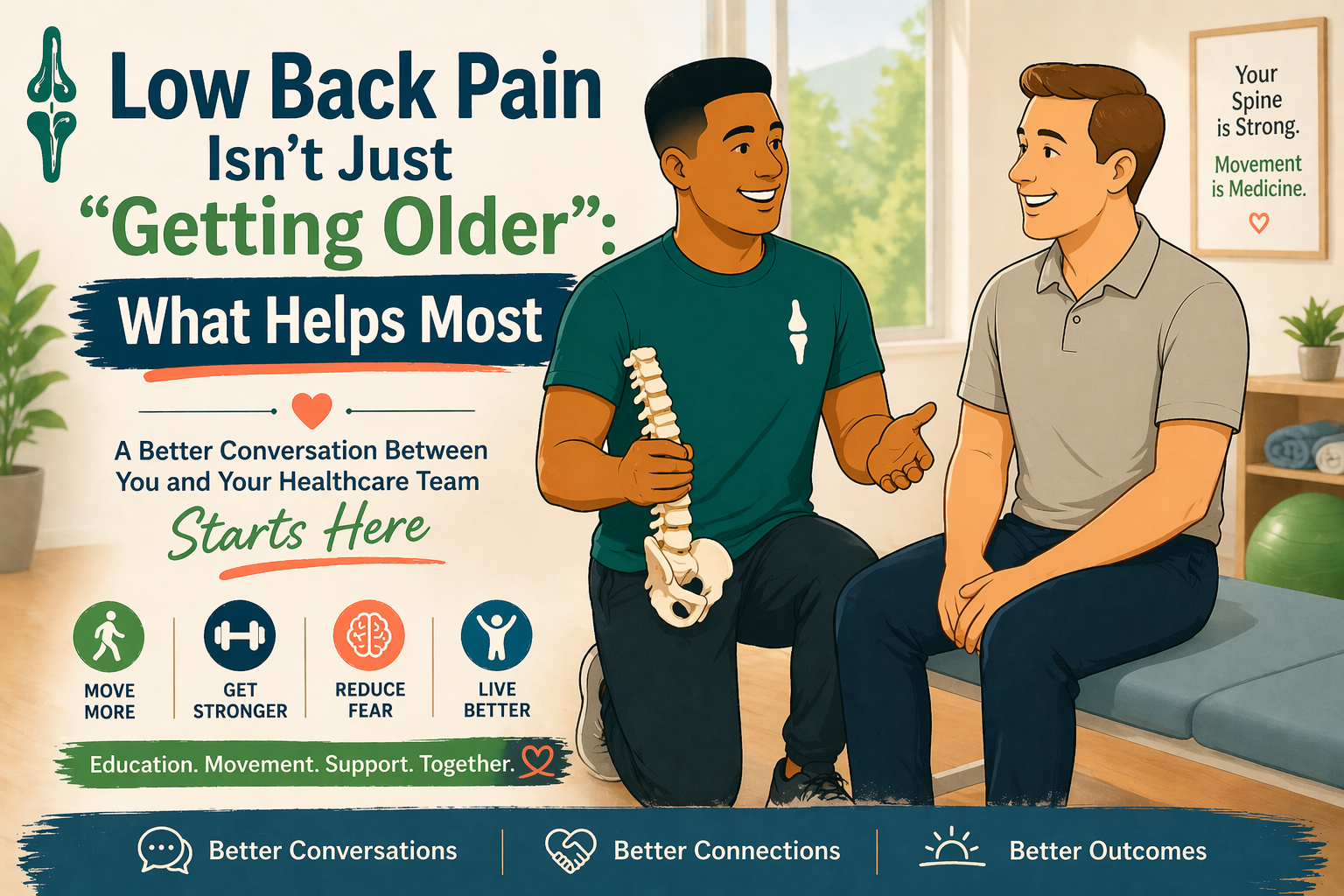
✨ Too Long Didn’t Read (TL;DR) / Summary
Low back pain is one of the most common reasons people visit a doctor or physical therapist—but it does notautomatically mean something is seriously wrong, and it does not mean you are stuck with it forever.
Many people improve with the right plan: movement, exercise, education, and support from a trusted provider.
Research shows that staying active within your comfort level is usually better than complete bed rest. Treatments like physical therapy, walking, strengthening, yoga, aquatic exercise, and guided movement can help many people feel better and move better.
One of the most important parts of recovery is having a provider who listens, explains things clearly, and helps you build confidence again.
🧾 Condition-Specific General Information
What Is Low Back Pain?
Low back pain refers to pain or discomfort in the lumbar spine region—the area between your ribs and pelvis. It may feel like:
Aching or stiffness
Sharp pain with bending or twisting
Tight muscles
Pain on one side
Pain across the beltline
Pain going into the buttock or leg
Worse after sitting too long
Worse after lifting, bending, or inactivity
Low back pain may be:
Acute: sudden or recent onset
Subacute: lasting several weeks
Chronic: lasting more than 12 weeks
Low back pain is extremely common and very treatable.
Important Truth: Pain Does Not Always Equal Damage
Many people fear:
“Did I throw my back out?”
“Did I slip a disc?”
“Is my spine damaged?”
“Should I stop moving?”
The truth is: pain does not always mean injury severity. Pain can also be influenced by:
Muscle irritation
Joint sensitivity
Nerve irritation
Stress
Poor sleep
Fear of movement
Previous pain experiences
Deconditioning
That means healing often involves treating the whole person, not just one body part.
What Usually Helps Most?
🚶 Keep Moving (Within Tolerance)
Years ago, people were told to stay in bed. We now know that too much rest can slow recovery. Gentle movement is often one of the best medicines.
Try:
Walking
Light stretching
Changing positions often
Short movement breaks
Gradually returning to normal activity
Motion is lotion.
💪 Exercise Is One of the Best Treatments
Research strongly supports exercise for low back pain. Helpful options may include:
Core strengthening
Pilates
Strength training
Walking programs
Swimming / aquatic therapy
Yoga
Tai chi
Guided physical therapy exercises
There is no single perfect exercise. The best program is the one you can do consistently.
🧠 Education Reduces Fear
When people understand that:
The spine is strong
Movement is safe
Pain often improves
Flare-ups do not always mean damage
…they often recover better and faster.
🤝 Physical Therapy Can Help
Physical therapy can be useful for:
Herniated disc symptoms
Sciatica / radiating leg pain
Muscle tightness
Recurring back pain
Weakness after inactivity
Pain with bending/lifting
Returning to workouts or sports
A PT may help with:
Customized exercises
Stretching programs
Manual therapy
Nerve mobility work
Posture / lifting education
Confidence-building movement progressions
🚩 When to Seek Prompt Medical Care
See a healthcare professional urgently if you have:
Loss of bowel or bladder control
Major leg weakness
Severe numbness in groin/saddle area
Fever with back pain
Unexplained weight loss
Recent trauma/fall
History of cancer with new back pain
Rapidly worsening symptoms
💙 For Patients
What Should I Ask My Doctor or Physical Therapist?
A great appointment is a conversation—not just an exam. Consider asking:
About Your Pain
What do you think is causing my pain?
Do my symptoms sound muscular, joint-related, nerve-related, or disc-related?
Are there any red flags we should rule out?
About Imaging
Do I need an X-ray or MRI right now?
Would imaging change treatment?
If I have a bulging disc or degeneration, does that always cause pain?
(Don’t be surprised if the answer is no to imaging. Lots of times, there can be findings on imaging; however, just because something is found on an image doesn’t always mean that is the source of your pain. Imaging can help but it’s not the whole picture.)
About Treatment
What movements are safe for me right now?
What activities should I keep doing?
Should I start physical therapy?
What exercises would help most?
Is walking a good place to start?
Could yoga, Pilates, or strength training help me?
About Herniated Disc / Sciatica Symptoms
Is this nerve irritation?
What symptoms should improve first?
When should I worry about worsening numbness or weakness?
About Recovery
What is the normal timeline for improvement?
What should progress look like over the next 2–6 weeks?
How do I handle flare-ups if they happen?
About Prevention
How can I keep this from returning?
What strength or mobility work should I continue long term?
What You Should Expect From a Good Provider
A quality physician or therapist should help you feel:
✅ Heard
✅ Understood
✅ Less fearful
✅ Clear on the plan
✅ Confident moving again
✅ Hopeful about recovery
If you leave more confused and scared than when you arrived—it may be time for a second opinion.
What Helps Most Long-Term?
Most people do best when they combine:
Regular movement
Strength work
Walking
Stress management
Sleep improvement
Healthy body weight
Confidence with bending/lifting
A plan for flare-ups
Recovery is usually a process, not one magic fix.
Key Takeaways
Low back pain is common and usually manageable.
Movement is often better than bed rest.
Exercise is one of the strongest treatments available.
Physical therapy can be highly helpful.
Imaging is not always needed immediately.
You deserve a provider who explains, listens, and builds confidence.
📂 Supplemental Information / Citations
George SZ, Fritz JM, Silfies SP, et al. Interventions for the management of acute and chronic low back pain: revision 2021. J Orthop Sports Phys Ther. 2021;51(11):CPG1-CPG60. doi:10.2519/jospt.2021.0304
Fernández-Rodríguez R, Álvarez-Bueno C, Cavero-Redondo I, et al. Best exercise options for reducing pain and disability in adults with chronic low back pain: Pilates, strength, core-based, and mind-body. A network meta-analysis. J Orthop Sports Phys Ther. 2022;52(8):505-521.
Delitto A, George SZ, Van Dillen L, et al. Low back pain. J Orthop Sports Phys Ther. 2012;42(4):A1-A57. doi:10.2519/jospt.2012.42.4.A1
Nicol V, Verdaguer C, Daste C, et al. Chronic low back pain: a narrative review of recent international guidelines for diagnosis and conservative treatment. J Clin Med. 2023;12(4):1685.
Ma J, Zhang T, He Y, et al. Effect of aquatic physical therapy on chronic low back pain: a systematic review and meta-analysis. BMC Musculoskelet Disord. 2022;23(1):1050. doi:10.1186/s12891-022-05981-8
Marshall A, Joyce CT, Tseng B, et al. Changes in pain self-efficacy, coping skills, and fear-avoidance beliefs in a randomized controlled trial of yoga, physical therapy, and education for chronic low back pain. Pain Med.2022;23(4):834-843. doi:10.1093/pm/pnab318
Maharty DC, Hines SC, Brown RB. Chronic low back pain in adults: evaluation and management. Am Fam Physician.2024;109(3):233-244.
This content drafted, researched, edited, and generated by:
Jackson Kojima, PT, DPT
Jackson Kojima, PT, DPT, OCS is a physical therapist with an extensive background in orthopedics, geriatrics, and sports rehabilitation. Dr. Kojima is a board-certified orthopedic clinical specialist (OCS) with a passion for post-operative rehabilitation and enjoys treating multi-factorial conditions like low back pain and generalized joint pain. Dr. Kojima earned his doctorate of physical therapy from Campbell University in 2021 and currently practices in Greenville, SC.
© 2026 The Joint Connection Company. All rights reserved.
The content on this website, including all text, graphics, and materials, is the exclusive property of The Joint Connection Company and is protected by applicable copyright and intellectual property laws. No part of this site may be reproduced, distributed, or used without prior written permission.