

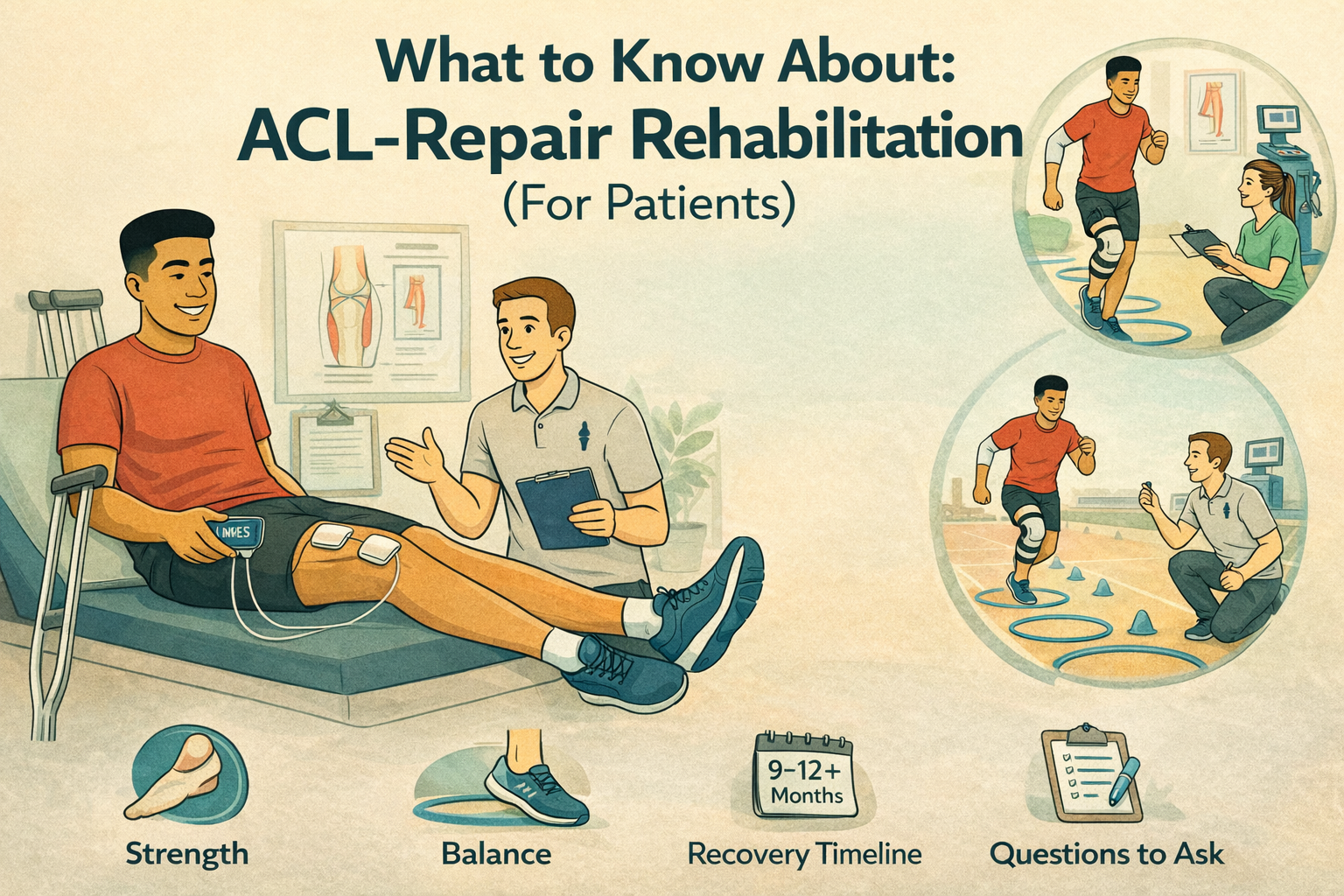
✨ Too Long Didn’t Read (TLDR) / Summary
Recovering from an ACL injury—especially after surgery—takes time, patience, and teamwork. Most people need 9–12 months or more before safely returning to sports or high-level activity, and rushing the process greatly increases the risk of re-injury.
Your recovery should be guided by how your knee is functioning, not just how many weeks it’s been. Strength, balance, movement quality, and confidence all matter. The most successful ACL recoveries happen when patients feel informed, heard, and actively involved in decisions—not pressured by timelines.
🧾 Condition-Specific General Information
What Is the ACL—and Why Does It Matter?
The ACL (anterior cruciate ligament) is a strong ligament inside your knee that helps keep it stable during movements like twisting, cutting, and jumping. When it’s torn, the knee can feel unstable, unpredictable, or unsafe—physically and emotionally.
An ACL injury doesn’t just affect sports. It can impact:
Work
Parenting
Confidence in daily movement
Mental health and identity
Your recovery plan should reflect your life and goals, not just imaging results.
Do All ACL Tears Need Surgery?
No. Some people—often called “copers”—can return to daily life or low-demand activities without surgery through structured rehabilitation alone.
Surgery is more commonly recommended if you:
Want to return to cutting or pivoting sports
Experience repeated knee instability
Have additional injuries (meniscus, cartilage)
This decision should feel shared, unrushed, and pressure-free.
💙 For Patients
🦿 What to Expect If You Have ACL Reconstruction Surgery
Early Symptoms After Surgery
It’s normal to experience:
Swelling and stiffness
Pain (usually well-managed with medication and movement)
Difficulty activating your quadriceps muscle
Fatigue and emotional ups and downs
If something feels off or worsening, you should always feel comfortable speaking up.
The Realistic Recovery Timeline
While everyone is different, here’s a general overview:
Weeks 0–6:
Focus on reducing swelling, restoring motion, and waking up the quad muscle.Months 2–4:
Building strength, balance, and control. Walking normally without a brace.Months 4–6:
Higher-level strengthening, light running (if criteria are met).Months 6–9+:
Jumping, agility, and sport-specific movements.9–12+ months:
Potential return to sport if strength, movement, and confidence are ready.
👉 Returning before 9 months can increase re-injury risk up to seven times.
💪 How to Know If Your Rehab Is Actually Progressing
Rehab shouldn’t feel random. You deserve to know why you’re doing what you’re doing.
Key things your care team should be monitoring:
Knee range of motion (can you fully bend and straighten?)
Quadriceps strength (often the biggest limiter)
Balance and control on one leg
How you jump, land, and change direction
Swelling and pain response to activity
Tools like neuromuscular electrical stimulation (NMES) may be used early on to help your quad muscle “reconnect” and strengthen faster.
🗣️ How to Advocate for Yourself During ACL Rehab
You are not being “difficult” by asking questions—you’re being responsible.
Important Questions to Ask Your Provider
“How does my strength compare to my other leg?”
“What tells us I’m not ready yet?”
“What movements put me at the highest risk right now?”
“What would waiting longer protect me from?”
“What should progress look like over the next month?”
If answers feel vague or rushed, it’s okay to ask for clarification.
Signs Your Rehab Is on the Right Track
✔ You understand why exercises are changing
✔ Progressions are based on performance, not just time
✔ Your provider checks how your knee responds between visits
✔ You feel encouraged—not pressured—to return faster
✔ Your concerns are taken seriously
🏃 What “Ready to Return” Really Means
Returning to activity isn’t just about being pain-free.
A well-rounded return-to-activity checklist often includes:
Full knee motion
Minimal or no swelling with activity
Walking and moving normally without a brace
Quadriceps strength within 10% of the other leg
Passing balance and hopping tests
Feeling confident and trusting your knee
Understanding your remaining risks
If one of these pieces is missing, slowing down is often the smartest move—not a failure.
❤️ Why the Conversation Matters as Much as the Exercises
Many patients ask, “When can I go back?”
But what they’re really asking is:
“Can I trust my knee?”
“Will this happen again?”
“Do you believe I’ll get there?”
The best rehab experiences feel like a partnership, not a countdown clock. You deserve providers who explain, listen, and support you through the uncertainty—not just push milestones.
🌱 The Takeaway
ACL recovery is not about proving toughness or beating a timeline.
It’s about rebuilding strength, confidence, and trust—step by step.
When you understand your rehab, ask questions, and feel supported, your chances of a safe, lasting recovery improve dramatically.
Be patient. Be kind.
You’re rebuilding. You can do this.
📚 Bibliography
Marom N, Xiang W, Wolfe I, et al. High variability and lack of standardization in the evaluation of return to sport after ACL reconstruction: a systematic review. Knee Surg Sports Traumatol Arthrosc. 2022;30(4):1369-1379.
Li Z, Jin L, Chen Z, et al. Effects of neuromuscular electrical stimulation on quadriceps femoris muscle strength and knee joint function after ACL surgery: a systematic review and meta-analysis. Orthop J Sports Med.2025;13(1):23259671241275071.
Rambaud AJM, Ardern CL, Thoreux P, Regnaux JP, Edouard P. Criteria for return to running after ACL reconstruction: a scoping review. Br J Sports Med. 2018;52(22):1437-1444.
Pamboris GM, Pavlou K, Paraskevopoulos E, Mohagheghi AA. Open vs closed kinetic chain exercises in ACL rehabilitation: a systematic review and meta-analysis. Front Sports Act Living. 2024;6:1416690.
Beischer S, Gustavsson L, Senorski EH, et al. Young athletes returning to sport before 9 months after ACL reconstruction have a rate of new injury 7 times higher. J Orthop Sports Phys Ther. 2020;50(2):83-90.
Cristiani R, Forssblad M, Edman G, Eriksson K, Stålman A. Age, time from injury to surgery, and quadriceps strength affect revision risk after ACL reconstruction. Knee Surg Sports Traumatol Arthrosc. 2021;29(12):4154-4162.