

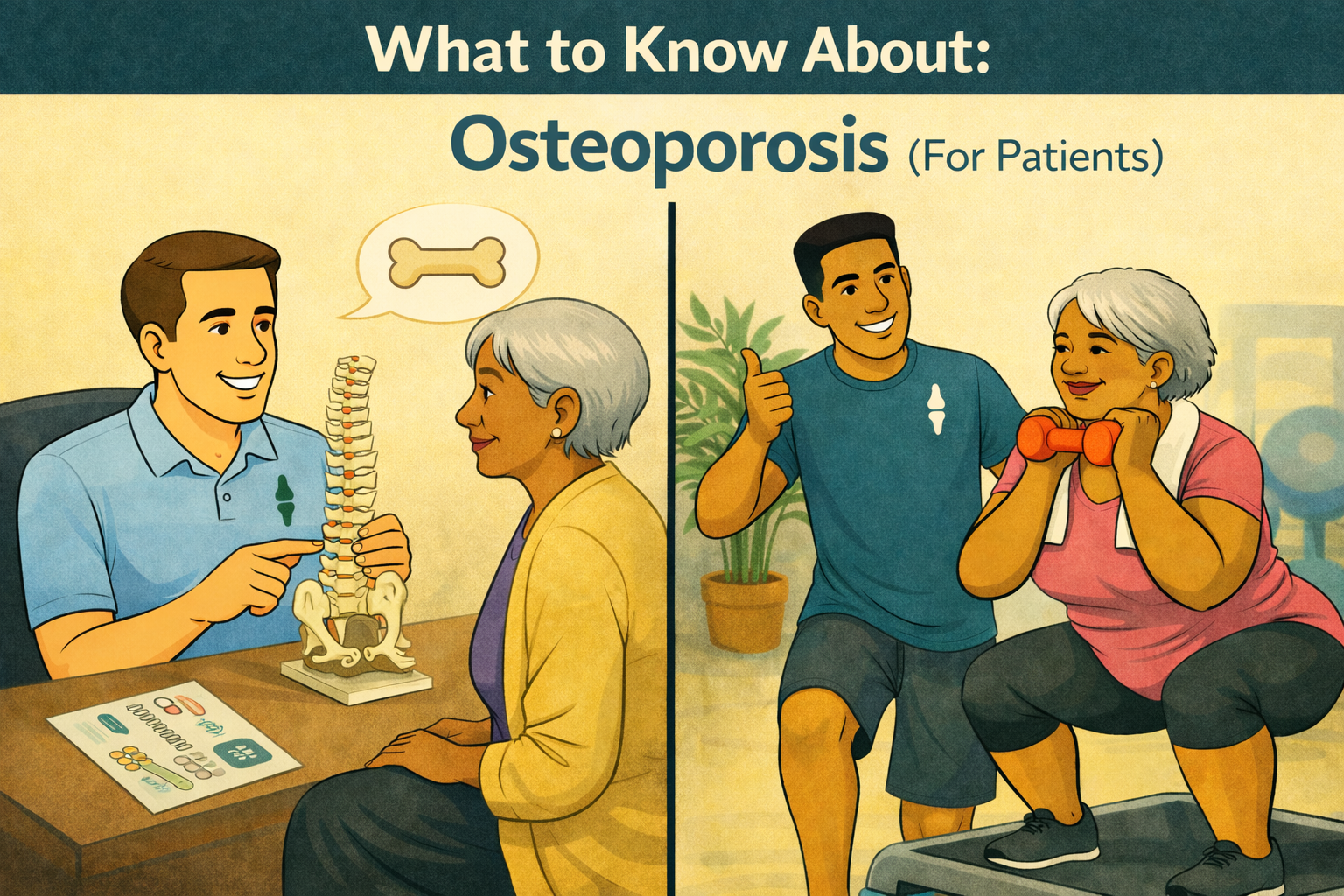
Osteoporosis is often called a “silent disease”—not because it isn’t serious, but because many people don’t realize they have it until a fracture happens. We’re here to change that.
We’ll walk through what osteoporosis is, how it’s diagnosed, what you can do about it, and—most importantly—how to talk about it with your healthcare provider so you feel informed, confident, and heard.
✨ Too Long Didn’t Read (TLDR) / Summary
Osteoporosis means bones are weaker and more likely to break—even from a simple fall.
You don’t need to have “severe” bone loss to be at risk—many fractures happen in people with osteopenia (mild bone loss).
A DXA scan and a fracture risk tool (FRAX) help estimate your risk.
Exercise, especially strength and balance training, matters—a lot. It helps reduce falls, which are often what lead to fractures.
Medications can help, but many people who need treatment never get it—often because the conversation never happens.
The goal isn’t fear. It’s prevention, confidence, and partnership.
If you remember one thing:
👉 A fracture after a small fall is not “just bad luck.” It’s information.
🧾 Condition-Specific General Information
What exactly is osteoporosis?
Osteoporosis is a condition where bones lose strength and density over time, making them more likely to fracture. After menopause, this process can speed up because estrogen—which helps protect bone—drops significantly.
Bones are living tissue. They’re constantly breaking down and rebuilding. With osteoporosis, breakdown happens faster than rebuilding.
Osteoporosis vs. Osteopenia: what’s the difference?
Bone density is usually measured with a DXA scan, which gives you a T-score:
Normal: −1.0 or higher
Osteopenia (low bone mass): between −1.0 and −2.5
Osteoporosis: −2.5 or lower
Here’s the part many people don’t hear clearly enough:
Most fractures actually happen in people with osteopenia, not osteoporosis.
Why? Because there are simply more people in that middle category. So if you’ve been told, “It’s just osteopenia,” that doesn’t automatically mean “no risk.”
What counts as an osteoporosis-related fracture?
A fragility fracture usually means a broken bone that happens from:
A fall from standing height
Minimal trauma (tripping, slipping, missing a step)
Common sites linked to osteoporosis include:
Hip
Spine
Wrist
Shoulder (upper arm)
Fractures of the hands, feet, or face are usually not considered osteoporosis-related.
Why fractures matter (beyond the bone)
Fractures can affect much more than X-rays. Fractures can lead to:
Pain and long recovery times
Loss of independence
Fear of movement or falling again
Changes in daily life and confidence
Hip fractures, in particular, can be life-changing. Many people never fully regain their prior level of independence. This is why prevention matters.
How is fracture risk estimated?
In addition to bone density, providers often use a tool called FRAX, which estimates your 10-year fracture risk based on factors like:
Age and sex
Weight
Prior fractures
Family history of hip fracture
Smoking or alcohol use
Certain medications (like steroids)
Other health conditions
In the U.S., treatment is often considered if FRAX determines:
Hip fracture risk ≥ 3%, or
Major fracture risk ≥ 20% over 10 years
You don’t need to memorize the numbers—but you should know whether your risk is considered low, moderate, high, or very high.
💙 For Patients
Questions to ask your provider (bring this list!)
Sometimes the hardest part is knowing what to ask. Try these:
“What is my actual fracture risk—not just my bone density?”
“Does my past fracture count as an osteoporosis fracture?”
“How does my FRAX score affect treatment decisions?”
“What kind of exercise is safe and helpful for me?”
“Should I be doing strength training—and how do I start safely?”
“Do my medications affect my bones?”
“What are the pros and cons of medication in my situation?”
“What’s our plan to prevent my next fracture?”
If something feels rushed or unclear, it’s okay to say:
“Can you explain that in a different way?”
That’s not a challenge—it’s good healthcare.
What you can do right now (even before your next appointment)
1. Move your body—on purpose
Exercise is one of the most powerful tools you have.
What helps most:
Strength training (especially legs, hips, and core)
Balance training (to reduce falls)
Functional movements (squats, sit-to-stands, step-ups)
Walking is great for general health—but it’s usually not enough by itself to protect bones or reduce fall risk.
If you’re nervous about exercise:
A physical therapist can help you move safely and confidently.
Exercises can always be modified.
2. Think “fall prevention,” not fear
Falls are often the trigger that turns bone weakness into a fracture.
Helpful steps:
Improve balance and leg strength
Review medications that may cause dizziness
Check vision and footwear
Make home changes (improve lighting, remove rugs, make sure stairs have handrails)
Preventing falls = preventing fractures.
3. Nutrition supports the plan (but isn’t the whole plan)
Calcium and vitamin D matter—but they’re not magic.
General guidance often includes:
Adequate calcium (ideally from food first)
Vitamin D if levels are low
Supplements should fit your diet, labs, and medical history. More isn’t always better. Check with a certified professional for specific recommendations for supplementation.
A note about medications
There are medications that can:
Slow bone breakdown
Build new bone
Reduce fracture risk significantly
But here’s the surprising part:
Many people who qualify for treatment never receive it — even after a fracture.
If you’ve had a fracture and no one has talked to you about bone health since, that’s a gap worth addressing.
Medication decisions should be:
Individualized
Discussed openly
Revisited over time
You’re allowed to ask, “Why should I take this medication or why not?”
Monitoring and follow-up: what to expect
Many people repeat a DXA scan 1–2 years after starting or changing treatment. This helps check whether the plan is working.
Important to know:
No treatment removes fracture risk completely
A plan can (and should) change if your situation changes
Bone health is a long-term conversation, not a one-time test
One last thought
Osteoporosis care works best when it’s shared.
Not just scans and scores—but conversations.
Not just prescriptions—but movement and confidence.
Not just avoiding fractures—but supporting the life you want to live.
📚 Citations
Subarajan P, Arceo-Mendoza RM, Camacho PM. Postmenopausal osteoporosis: a review of latest guidelines. Endocrinol Metab Clin North Am. 2024;53(4):497-512. doi:10.1016/j.ecl.2024.08.008
Walker MD, Shane E. Postmenopausal osteoporosis. N Engl J Med. 2023;389(21):1979-1991. doi:10.1056/NEJMcp2307353
Morin SN, Feldman S, Funnell L, et al. Clinical practice guideline for management of osteoporosis and fracture prevention in Canada: 2023 update. CMAJ. 2023;195:E1333-E1348.
Morin SN, Leslie WD, Schousboe JT. Osteoporosis: a review. JAMA. 2025;334(10):894-907. doi:10.1001/jama.2025.6003
Hartley GW, Roach KE, Nithman RW, et al. Physical therapist management of patients with suspected or confirmed osteoporosis: a clinical practice guideline from the Academy of Geriatric Physical Therapy. J Geriatr Phys Ther.2022;44(2):E106-E119. doi:10.1519/JPT.0000000000000346
Silverstein WK, Cantor N, Cheung AM. Postmenopausal osteoporosis. N Engl J Med. 2024;390(7):673-674. doi:10.1056/NEJMc2314624
This content drafted, researched, edited, and generated by:
McKinley Pollock, PT, DPT
McKinley Pollock, PT, DPT, OCS, CSCS is a physical therapist with a background in orthopedics and sports rehabilitation. Dr. Pollock earned his doctorate of physical therapy from Campbell University in 2021, is a board-certified orthopedic clinical specialist (OCS), and certified strength and conditioning specialist (CSCS). Dr. Pollock enjoys combining lessons learned from his DPT training and research, translating these into clinical practice. His passions include promoting relationships between patients & clinicians to promote clinical effectiveness, satisfaction, and efficiency, the implementation of primary preventative medicine into clinical practice, and leadership and education development.