

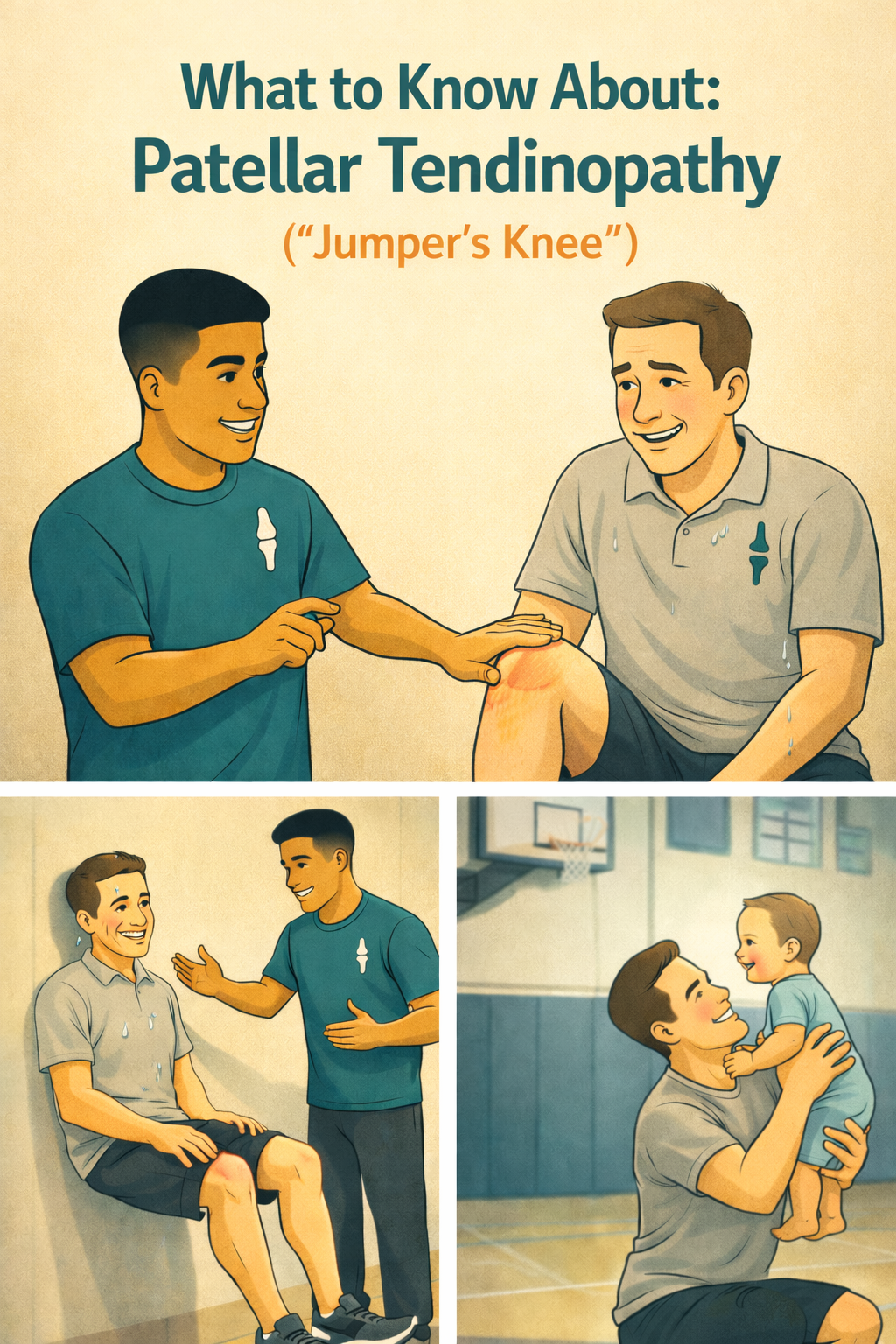
✨ Too Long Didn’t Read (TLDR) / Summary
What is it?
Patellar tendinopathy (often called jumper’s knee) is pain in the patellar tendon—the strong tissue that connects your kneecap to your shin bone. Pain is most often felt just below the kneecap and flares with activities like jumping, squatting, or stairs.
Common symptoms:
Pain right below the kneecap
Pain with squats, stairs, jumping, or quick direction changes
Stiffness, especially after rest
Feeling like the knee “warms up, then hurts later”
Recovery window:
Tendon healing can take months, not days. Many people improve over time with the right plan, but symptoms can last 6 months or longer without structured care.
Care focus:
Reduce painful activity just enough, then rebuild strength—especially the quadriceps (front thigh muscles)—using gradual, progressive exercise.
Prevention & performance:
Stronger thigh muscles help protect the knee and improve daily activities like stairs, squatting, and getting up from a chair.
🧾 Condition-Specific General Information
What’s happening in patellar tendinopathy?
Your patellar tendon helps transfer force from your thigh muscles to your lower leg. Every time you jump, land, squat, or go downstairs, this tendon helps absorb and release force.
Tendinopathy is a general term that means the tendon is irritated or overloaded. It can include:
Inflammation (irritation)
Degeneration (wear and tear)
Or a mix of both
This happens when the tendon is asked to do more work than it’s ready for, such as:
Repeated jumping or sprinting
Sudden increases in training or activity
Doing a lot of squats or stairs without enough recovery
Key signs that point to patellar tendinopathy
Pain is usually right on the tendon, just below the kneecap
Pain increases with springy or powerful movements
Imaging (like MRI or ultrasound) may help rule out other problems—but tendon changes can show up even in people without pain, so the diagnosis is mostly based on your story and exam
💡 Why Strength Keeps Showing Up in Research
Research across many age groups shows one clear theme:
Stronger thigh muscles = happier knees.
Teens with weaker thigh muscles have a higher risk of knee injuries
Older adults improve walking, stairs, and daily activities when they strengthen the quadriceps
Tendon rehab focuses on strength because strong muscles share the load
Plain-language translation:
If the quadriceps can’t help enough, the tendon does extra work—and gets sore.
Thus, you need strength in your quadriceps muscles to protect your knee.
That doesn’t mean more pain = more gain.
It means the right amount of exercise, at the right time.
💙 For Patients
👩⚕️ What to Expect From Care
It is OK to be worried and discouraged. People often ask common questions like:
“Is this tearing?”
“Do I need a scan?”
“Why does it feel okay while I’m working out, but worse later?”
“Why hasn’t rest fixed this?”
These are good questions. Your provider will need some specific information to answer these questions for you.
🔑 Key Education Points (In Simple Terms)
1) Your pain history matters
How long you’ve had pain and how strong it feels both affect strength and recovery. This helps guide how fast (or slow) we progress.
2) Imaging helps—but doesn’t decide everything
Scans can rule out other problems, but they don’t always explain pain. Your symptoms and movement matter most.
3) Exercise is the main treatment
Gentle, progressive strength training works better than rest alone.
Programs that slowly increase tendon load work better than exercise plans that only focus on lowering movements (eccentrics).⁴⁻⁷
4) Isometric exercises can help pain
Exercises where the muscle tightens without moving (like wall sits) can calm pain—but long-term improvement comes from progressive loading.
5) Common mistakes to avoid
Expecting quick fixes
Only using passive treatments (like massage or injections)
Avoiding movement for too long
Skipping strength work
❓ Common Patient Questions (Answered)
“Is my tendon inflamed?”
It might be irritated, worn down, or both. Either way, the goal is to slowly build strength and tolerance.
“Should I stop all activity?”
Usually no. We adjust activity—not eliminate it.
“Why does it feel better during exercise but worse later?”
Warm-up effects are common. How you feel 24 hours later helps guide progress.
“How long will this take?”
Many people improve over months. Some need 6 months or more, depending on goals.
“Do I need injections?”
Exercise is the foundation. Other treatments may help symptoms but shouldn’t replace movement.
“What are we strengthening—and why?”
Mostly the quadriceps, plus other leg muscles, to reduce stress on the tendon.
🗓️ Example Timeline (General Guide)
Weeks 0–2
Reduce painful activities
Start gentle strengthening or holds
Keep moving without pushing pain
Weeks 2–8
Build strength gradually
Track pain using a simple scale
Watch how the knee feels the next day
Weeks 8–16+
Add jumping, running, or sport-specific drills
Progress only when strength and pain allow
Return to sport/work
Gradual return with confidence and clear goals
🤝 The Joint Connection Approach
Recovery is a partnership.
It is key for your provider to explain why you’re doing each step.
To listen to frustration.
To focus on progress—not perfection.
Equipped with the information and questions above, YOU can empower yourself to take charge at your next visit.
📚 Bibliography
Kim S, Park J. Influence of severity and duration of anterior knee pain on quadriceps function and self-reported function. Journal of Athletic Training. 2022;57(8):771-779. PubMed
Rosen AB, Wellsandt E, Nicola M, Tao MA. Clinical management of patellar tendinopathy. J Athl Train. 2022;57(7):621-631. PubMed
Malliaras P, Cook J, Purdam C, Rio E. Patellar tendinopathy: Clinical diagnosis, load management, and advice for challenging case presentations. J Orthop Sports Phys Ther. 2015;45(11):887-898. PubMed
Figueroa D, Figueroa F, Calvo R. Patellar tendinopathy: Diagnosis and treatment. J Am Acad Orthop Surg. 2016;24(12):e184-e192. PubMed
Breda SJ, Oei EHG, Zwerver J, Visser E, Waarsing E, Krestin GP, de Vos RJ. Effectiveness of progressive tendon-loading exercise therapy in patients with patellar tendinopathy: a randomised clinical trial. Br J Sports Med. 2021;55(9):501-509. PubMed
Rich A, Cook JL, Hahne AJ, Rio EK, Ford J. Randomised, cross-over trial on the effect of isotonic and isometric exercise on pain and strength in proximal hamstring tendinopathy: trial protocol. BMJ Open Sport Exerc Med. 2021;7(1):e000954. PubMed
Followay B, Holland T, Rowley L. Effects of a quadricep-dominant vs. functional training program on activities of daily living, functional performance, and motor unit recruitment in older adults. Int J Exerc Sci. 2025;18(8):1096. PMC