

✨ Too Long Didn’t Read (TL;DR) / Summary
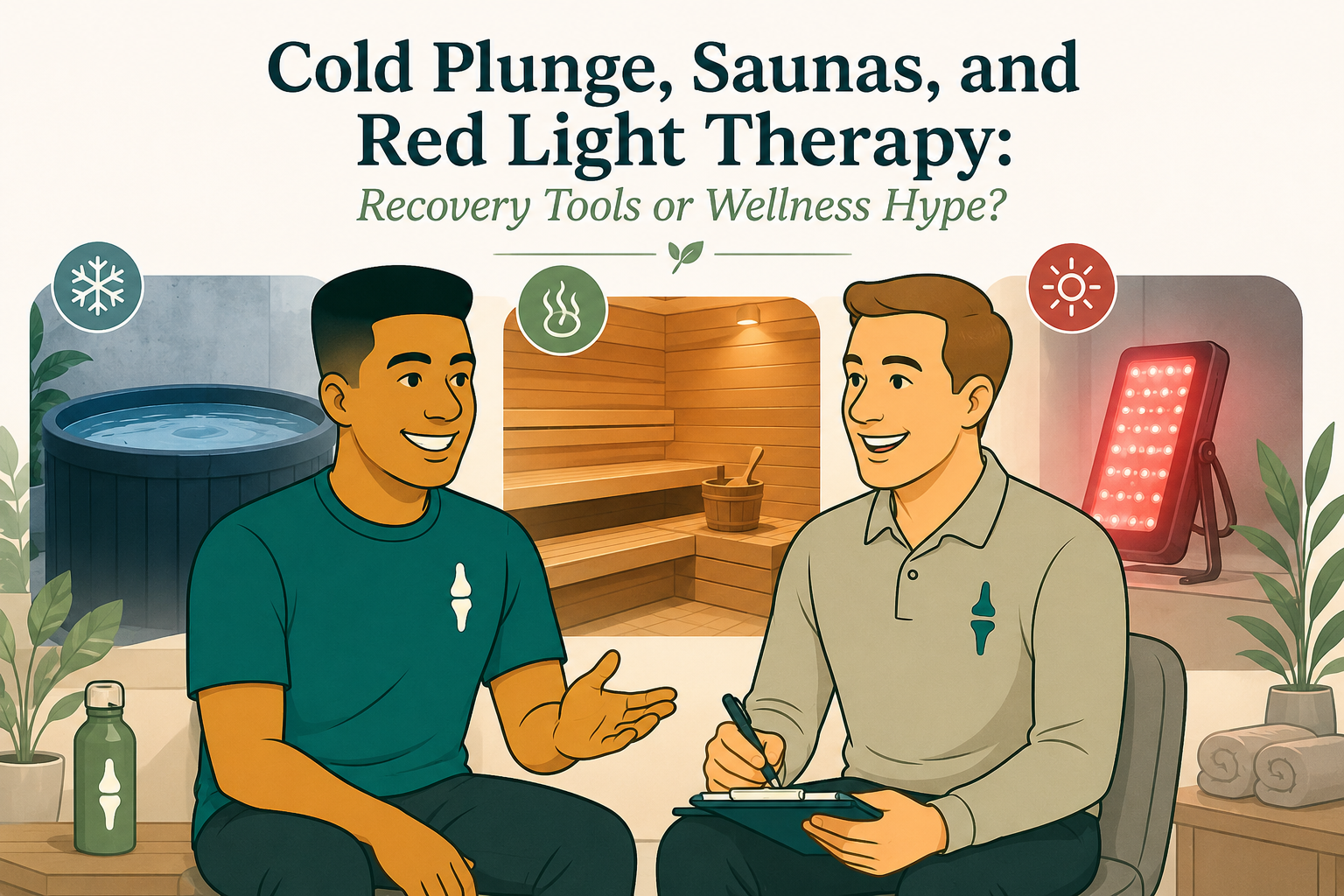
Cold plunges, saunas, and red light therapy are popular recovery tools—but they are not magic buttons.
Patients are already asking about these modalities in clinic: benefits, risks, necessity, and more. Physical therapists need to be have a basic understanding of the patient’s goals and purpose of these modalities before providing recommendations.
What are patients trying to recover from?
Is this safe for the patients’ health history?
Is it helping the patient move, sleep, train, or feel better?
Is it replacing something more important, like progressive loading, sleep, nutrition, or medical care?
Current evidence suggests:
Cold plunge may help short-term soreness, perceived recovery, stress, and mood, but evidence is still evolving and responses vary based on timing, temperature, and frequency.
Sauna bathing is associated with cardiovascular and wellness benefits, especially in Finnish sauna literature, though many studies are observational.
Red light therapy / photobiomodulation (PBM) may improve pain and function in some tendinopathy cases, particularly when combined with exercise but more research is still needed.
Physical therapists can discuss these tools within wellness, recovery, education, and movement-focused care while remaining within professional and jurisdictional scope of practice.
🧾 General Information
1. Cold Plunge
Cold-water immersion generally involves partial or full-body immersion in cold water around 10–15°C (50–59°F).
Patients commonly use cold plunges for:
Post-exercise soreness
Recovery perception
Mood regulation
Stress management
Mental resilience
Sleep and wellness routines
The clinical conversation should sound less like:
“Cold plunge fixes recovery.”
And more like:
“Let’s figure out what your body is recovering from and whether cold exposure fits safely into your bigger plan.”
Research suggests cold-water immersion may positively influence inflammation, sleep, stress, immune response, and overall wellness, but evidence quality remains variable and more randomized controlled trials are needed.
PT Clinical Pearl
Cold plunges may help athletes feel less sore after training, but some research reports that frequent use immediately after resistance training may actually blunt desired strength and hypertrophy adaptations.
When to Refer or Use Caution
Cold-water immersion can rapidly increase heart rate, breathing rate, and blood pressure.
Patients should discuss cold plunge use with a physician, cardiologist, pharmacist, or other provider if they have:
Cardiovascular disease
Uncontrolled hypertension
Arrhythmias
History of syncope
Pregnancy
Peripheral vascular disease
Raynaud’s phenomenon
Diabetes with neuropathy
Medication concerns involving blood pressure or circulation
2. Sauna Therapy
Sauna bathing creates a controlled heat stress response that many patients associate with relaxation, recovery, stress reduction, and improved wellness habits.
Research has associated regular sauna use with potential benefits related to:
Cardiovascular health
Blood pressure regulation
Stress reduction
Recovery perception
Respiratory health
Keep in mind, most long-term health data are observational, meaning sauna use may be associated with healthier outcomes; however, none of these studies have actually been able to prove direct causation.
PT Clinical Pearl
For many patients, the greatest benefit of sauna use may not be physiological optimization—it may be creating intentional recovery routines that improve stress management, sleep consistency, and body awareness.
Conversation Example
“Sauna may support recovery and wellness, especially if it helps you relax and sleep better. Let’s make sure it fits safely into your medical history and rehab plan.”
When to Refer or Use Caution
Patients should consult a physician before sauna use if they have:
Unstable cardiovascular disease
Recent cardiac events
Heat intolerance
Kidney disease
Pregnancy concerns
Uncontrolled blood pressure
Medications affecting hydration or thermoregulation
PTs should also educate patients that dizziness, dehydration, and overheating are warning signs—not achievements.
3. Red Light Therapy / Photobiomodulation
Red light therapy (RLT), also called photobiomodulation (PBM), low-level laser therapy, or low-level light therapy, uses red or near-infrared light to create biological effects in tissue.
Patients frequently ask about red light therapy for:
Pain reduction
Tendinopathy
Skin health
Recovery
Inflammation
Performance recovery
Current evidence suggests PBM may improve pain and function in tendinopathy, especially when combined with exercise-based rehabilitation.
Importantly:
Exercise remains the primary intervention.
PBM should be viewed as a possible adjunct—not a replacement—for progressive loading, education, and functional rehabilitation.
Evidence Highlights
A systematic review and meta-analysis by Tripodi et. al involving 17 trials and 835 participants found:
PBM plus exercise improved pain and function more than sham treatment plus exercise
Evidence quality ranged from very low to moderate
PBM alone demonstrated mixed outcomes depending on comparison groups
Patient Education Matters
The Cleveland Clinic notes that red light therapy remains an emerging treatment area with promising but still developing evidence.
That nuance matters.
Patients deserve balanced conversations that avoid exaggerated claims while still acknowledging potential benefits.
PT Clinical Pearl
If a patient says:
“I saw this on social media and everyone says it works.”
That is an opportunity for relationship-centered education—not dismissal.
When to Refer or Use Caution
Patients should consult another provider if they have:
Active cancer
Suspicious skin lesions
Photosensitive disorders
Retinal or eye concerns
Photosensitizing medications
Pregnancy concerns
New or unexplained symptoms
Pharmacists can be especially helpful when evaluating medication-related photosensitivity risks.
👩⚕️ For Providers 👨⚕️
Stay in the PT lane—but do not avoid the conversation
Patients are already asking about cold plunges, saunas, and red light therapy. If we do not help them think critically, the algorithm will.
Physical therapists can support patients by:
Screening for red flags and contraindications
Asking what outcome the patient wants
Connecting recovery tools to function
Reinforcing sleep, load management, nutrition, and progressive exercise
Referring when medical risk is outside PT scope
Avoiding exaggerated claims
The American Physical Therapy Association (APTA) supports the PT role in prevention, wellness, fitness, health promotion, and management of disease and disability. PT scope is also influenced by professional, jurisdictional, and personal scope, so clinicians should follow their state practice act and employer policies.
The Joint Connection clinical framing
Try this simple script:
“These tools may have a role, but they are not the plan by themselves. Let’s look at your goals, your health history, your training load, your symptoms, and your recovery habits. Then we can decide whether this supports your progress—or distracts from it.”
That is the real recovery modality: better conversation.
Key Clinical Takeaways
Recovery modalities should support—not replace—progressive loading, movement, sleep, nutrition, hydration, and patient education.
Cold-water immersion may improve perceived recovery and soreness, but frequent use immediately after resistance training may blunt strength and hypertrophy adaptations.
Sauna bathing may support cardiovascular wellness, stress management, and recovery routines, though much of the long-term evidence is observational.
Red light therapy / photobiomodulation may help pain and function in tendinopathy when combined with exercise-based rehabilitation.
Patient goals matter more than trends. Ask:
“What are you hoping this helps with?”
“What outcomes are you noticing?”
“Does this improve your function?”
Physical therapists should screen for contraindications and red flags before discussing these modalities.
Refer patients to physicians, pharmacists, or specialists when cardiovascular risk, medication interactions, pregnancy concerns, photosensitivity, or systemic symptoms are present.
Scope matters. PTs can discuss wellness, recovery, exercise, and education while remaining within state practice acts and employer policies.
Avoid overpromising outcomes. Current evidence for many wellness modalities remains mixed, emerging, or population-specific.
The therapeutic alliance remains the most important recovery tool:
listening,
shared decision-making,
patient education,
and individualized care planning.
Social media popularity does not equal clinical effectiveness—but it does create opportunities for meaningful patient conversations.
The best clinical question is often:
“How does this fit into the bigger picture of your recovery and health?”
📂 Supplemental Information / Citations
Cain T, Brinsley J, Bennett H, Nelson M, Maher C, Singh B. Effects of cold-water immersion on health and wellbeing: a systematic review and meta-analysis. PLoS One. 2025;20(1). doi:10.1371/journal.pone.0317615.
Kunutsor SK, Laukkanen JA. Does the combination of Finnish sauna bathing and other lifestyle factors confer additional health benefits? A review of the evidence. Mayo Clin Proc. 2023;98(6):915-926. doi:10.1016/j.mayocp.2023.01.008.
Patrick RP, Johnson TL. Sauna use as a lifestyle practice to extend healthspan. Exp Gerontol. 2021;154:111509. doi:10.1016/j.exger.2021.111509.
Tripodi N, Feehan J, Husaric M, Sidiroglou F, Apostolopoulos V. The effect of low-level red and near-infrared photobiomodulation on pain and function in tendinopathy: a systematic review and meta-analysis of randomized control trials. BMC Sports Sci Med Rehabil. 2021;13(1):91. doi:10.1186/s13102-021-00306-z.
American Physical Therapy Association. Physical therapists’ role in prevention, wellness, fitness, health promotion, and management of disease and disability. Published September 20, 2019.
American Physical Therapy Association. Scope of practice.
American Heart Association. You’re not a polar bear: the plunge into cold water comes with risks. Published December 9, 2022.
Cleveland Clinic. Red Light Therapy: Benefits, Side Effects & Uses. Published December 1, 2021. Accessed June 9, 2026. https://my.clevelandclinic.org/health/articles/22114-red-light-therapy
This content drafted, researched, edited, and generated by:
McKinley Pollock, PT, DPT
McKinley Pollock, PT, DPT, OCS, CSCS is a physical therapist with a background in orthopedics and sports rehabilitation. Dr. Pollock earned his doctorate of physical therapy from Campbell University in 2021, is a board-certified orthopedic clinical specialist (OCS), and certified strength and conditioning specialist (CSCS). Dr. Pollock enjoys combining lessons learned from his DPT training and research, translating these into clinical practice. His passions include promoting relationships between patients & clinicians to promote clinical effectiveness, satisfaction, and efficiency, the implementation of primary preventative medicine into clinical practice, and leadership and education development.
© 2026 The Joint Connection Company. All rights reserved.
The content on this website, including all text, graphics, and materials, is the exclusive property of The Joint Connection Company and is protected by applicable copyright and intellectual property laws. No part of this site may be reproduced, distributed, or used without prior written permission.