

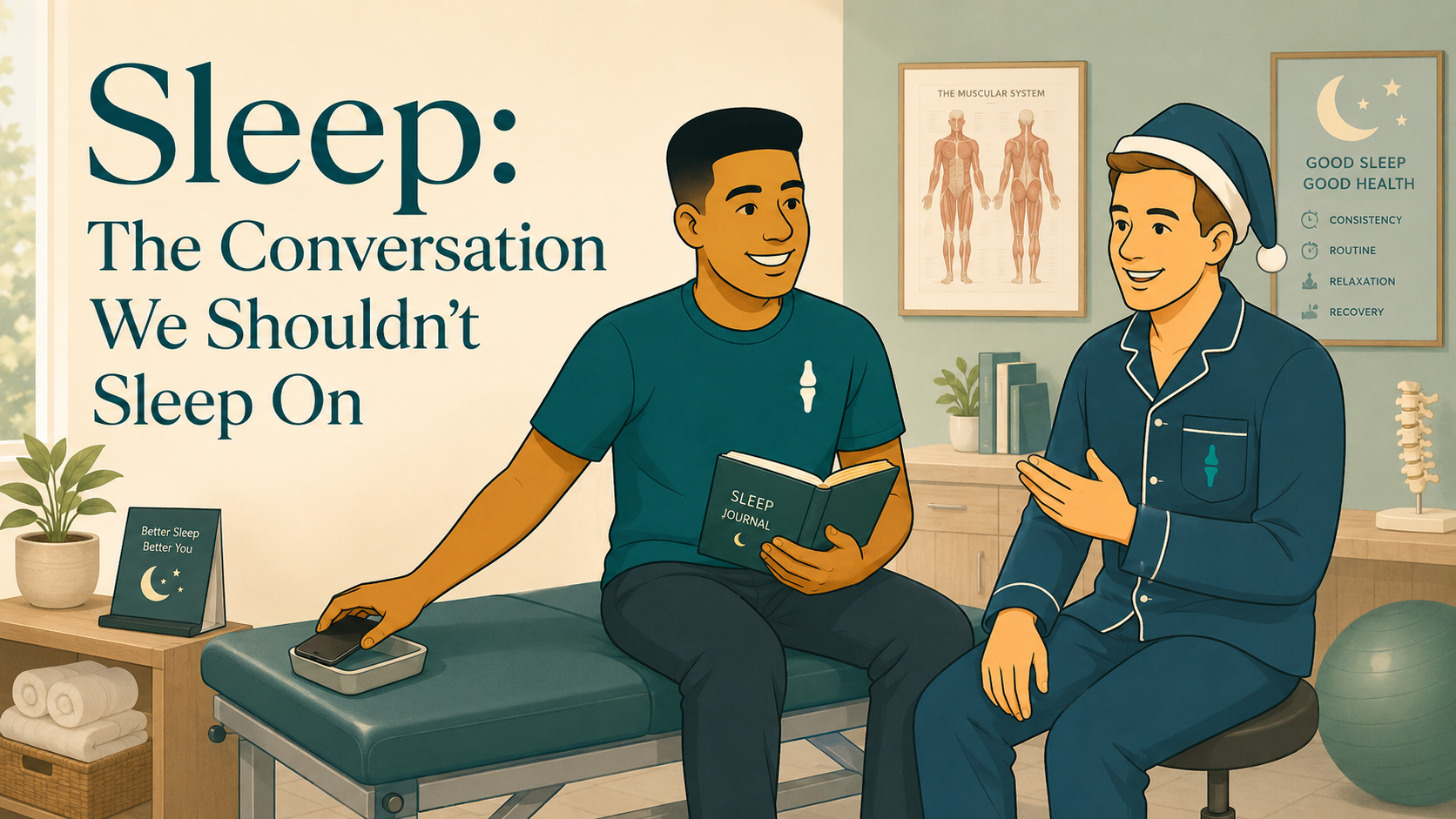
Sleep is one of those topics patients often bring into the clinic quietly.
Sometimes it sounds like, “I’m just tired.”
Sometimes it sounds like, “My pain is worse at night.”
Sometimes it shows up as poor recall, low motivation, irritability, delayed recovery, or a patient who simply cannot seem to tolerate the plan of care.
And sometimes, all it takes is one question:
“How have you been sleeping?”
For healthcare providers, especially physical therapists and rehabilitation professionals, sleep is not a side conversation. It is connected to pain, tissue healing, immune function, cognition, mood, motor learning, physical activity, function, and overall well-being. The American Physical Therapy Association recognizes physical therapists as part of the interdisciplinary team involved in screening for sleep dysfunction, educating patients about healthy sleep behaviors, addressing impairments that interfere with sleep, and referring to sleep medicine professionals when appropriate.
That does not mean every provider becomes a sleep specialist. It means we become better listeners.
Because when sleep is suffering, the person in front of us may not just need another exercise. They may need a better conversation.
✨ Too Long Didn’t Read (TL;DR) / Summary
Sleep is a key part of recovery, pain management, learning, emotional regulation, and overall health. Adults generally need at least 7 hours of sleep per night, though sleep needs vary by age. Poor sleep quality may show up as difficulty falling asleep, waking often, feeling tired despite enough time in bed, increased pain sensitivity, reduced attention, impaired memory, and reduced ability to learn new motor skills.
Within physical therapy and rehabilitation practice, providers can screen for sleep concerns, educate patients on healthy sleep behaviors, consider positioning and mobility barriers, support appropriate exercise, and refer when symptoms suggest a possible sleep disorder such as insomnia, restless legs syndrome, narcolepsy, or sleep apnea.
A practical provider takeaway:
Ask. Listen. Educate. Adapt. Refer when needed.
Sleep health is not just about bedtime. It is about trust, safety, recovery, and helping patients feel seen.
🧾 General Information
What Is Sleep Health?
Sleep health includes both sleep quantity and sleep quality.
Sleep quantity refers to how much sleep a person gets. According to the CDC, adults ages 18–60 should get 7 or more hours of sleep per night. Adults ages 61–64 should get 7–9 hours, and adults 65 and older should get 7–8 hours. See the table below for a good outline.
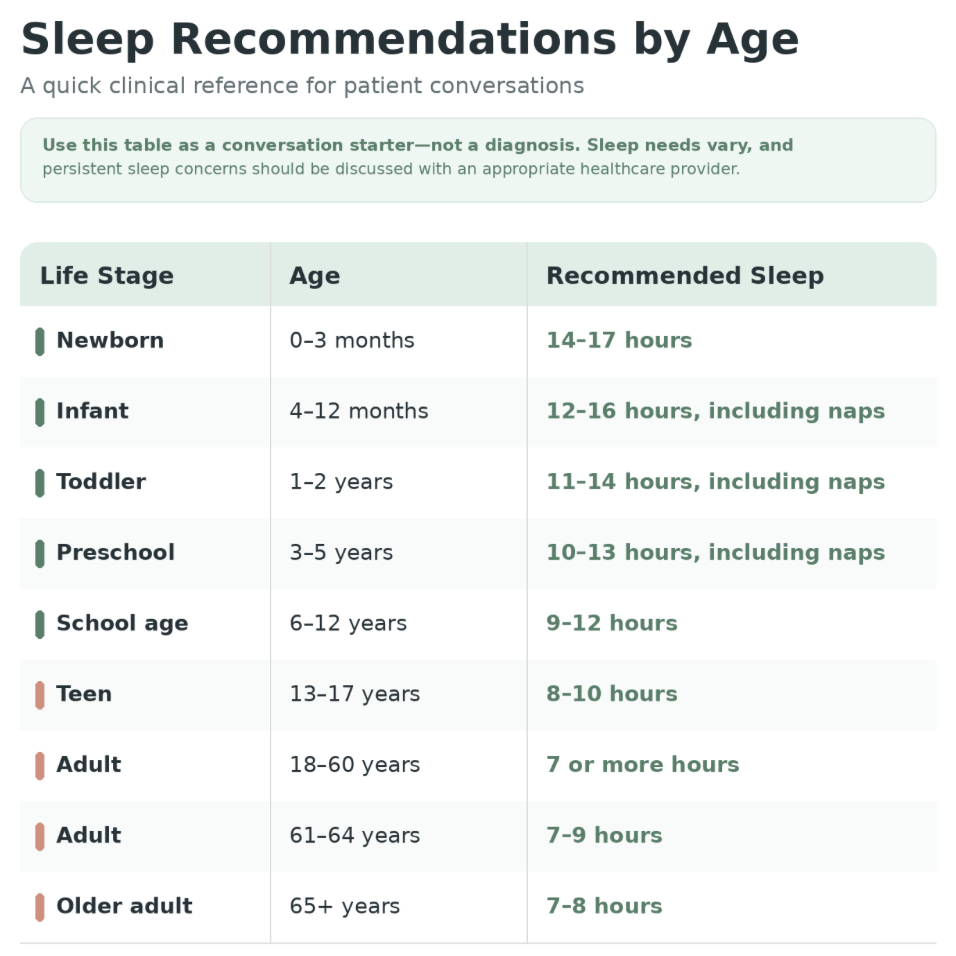
Sleep quality refers to how restorative sleep feels. A person may spend enough time in bed but still experience poor sleep quality if they wake frequently, have trouble falling asleep, or feel tired despite sleeping.
Good sleep supports:
Immune function
Tissue healing
Pain modulation
Cardiovascular health
Metabolism
Cognition
Memory
Motor learning
Emotional well-being
In plain language:
Sleep helps the body repair, the brain organize, and the nervous system settle.
Why Sleep Matters in Pain and Rehabilitation
Many patients seeking physical therapy or rehabilitation are not only dealing with pain, stiffness, weakness, or mobility limitations. They are also dealing with the emotional load of not sleeping well.
Poor sleep can increase pain perception, reduce function, decrease quality of life, worsen attention, impair memory, and reduce the ability to learn new motor skills. That matters in rehab because so much of what we ask patients to do requires learning, consistency, confidence, and trust.
If a patient is exhausted, the home exercise program may feel overwhelming.
If a patient is sleeping poorly, pain may feel louder.
If a patient is anxious at bedtime, their nervous system may never fully power down.
This is where skilled communication becomes part of skilled care.
Instead of asking only, “Did you do your exercises?” we can ask:
“What gets in the way of doing them?”
“How does your pain behave at night?”
“What position feels safest or most comfortable?”
“When you wake up, do you feel restored?”
Those questions open the door to better clinical reasoning and a stronger therapeutic relationship.
Common Sleep Concerns Providers May Hear
Patients may describe sleep concerns in many ways:
“I can’t fall asleep.”
“I wake up every hour.”
“My pain spikes when I lie down.”
“I feel tired even after sleeping.”
“My partner says I snore.”
“My legs feel restless at night.”
“I’m afraid to move in bed.”
“I can’t get comfortable.”
“I wake up stiff.”
“I dread bedtime.”
The CDC lists common sleep disorders including insomnia, restless legs syndrome, narcolepsy, and sleep apnea. Providers should not diagnose these conditions unless it is within their professional scope and jurisdiction. However, providers can screen, document concerns, educate appropriately, and refer to a physician, sleep medicine professional, or other qualified provider when indicated.
Sleep Hygiene: Helpful, But Not Always Simple
Sleep hygiene refers to habits and environmental factors that support better sleep. Common recommendations include:
Going to bed and waking up at consistent times
Keeping the bedroom quiet, dark, relaxing, and cool
Turning off electronic devices at least 30 minutes before bedtime
Avoiding large meals, alcohol, and caffeine close to bedtime
Exercising regularly
Maintaining a healthy diet
These are helpful recommendations, but providers should avoid making sleep hygiene sound easy for everyone.
Some patients work night shifts.
Some share a room.
Some live in noisy environments.
Some are caregivers.
Some are managing trauma, financial strain, chronic pain, or unsafe housing.
That is why the most compassionate version of sleep education sounds less like:
“Just fix your routine.”
And more like:
“Let’s look at what is realistic in your life right now.”
Even one small change can matter.
Movement, Exercise, and Sleep
Exercise may support sleep quality, especially when it is appropriately prescribed and matched to the patient’s health status, goals, and tolerance. Research suggests that aerobic exercise, strengthening exercise, and combined exercise programs may improve subjective sleep quality in some populations, including older adults and people with chronic pain, though more research is needed to determine which interventions work best for specific patients.
From a physical therapy perspective, this is not about telling every patient to “exercise more.” It is about clinical reasoning.
For one patient, better sleep may start with gentle mobility before bed.
For another, it may involve daytime walking.
For another, it may involve progressive strengthening.
For another, it may mean modifying pain-provoking evening activities.
The best plan is the one the patient understands, believes in, and can actually do.
👩⚕️ For Providers 👨⚕️
Sleep Screening Is a Relationship Skill
Sleep screening does not need to feel like an interrogation. It can feel like care.
Try opening with:
“Sleep can have a big impact on pain, healing, energy, and how well your body responds to rehab. Would it be okay if I ask a few quick questions about your sleep?”
This does three things:
It explains why sleep matters.
It asks permission.
It makes the conversation collaborative.
That tone matters. Patients may feel embarrassed, frustrated, or hopeless about sleep. A calm, nonjudgmental approach can help them share more honestly.
Simple Sleep Questions to Add to Your Evaluation
Consider adding these questions when clinically appropriate:
Sleep quantity
“About how many hours of sleep do you usually get?”
“Is that typical for you?”
Sleep quality
“Do you wake up feeling rested?”
“Do you wake often during the night?”
Pain and positioning
“Does pain affect your ability to fall asleep or stay asleep?”
“What sleeping positions feel better or worse?”
“Do you have trouble rolling, getting in or out of bed, or finding support?”
Daytime impact
“Do you feel sleepy during the day?”
“Does fatigue affect your activity, work, mood, or exercises?”
Referral indicators
“Has anyone told you that you snore, gasp, or stop breathing during sleep?”
“Do you have restless or uncomfortable sensations in your legs at night?”
“Have you talked with your medical provider about your sleep?”
These questions can help identify whether sleep is affecting function, participation, safety, and treatment response.
What Physical Therapists Can Do Within Scope
The American Physical Therapy Association (APTA) position on sleep health states that physical therapists are part of an interdisciplinary team involved in prevention and management of sleep impairments and promotion of healthy sleep behaviors. The physical therapist’s role includes screening for sleep dysfunction, identifying impairments related to sleep dysfunction, implementing interventions that address impairments interfering with sleep, educating patients and providers, monitoring sleep quality and quantity when indicated, and referring to sleep medicine professionals as appropriate.
Within PT scope, this may include:
Screening for sleep concerns
Educating on the relationship between sleep, pain, activity, function, and well-being
Addressing pain-limited positioning
Teaching bed mobility strategies
Recommending supportive positioning options
Prescribing appropriate therapeutic exercise
Supporting relaxation or down-regulation strategies when within training and scope
Coordinating with the broader healthcare team
Referring when symptoms suggest a possible sleep disorder or medical concern
Physical therapists should follow applicable state practice acts, payer rules, facility policies, and referral requirements. Providers should avoid diagnosing sleep disorders unless it is within their professional scope and jurisdiction.
Red Flags and Referral Considerations
Refer to a physician, sleep medicine professional, or appropriate healthcare provider when a patient reports symptoms that may suggest a sleep disorder or medical concern, such as:
Loud snoring with gasping or witnessed pauses in breathing
Excessive daytime sleepiness
Falling asleep while driving or during daily activities
Persistent insomnia
Restless legs symptoms that disrupt sleep
Sudden sleep attacks
Sleep concerns associated with significant anxiety, depression, trauma, or safety concerns
Sleep disruption that is worsening, unexplained, or not responding to basic education
Medication-related concerns
Symptoms outside your professional scope
A helpful phrase:
“This sounds important enough that I’d like your medical provider to take a closer look. I can still help with positioning, movement, and pain-related barriers, but I don’t want us to miss something that needs medical evaluation.”
That sentence protects scope while strengthening trust.
How to Talk About Sleep Without Sounding Judgmental
Patients often already know they “should sleep more.” What they need is not a lecture. They need partnership.
Instead of saying:
“You need better sleep hygiene.”
Try:
“Your sleep environment and routine may be influencing how your nervous system settles at night. Would you like to look at one small change that feels realistic this week?”
Instead of:
“Stop using your phone before bed.”
Try:
“Screens can make it harder for the brain to wind down. What would feel doable: dimming the screen, setting a 30-minute cutoff, or moving the phone across the room?”
Instead of:
“You should exercise more.”
Try:
“Let’s find the amount and timing of movement that helps your body feel better without flaring symptoms before bed.”
The goal is not perfection.
The goal is progress with dignity.
A Provider-Friendly Sleep Conversation Framework
Use the SLEEP framework:
S — Start with permission
“Would it be okay if we talk about sleep for a minute?”
L — Listen for barriers
Pain, stress, caregiving, shift work, environment, fear of movement, medications, mood, breathing concerns.
E — Educate simply
“Sleep affects pain sensitivity, healing, attention, and how well the body learns movement.”
E — Experiment with one change
Pick one realistic strategy: positioning, routine, light exposure, activity timing, relaxation, or referral.
P — Partner and plan
“Let’s try this for one week and see what changes, if anything.”
This keeps the conversation short, compassionate, and clinically useful.
Clinical Documentation Ideas
When sleep affects function or plan of care, document it clearly.
Example:
Patient reports sleeping 4–5 hours/night with frequent waking due to right shoulder pain. Reports increased morning stiffness and difficulty completing home exercise program due to fatigue. Provided education on sleep positioning, pillow support, and symptom monitoring. Recommended patient discuss persistent sleep disruption with primary care provider. Will reassess sleep-related functional barriers next visit.
Documentation should reflect your scope, clinical reasoning, education provided, patient response, and referral recommendations when appropriate.
Equity Matters in Sleep Health
Sleep recommendations should be realistic and culturally responsive. Not every patient has access to a quiet bedroom, a consistent work schedule, childcare support, a safe home environment, or control over nighttime noise and light.
Providers can ask:
“What parts of your sleep routine are actually within your control right now?”
That question respects the patient’s lived experience. It also helps the provider avoid giving advice that sounds helpful in theory but impossible in practice.
Connection comes from understanding the person, not just correcting the habit.
Key Clinical Takeaways
Sleep is essential for physical health, emotional well-being, cognition, memory, immune function, and recovery.
Poor sleep may contribute to increased pain perception, reduced function, decreased quality of life, impaired attention, and reduced motor learning.
Physical therapists can screen for sleep dysfunction, educate patients, address impairments that interfere with sleep, monitor sleep quality and quantity when indicated, and refer appropriately.
Exercise and physical therapy interventions may improve sleep quality in some populations, including older adults and individuals with chronic pain, but evidence varies by intervention type and patient characteristics.
Providers should stay within professional scope and state jurisdiction, avoiding diagnosis of sleep disorders unless appropriately licensed and trained to do so.
Sleep conversations should be compassionate, practical, and patient-centered.
📂 Supplemental Information / Citations
Wojciechowski M. A good night’s sleep: PTs’ role in patients’ sleep health. APTA Magazine. Published May 2021. Accessed June 1, 2026. https://www.apta.org/apta-magazine/archive/2021/05/01/a-good-nights-sleep-pts-role-in-patients-sleep-health
American Physical Therapy Association. Role of the physical therapist and APTA in sleep health. Published August 20, 2020. Accessed June 1, 2026. https://www.apta.org/apta-and-you/leadership-and-governance/policies/role-pt-apta-sleep-health
American Physical Therapy Association. Let’s talk about sleep. Published October 28, 2021. Accessed June 1, 2026. https://www.apta.org/fit-for-practice/restoration/lets-talk-about-sleep
Centers for Disease Control and Prevention. About sleep. Published May 15, 2024. Accessed June 1, 2026. https://www.cdc.gov/sleep/about/index.html
Baranwal N, Yu PK, Siegel NS. Sleep physiology, pathophysiology, and sleep hygiene. Prog Cardiovasc Dis. 2023;77:59-69. doi:10.1016/j.pcad.2023.02.005
Calvo S, González C, Lapuente-Hernández D, Cuenca-Zaldívar JN, Herrero P, Gil-Calvo M. Are physical therapy interventions effective in improving sleep in people with chronic pain? A systematic review and multivariate meta-analysis. Sleep Med. 2023;111:70-81. doi:10.1016/j.sleep.2023.09.008
Navarro-Ledesma S, Hamed-Hamed D, Gonzalez-Muñoz A, Pruimboom L. Impact of physical therapy techniques and common interventions on sleep quality in patients with chronic pain: a systematic review. Sleep Med Rev. 2024;76:101937. doi:10.1016/j.smrv.2024.101937
Coren S. Sleep health and its assessment and management in physical therapy practice: the evidence. Physiother Theory Pract. 2009;25(5-6):442-452. doi:10.1080/09593980902835351
Centers for Disease Control and Prevention. Sleep and health. Published July 2, 2024. Accessed June 1, 2026. https://www.cdc.gov/physical-activity-education/staying-healthy/sleep.html
This content drafted, researched, edited, and generated by:
McKinley Pollock, PT, DPT
McKinley Pollock, PT, DPT, OCS, CSCS is a physical therapist with a background in orthopedics and sports rehabilitation. Dr. Pollock earned his doctorate of physical therapy from Campbell University in 2021, is a board-certified orthopedic clinical specialist (OCS), and certified strength and conditioning specialist (CSCS). Dr. Pollock enjoys combining lessons learned from his DPT training and research, translating these into clinical practice. His passions include promoting relationships between patients & clinicians to promote clinical effectiveness, satisfaction, and efficiency, the implementation of primary preventative medicine into clinical practice, and leadership and education development.
© 2026 The Joint Connection Company. All rights reserved.
The content on this website, including all text, graphics, and materials, is the exclusive property of The Joint Connection Company and is protected by applicable copyright and intellectual property laws. No part of this site may be reproduced, distributed, or used without prior written permission.