

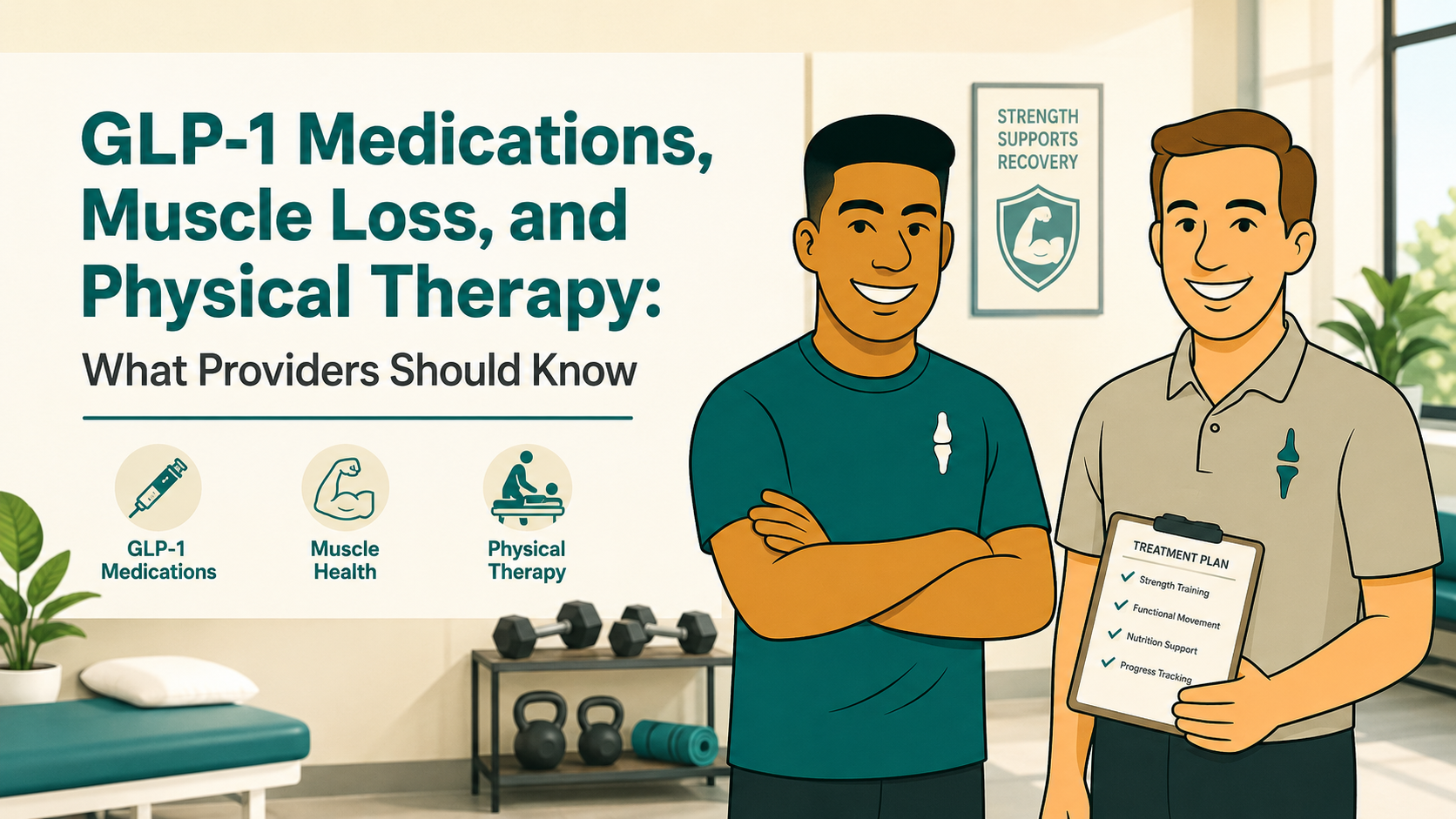
A professional, illustrated blog title image featuring two smiling healthcare providers standing in a bright, modern physical therapy clinic. The title reads, “GLP-1 Medications, Muscle Loss, and Physical Therapy: What Providers Should Know.” The image includes visual elements related to GLP-1 medications, muscle health, and physical therapy, including a medication icon, muscle icon, treatment table, dumbbells, kettlebells, and a clipboard labeled “Treatment Plan.” The clipboard highlights key themes from the article, including strength training, functional movement, nutrition support, and progress tracking. The overall design uses a clean teal, cream, and gray color palette that feels professional, approachable, and aligned with The Joint Connection Company’s educational brand.
Clinical Notes for Readers
This article is intended for educational purposes for physical therapists and healthcare providers. It is not a medication-management guide and should not replace physician, pharmacist, registered dietitian, or prescribing-provider guidance.
Physical therapists should follow their state practice act, payer requirements, facility policies, and personal competence when screening, educating, documenting, referring, and communicating with the healthcare team. Now… Let’s begin!
Introduction:
GLP-1 medications are everywhere right now.
Patients are asking about them. Providers are prescribing them. Social media is debating them. And somewhere in the middle of all of that, clinicians are seeing real people who are losing weight, changing activity levels, feeling stronger, feeling weaker, navigating side effects, trying to exercise, and wondering what their bodies are doing.
This is exactly where physical therapists have something meaningful to offer.
Not because PTs prescribe GLP-1 medications. We do not.
Not because PTs should manage medication decisions. We should not.
But because physical therapists are experts in movement, function, strength, health behavior, musculoskeletal screening, exercise prescription, and helping people turn medical change into real-life capacity.
And that matters.
GLP-1 medications may change body weight. Physical therapy can help protect and build the person who lives inside that body.
✨ Too Long Didn’t Read (TL;DR) / Summary
GLP-1 receptor agonists and related incretin-based medications, including Wegovy, Ozempic, and Mounjaro, can produce substantial weight loss and important cardiometabolic benefits for many patients with obesity and/or type 2 diabetes.
Weight loss from GLP-1 medications usually comes mostly from fat mass, but some fat-free mass and lean mass loss can occur. Current evidence does not support the blanket claim that GLP-1 medications automatically cause frailty or clinically meaningful sarcopenia, but high-risk patients deserve thoughtful monitoring.
Physical therapists SHOULD NOT manage GLP-1 prescriptions, dosing, or medication side effects. PTs can, however, screen medication history, monitor functional changes, prescribe progressive exercise, support long-term activity habits, communicate with the prescribing provider, and refer when symptoms fall outside PT scope.
Resistance training, aerobic exercise, adequate recovery, and appropriate nutrition conversations are especially important. The American Physical Therapy Association (APTA) recognizes that diet and nutrition are relevant to PT-managed conditions and that PTs may screen and provide general information while referring to dietitians or other qualified providers when care exceeds professional or personal scope.
The best conversation is not “Are GLP-1 medications good or bad?”
The better conversation is: How do we help this specific patient preserve function, build strength, stay safe, and remain connected to the right healthcare team?
🧾 General Information
What are GLP-1 medications?
GLP-1 receptor agonists are medications that mimic or enhance the action of glucagon-like peptide-1, a hormone involved in glucose regulation, satiety, and gastric emptying. These medications were initially developed for type 2 diabetes and are now widely used in obesity medicine.
Commonly discussed medications include semaglutide and tirzepatide. Semaglutide (active in Wegovy and Ozempic) acts through GLP-1 receptor agonism, while tirzepatide (active in Mounjaro) acts through both GIP and GLP-1 receptor pathways.
These medications can help some patients achieve substantial weight loss. Recent reviews describe average weight loss in the range of approximately 15% to 25% over 1 to 1.5 years with GLP-1–based anti-obesity medications. They may also improve glucose control and reduce certain cardiovascular and kidney risks in select populations.
That is the medical story.
The movement story is more nuanced.
Why physical therapists should care
When patients lose weight quickly or substantially, their movement experience may change.
They may report:
Less joint pain
Improved walking tolerance
Better ability to climb stairs
Improved confidence with activity
New fatigue during dose escalation
Lower appetite and lower energy intake
Less muscle “fullness” or perceived strength
New aches as they begin exercising more
Worries about “losing muscle”
This is where PTs can help patients make sense of the difference between scale change, body composition change, and functional change.
A patient may lose lean mass on a body composition scan but improve walking speed, stair tolerance, pain, cardiometabolic health, and daily participation. Another patient may lose weight and feel weaker, under-fueled, dizzy, or poorly prepared to exercise. Both situations require clinical reasoning, not assumptions.
The muscle loss conversation: real, but often oversimplified
Intentional weight loss in people with obesity primarily reduces body fat, but it also can reduce fat-free mass. Skeletal muscle mass makes up about half of fat-free mass, with the remainder including fluids, organs, and other tissues.
In the GLP-1 conversation, this has raised concern about muscle loss, sarcopenia, and frailty. The concern is understandable. But the current evidence does not support panic-based messaging.
Conte and colleagues note that while fat-free mass loss occurs with weight loss, the relative decrease in fat-free mass is usually less than the relative decrease in fat mass. As a result, the ratio of lean tissue to fat mass may improve, and physical function can improve even when fat-free mass decreases.
That does not mean we ignore muscle.
It means we stop talking about muscle loss like a social media scare tactic and start talking about it like clinicians.
The better question is:
Is this patient losing function, strength, confidence, nutrition quality, activity tolerance, or independence?
If yes, we have work to do.
Why exercise matters
Exercise, especially resistance training, appears to help attenuate the proportion of weight loss that comes from fat-free mass. Patients using GLP-1 agonist medications may benefit from resistance training, aerobic exercise, gradual loading, and long-term activity support, especially when energy levels fluctuate during medication escalation.
This is not just about “preserving muscle.”
It is about preserving:
Strength
Balance
Tendon capacity
Bone-loading stimulus
Confidence with movement
Cardiovascular capacity
Functional reserve
Independence
Participation in meaningful life activities
The side effect conversation
Common side effects of GLP-1 medications include nausea, diarrhea, constipation, and vomiting, especially during dose initiation and escalation. Some patients may also experience fatigue, appetite changes, and reduced intake, which can affect exercise tolerance.
More serious or clinically important issues may include dehydration, gallbladder disease, hypoglycemia when combined with certain diabetes medications, rare pancreatitis concerns, allergic reactions, and pregnancy-related considerations.
Physical therapists should not diagnose or manage these medication-related conditions. But PTs should be alert to symptoms that affect safety during rehabilitation.
A patient who is nauseated, under-fueled, dehydrated, dizzy, constipated, or rapidly changing weight may need a modified plan that day. They may also need communication with the prescribing clinician, pharmacist, registered dietitian, or primary care provider.
👩⚕️ For Providers 👨⚕️
The PT role: movement expert, not medication manager
Physical therapists should stay clearly within scope.
APTA describes scope of practice as having professional, jurisdictional, and personal components. For example, in North Carolina, the Board describes permitted practice as acts, tests, procedures, modalities, treatments, or interventions that are routinely taught in PT education or continuing education and routinely performed in practice settings.
In plain language:
Just because GLP-1 medications affect movement, weight, energy, and function does not mean PTs manage the medication.
But it absolutely means PTs should understand how the medication may influence the movement plan.
Appropriate PT roles may include:
Medication history screening
Screening for side effects that affect exercise safety
Monitoring strength, balance, function, endurance, and symptoms over time
Prescribing progressive aerobic and resistance exercise
Helping the patient build sustainable movement habits
Screening nutrition risk within scope → Referring to a registered dietitian when nutrition needs exceed PT scope
Communicating with the physician, pharmacist, or prescribing clinician when symptoms raise concern
Intake question PTs should consider adding
Add a specific medication-history question such as:
“Are you currently taking or have you recently taken a GLP-1 or weight-loss medication, such as semaglutide, tirzepatide, Ozempic, Wegovy, Mounjaro, or Zepbound?”
Follow-up questions may include:
Who prescribed it?
When did you start?
Has the dose changed recently?
Are you experiencing nausea, vomiting, constipation, dizziness, fatigue, or low appetite?
Have you had any recent major weight change?
Are you eating enough to support your activity?
Are you also taking insulin, sulfonylureas, or other glucose-lowering medications?
Do you have any upcoming surgery, endoscopy, colonoscopy, or procedure requiring anesthesia?
These questions do not turn the PT into the prescriber. They make the PT a safer movement clinician.
Red flag screening needs context
Traditional red flags such as fatigue, bowel changes, appetite changes, and major weight change may raise concern. However, keep in mind: in patients taking GLP-1 medications, some of these symptoms may be expected medication effects.
That does not mean we ignore them.
It means we ask better questions.
A symptom that is expected, mild, improving, and already known by the prescribing clinician may simply require program modification. A symptom that is severe, worsening, unexplained, associated with systemic illness, or unknown to the prescribing clinician deserves referral.
When to refer to another provider
Refer to the prescribing physician, primary care physician, pharmacist, urgent care, or emergency services as appropriate when a patient reports:
Persistent or severe vomiting
Signs of dehydration
Fainting or near-fainting
Severe abdominal pain, especially with nausea/vomiting
Symptoms concerning for gallbladder disease
Symptoms concerning for pancreatitis
New confusion, severe weakness, or inability to tolerate food or fluids
Recurrent hypoglycemia symptoms, especially if taking insulin or other diabetes medications
Allergic symptoms such as hives, facial swelling, throat tightness, or breathing difficulty
Pregnancy, planned pregnancy, or questions about fertility medication safety
Upcoming anesthesia, surgery, endoscopy, or colonoscopy without clear medication guidance
Rapid functional decline, unexplained frailty, or major strength loss
Nutrition concerns beyond general screening and education
For medication-specific questions, pharmacists are often underused allies. If a patient asks, “Should I skip my dose?” or “Is this side effect normal?” that question belongs with the prescribing clinician or pharmacist. Please - stay within your scope of practice.
Resistance training: the non-negotiable conversation
A GLP-1 plan without a movement plan is incomplete.
That does not mean every patient needs to become a powerlifter. It means the patient needs a progressive loading strategy that matches their body, goals, joints, energy availability, and medical status.
A starting point may include:
2 days per week of resistance training
8–10 major exercises
1–2 sets to start
10–15 repetitions when appropriate
Gradual progression toward 2–3 sets
Emphasis on major movement patterns: squat, hinge, push, pull, carry, step, and rotate
Monitoring of fatigue, dizziness, nausea, soreness, tendon irritability, and recovery
For some patients, the first win is not load.
It is consistency.
If a patient is in the early dose-escalation phase and feels exhausted, nauseated, or under-fueled, the program may need to start with shorter sessions, more rest breaks, lower volume, and more frequent check-ins.
Aerobic exercise still matters
Resistance training gets a lot of attention in the “muscle loss” conversation, but aerobic exercise remains essential for cardiometabolic health, fatigue management, functional capacity, and weight maintenance.
A practical progression may include:
Short walking intervals
Cycling, rowing, elliptical, or aquatic exercise for joint-sensitive patients
Step count goals when appropriate
Zone 2-style conversational intensity
Gradual progression toward public health recommendations when tolerated
The point is not perfection.
The point is building a repeatable rhythm the patient can actually sustain.
Nutrition screening: stay helpful and stay in scope
APTA recognizes that diet and nutrition are relevant to prevention and management of many conditions PTs treat, and that PTs may screen and provide information on nutrition-related issues. APTA also emphasizes consultation, co-management, or referral to a registered dietitian when the patient needs services beyond the PT’s professional or personal scope.
For PTs, this means we can ask general screening questions like:
Are you eating enough to support your exercise?
Are you having difficulty tolerating meals?
Are you getting regular protein-containing meals?
Have you unintentionally reduced food variety?
Are you avoiding food because of nausea?
Have you talked with your prescribing clinician or a dietitian about nutrition while taking this medication?
Avoid drifting into individualized medical nutrition therapy unless it is within your jurisdictional and personal scope.
A good PT phrase is:
“Because your medication can affect appetite and intake, I want to make sure your exercise plan is supported. I can help screen for general concerns, and if we need more specific nutrition planning, I’d like to connect you with a registered dietitian or your prescribing provider.”
That is collaborative care.
That is patient-centered.
That is the conversation.
Outcome measures to consider
Track what matters beyond the scale.
Helpful measures may include:
30-second sit-to-stand
Five-times sit-to-stand
Grip strength, if available
Gait speed
Timed Up and Go
Six-minute walk test
Step-down tolerance
Loaded carry tolerance
Patient-Specific Functional Scale
PROMIS physical function
Single-leg balance
Repetition maximum estimates when appropriate
Rate of perceived exertion (RPE)
Session RPE and recovery response
Patients may come in focused on weight. PTs can help them focus on capacity.
Clinical Conversation Starter
Try this:
“This medication may be helping with weight loss or blood sugar, but our job together is to make sure your strength, balance, energy, and confidence come with you. Let’s track what your body can do, not just what the scale says.”
That sentence can change the entire visit.
Provider takeaway and Conclusion
GLP-1 medications are not a passing trend. They are changing the landscape of obesity, diabetes, cardiovascular risk, and long-term health management.
Physical therapists do not need to become medication experts.
But we do need to become better conversation partners.
The future of PT in this space is not about taking over medical management. It is about helping patients preserve and improve the human abilities that make medical change meaningful:
Getting off the floor.
Carrying groceries.
Walking farther.
Climbing stairs.
Training safely.
Playing with kids or grandkids.
Returning to work.
Feeling at home in a changing body.
That is where physical therapy belongs.
Right in the middle of the conversation between medicine, movement, and meaningful life.
📂 Supplemental Information / Citations
Conte C, Hall KD, Klein S. Is weight loss-induced muscle mass loss clinically relevant? JAMA. 2024;332(1):9-10. doi:10.1001/jama.2024.6586.
Drucker DJ. Efficacy and safety of GLP-1 medicines for type 2 diabetes and obesity. Diabetes Care.2024;47(11):1873-1888. doi:10.2337/dci24-0003.
Weighty Matters. Apta.org. Published August 2025. Accessed May 23, 2026. https://www.apta.org/apta-magazine/archive/2025/08/01/weighty-matters
Stefanakis K, Kokkorakis M, Mantzoros CS. The impact of weight loss on fat-free mass, muscle, bone and hematopoiesis health: Implications for emerging pharmacotherapies aiming at fat reduction and lean mass preservation. Metabolism. 2024 Dec;161:156057. doi: 10.1016/j.metabol.2024.156057. Epub 2024 Oct 30. PMID: 39481534.
American Physical Therapy Association. Role of the Physical Therapist and APTA in Diet and Nutrition. Published September 20, 2019. Accessed May 22, 2026.
Julie Mulcahy, Anna DeLaRosby, Todd Norwood, Transforming Care: Implications of Glucagon Like Peptide-1 Receptor Agonists on Physical Therapist Practice, Physical Therapy, Volume 105, Issue 6, June 2025, pzaf061, https://doi.org/10.1093/ptj/pzaf061
Rosen CJ, Ingelfinger JR. GLP-1 receptor agonists. N Engl J Med. 2026;394(13):1313-1324. doi:10.1056/NEJMra2500106.
American Physical Therapy Association. Scope of Practice. Accessed May 22, 2026.
North Carolina Board of Physical Therapy Examiners. Scope of Practice. Accessed May 22, 2026.
American Physical Therapy Association. Documentation: Initial Examination and Evaluation. Accessed May 22, 2026.
This content drafted, researched, edited, and generated by:
McKinley Pollock, PT, DPT
McKinley Pollock, PT, DPT, OCS, CSCS is a physical therapist with a background in orthopedics and sports rehabilitation. Dr. Pollock earned his doctorate of physical therapy from Campbell University in 2021, is a board-certified orthopedic clinical specialist (OCS), and certified strength and conditioning specialist (CSCS). Dr. Pollock enjoys combining lessons learned from his DPT training and research, translating these into clinical practice. His passions include promoting relationships between patients & clinicians to promote clinical effectiveness, satisfaction, and efficiency, the implementation of primary preventative medicine into clinical practice, and leadership and education development.
© 2026 The Joint Connection Company. All rights reserved.
The content on this website, including all text, graphics, and materials, is the exclusive property of The Joint Connection Company and is protected by applicable copyright and intellectual property laws. No part of this site may be reproduced, distributed, or used without prior written permission.