

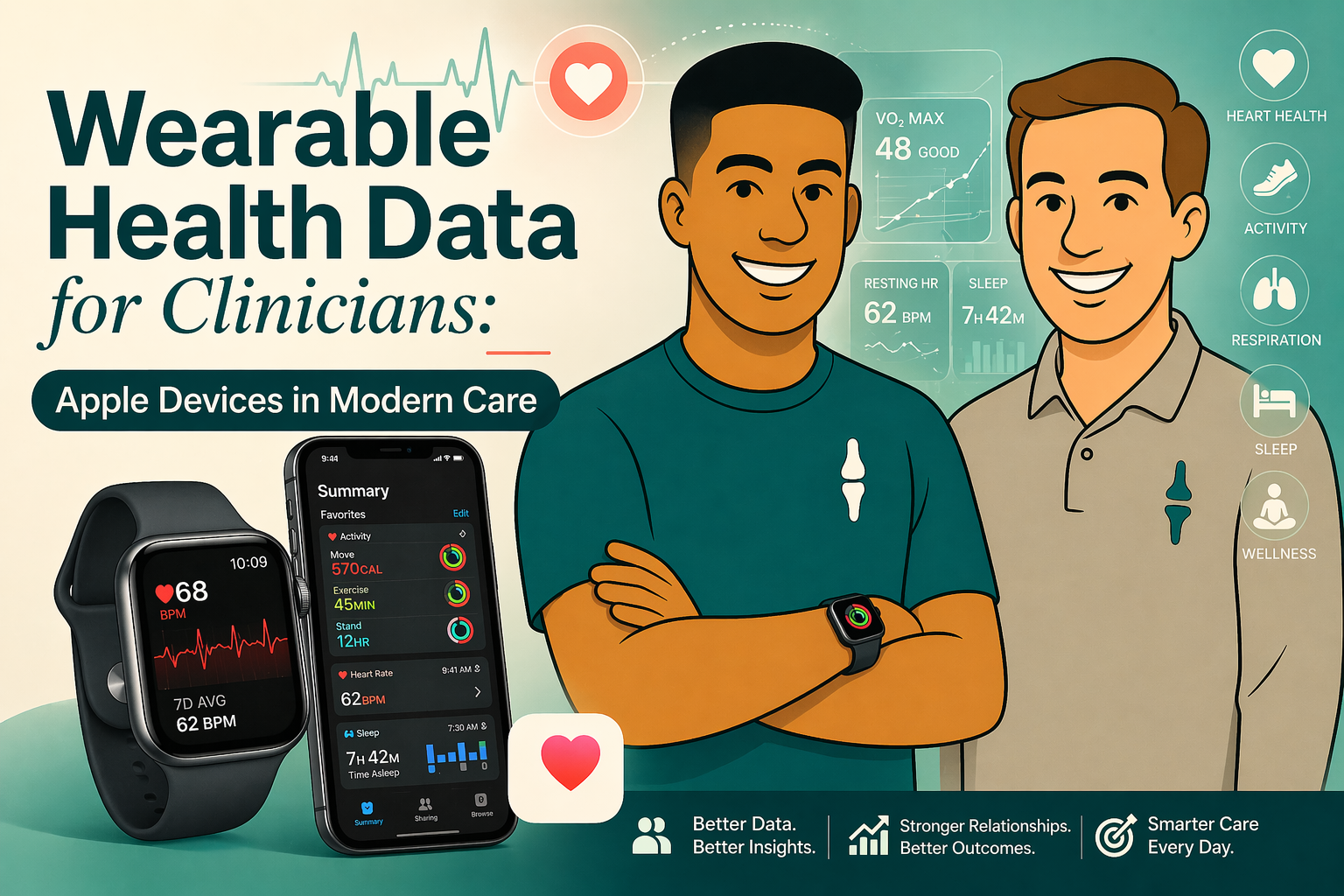
Healthcare is changing quickly—and much of that change is happening outside clinic walls. Patients now arrive with more health data than ever before. Their wristwatch may know their resting heart rate, oxygen saturation, sleep duration, walking steadiness, and daily activity trends before they even sit in the exam room.
Wearable technology has moved from novelty to meaningful tool. Devices from Apple Inc., especially the Apple Watch and iPhone, are helping patients engage with their health while giving clinicians access to valuable trends over time.
For providers, this matters. Snapshot vitals taken in office tell one story. Continuous data collected during real life tells another.
Used wisely, Apple devices can improve early detection, support preventative care, increase patient accountability, and strengthen long-term outcomes.
Apple Devices in Healthcare
Apple Watch
The Apple Watch is one of the most widely adopted wearable health tools. It can track:
Heart rate
Activity levels
Cardio fitness (VO2 max estimates)
ECG (supported models)
Fall detection
Sleep metrics
Oxygen saturation (in supported models)
Mobility trends
For providers, it offers practical patient-generated health data between visits.
iPhone Health App
The Apple Health centralizes metrics from Apple devices and compatible third-party tools. Patients can share summaries, trends, and records.
Apple Health Dashboard
The Health dashboard allows users to view changes over time rather than isolated readings—often more clinically meaningful than one-day measurements.
HealthKit Integrations
HealthKit enables approved apps and health systems to integrate wearable data into broader care plans.
ResearchKit and CareKit
ResearchKit and CareKit support research participation, remote monitoring workflows, symptom tracking, and care coordination.
iPad in Care Delivery
The iPad remains useful for:
Telehealth visits
Patient education
Exercise demonstrations
Consent workflows
Rehab tracking
Important Health Markers Providers Can Monitor
Cardiovascular Markers
Resting Heart Rate (RHR)
Measures: Baseline heart rate during rest.
Why it matters: Lower values often reflect cardiovascular conditioning or can indicate underlying cardiovascular conduction conditions; elevated trends may indicate illness, stress, dehydration, overtraining, anemia, or cardiac strain.
Clinical value: Trend changes often matter more than one reading.
Walking Heart Rate
Heart rate during daily ambulation can reflect conditioning, exertional tolerance, medication response, or decline.
Heart Rate Variability (HRV)
Measures: Variation between beats.
Why it matters: Often used as a proxy for autonomic balance and recovery status.
Low HRV may correlate with stress, illness, poor sleep, or overtraining.
Recovery Heart Rate
How quickly heart rate drops after exertion can help assess conditioning and autonomic recovery.
Irregular Rhythm Notifications
Consumer alerts may identify patterns suggestive of arrhythmia.
These should prompt evaluation—not replace diagnostic testing.
ECG / AFib Monitoring
Supported Apple Watch models can capture single-lead ECG tracings that may support atrial fibrillation screening conversations.
Again: These should prompt evaluation—not replace diagnostic testing.
Fitness & Endurance
VO2 Max / Cardio Fitness
Measures: Estimated aerobic capacity.
Why it matters: Strong predictor of cardiovascular fitness, can be correlated with mortality risk and functional reserve.
Clinical Use:
Cardiac rehab progress
Exercise prescription response
Functional decline detection
Wellness coaching
VO2 max Apple Watch medical use can be especially helpful when trended over months.
Step Count
Still one of the simplest and most useful markers of movement behavior.
Walking Speed
Often associated with longevity, frailty risk, and recovery progression.
Gait Symmetry & Mobility Trends
Useful in orthopedic rehab, neurologic care, and aging populations.
Exercise Minutes / Activity Rings
Behavioral adherence matters. These metrics can help reinforce movement goals.
Respiratory Markers
Respiratory Rate
Changes may indicate infection, anxiety, deconditioning, heart failure, or pulmonary concerns.
Oxygen Saturation (SpO2 / O2Sat)
Can support awareness of respiratory trends. Lower values may warrant clinical review depending on context.
Sleep Breathing Disturbances
Emerging sleep metrics may help identify patients who need formal sleep evaluation.
Sleep & Recovery
Sleep Duration
Insufficient sleep can contribute to metabolic dysfunction, poor recovery, pain sensitivity, and mood disruption.
Sleep Consistency
Regular sleep schedules often improve recovery and autonomic balance.
Sleep Stages
Consumer estimates have been shown to be imperfect; however, trends may still be informative.
Wake Frequency
Frequent awakenings may suggest pain, stress, nocturia, sleep apnea, or medication effects.
Recovery Trends
Combining HRV, sleep, activity, and symptoms can provide a broader picture of resilience.
Metabolic & Lifestyle Metrics
Calories Burned
Best used directionally rather than as exact precision data. Likely not precise but a good estimate for tracking.
Weight Trends
Connected scales can help track fluid changes, obesity treatment progress, or even post-op recovery.
Medication Reminders
Smart reminders may improve adherence.
Hydration Tracking
Helpful for athletes, older adults, and patients prone to dehydration.
Mindfulness / Stress Trends
Behavioral health support tools can improve patient engagement.
Fall Risk & Aging Metrics
Fall Detection
Immediate alerts can be meaningful for seniors and high-risk patients.
Walking Steadiness
May help identify mobility decline before a major event occurs.
Mobility Decline Alerts
Changes in speed, steps, or gait patterns can indicate deconditioning or emerging illness.
How Providers Can Use This Data
Practical Clinical Use Cases
1. Cardiac Rehab
Track exercise tolerance, recovery heart rate, and VO2 max progression.
2. Post-Operative Recovery
Monitor walking volume, mobility return, sleep disruption, and activity progression.
3. Chronic Disease Management
Useful in:
Hypertension
Diabetes
Obesity
CHF
COPD
4. Weight-Loss Programs
Daily accountability can improve adherence.
5. Sleep Disorder Screening
Wearable trends may justify referral for formal testing.
6. Elderly Decline Detection
Subtle decreases in movement can often precede hospitalization.
7. Physical Therapy Progression
Steps, gait, and consistency help validate recovery outside clinic.
8. Remote Wellness Coaching
Supports continuous touchpoints between visits.
Important Limitations & Ethical Considerations
Consumer Device vs. Medical Device
These tools are helpful adjuncts, not replacements for validated diagnostics.
Patients still need Clinical Interpretation
Data without context can mislead.
False Positives
Alerts may create anxiety or unnecessary utilization. Interpret cautiously.
HIPAA / Privacy
Providers should use secure workflows and approved systems when reviewing shared data.
Data Overload
Not every metric deserves equal attention. Focus on clinically relevant signals.
Equity Concerns
Not every patient owns Apple devices. Avoid creating two-tiered care models. Do not let the need for data replace your clinical reasoning for all patients.
Best Practices for Providers
Patients Who Benefit Most
Cardiac rehab patients
Motivated wellness patients
Seniors at fall risk
Post-op patients
Chronic disease populations
PT and sports rehab patients
Efficient Review Strategy
Use trends, not daily noise.
Example Metrics to Review:
30-day resting HR changes
Weekly steps
Sleep consistency
VO2 max direction
Mobility decline
Workflow Integration
Assign wearable review to care teams, coaches, or follow-up visits.
Encourage Adherence
Keep goals simple:
Walk daily
Wear device consistently
Charge nightly
Share summaries monthly
Future of Apple Devices in Healthcare
The next wave of remote patient monitoring Apple devices may include:
Predictive AI alerts
Personalized risk scoring
Expanded biometric sensors
Better EHR integration
Reimbursement growth for monitoring programs
Preventative medicine based on real-world trends
This is where Apple Health clinical use becomes increasingly meaningful.
Conclusion
Healthcare providers do not need more noise—they need better signals.
Apple devices can provide valuable real-world health trends that complement clinical judgment, improve patient engagement, and help detect decline earlier. They should never replace the exam room, diagnostics, or provider expertise.
But when used thoughtfully, they can become one more tool that helps clinicians care for patients more proactively, personally, and effectively.
The future of medicine may not be in the hospital alone. It may also be on the patient’s wrist.
This content drafted, researched, edited, and generated by:
McKinley Pollock, PT, DPT
McKinley Pollock, PT, DPT, OCS, CSCS is a physical therapist with a background in orthopedics and sports rehabilitation. Dr. Pollock earned his doctorate of physical therapy from Campbell University in 2021, is a board-certified orthopedic clinical specialist (OCS), and certified strength and conditioning specialist (CSCS). Dr. Pollock enjoys combining lessons learned from his DPT training and research, translating these into clinical practice. His passions include promoting relationships between patients & clinicians to promote clinical effectiveness, satisfaction, and efficiency, the implementation of primary preventative medicine into clinical practice, and leadership and education development.
© 2026 The Joint Connection Company. All rights reserved.
The content on this website, including all text, graphics, and materials, is the exclusive property of The Joint Connection Company and is protected by applicable copyright and intellectual property laws. No part of this site may be reproduced, distributed, or used without prior written permission.