

✨ Too Long Didn’t Read (TL;DR) / Summary
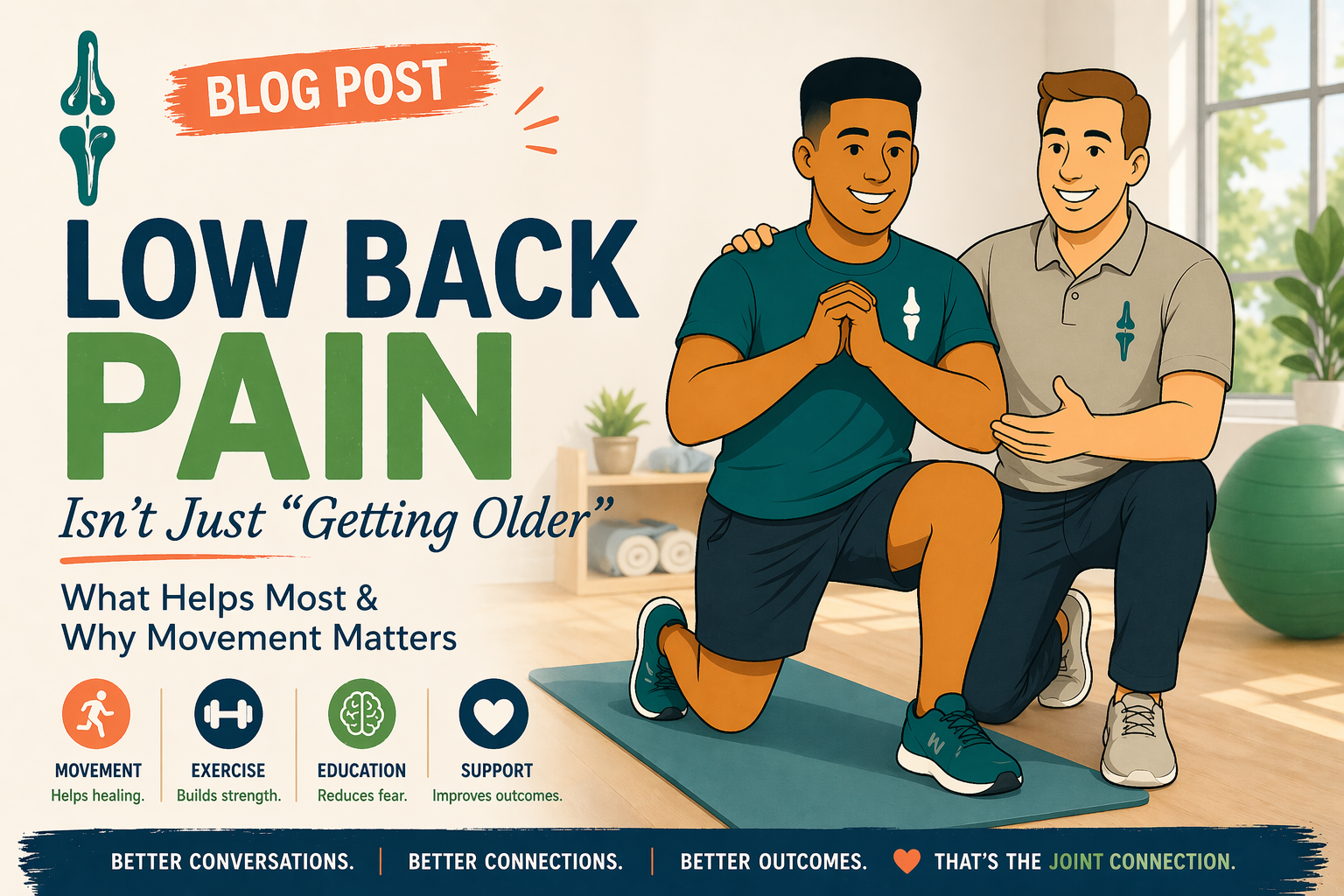
Low back pain is one of the most common reasons people seek healthcare—but it is not simply something you must “live with.” Many cases improve with the right plan, especially one focused on movement, education, exercise, and trust between patient and provider.
Research consistently shows that staying active within tolerance is better than prolonged bed rest, and treatments like physical therapy, exercise, spinal mobilization, yoga, aquatic therapy, and targeted strengthening can help many people.
For providers, one of the most powerful interventions is often the conversation itself: reducing fear, building confidence, explaining prognosis, and helping patients move forward safely.
🧾 Condition-Specific General Information
What Is Low Back Pain?
Low back pain refers to discomfort in the lumbar region—the area between the ribs and pelvis. It may feel:
Achy or stiff
Sharp with movement
Localized to one side
Across the beltline
Radiating into the buttock or leg
Worse after sitting, bending, lifting, or inactivity
Low back pain can be acute (short-term), subacute, or chronic (lasting 12 weeks or more). Chronic low back pain affects millions of adults and remains a leading cause of disability worldwide.
Important Truth: Pain Does Not Always Equal Damage
Many patients worry that pain automatically means something is “out of place” or permanently injured. Often, that is not the case. Pain can be influenced by muscles, joints, nerves, stress, sleep, fear of movement, workload, and previous pain experiences.
That’s why good care is not only about finding a structure—it is about understanding the whole person.
What Usually Helps Most?
🚶 Keep Moving (Within Tolerance)
Extended bed rest is no longer recommended for most low back pain cases. Gentle movement often helps recovery more than complete rest.
That may include:
Walking
Light stretching
Changing positions often
Gentle mobility work
Gradual return to daily activity
💪 Exercise Is One of the Best Treatments
Research supports exercise for both acute and chronic low back pain. Helpful approaches may include:
Core/trunk strengthening
Pilates
Aerobic exercise
Strength training
Aquatic therapy
Yoga or tai chi
Movement control training
There is no one “magic exercise.” The best program is often the one you can do consistently.
🧠 Education Matters
Understanding that the spine is strong, pain often improves, and movement is safe can reduce fear and improve outcomes.
🤝 Physical Therapy Can Help
Physical therapists can help guide recovery through:
Personalized exercise
Manual therapy when appropriate
Activity progression
Nerve mobility work for radiating symptoms
Confidence-building movement strategies
🚩 When to Seek Prompt Medical Care
Talk with a healthcare professional urgently if you have:
Loss of bowel/bladder control
Progressive leg weakness (on one side or both sides)
Fever or unexplained weight loss
Major trauma
History of cancer with new back pain
Severe numbness in the groin/saddle area
Pain that is rapidly worsening
👩⚕️ For Providers 👨⚕️
The Conversation Is Often the Treatment
Patients with low back pain commonly arrive worried:
“Did I slip a disc?”
“Am I making it worse by moving?”
“Will this ever go away?”
How we respond matters.
Helpful Clinical Language
Try:
“Your spine is strong.”
“Pain does not always mean damage.”
“Movement is usually part of recovery.”
“We’ll build a plan based on what you can tolerate today.”
“Most people improve, even if progress is gradual.”
Avoid fear-based messaging such as:
“Your back is worn out.”
“Never bend again.”
“You’ll just have to live with this.”
Research supports active education strategies over passive handouts alone.
Evidence-Informed Interventions
We recommend reading the 2021 Journal of Orthopedic and Sports Physical Therapy (JOSPT) Clinical Practice Guideline for a full update of clinical evidence. In short, the guideline recommends the following when appropriate:
Acute LBP
Exercise training
Trunk activation
Thrust/non-thrust mobilization
Active education
Chronic LBP
Strengthening/endurance programs
Aerobic exercise
Aquatic exercise
Multimodal exercise
Pilates / movement control
Pain neuroscience education
Manual therapy when indicated
Trigger point dry needling is gaining support for treatment
LBP With Leg Pain
Neural mobilization
Targeted exercise
Movement control strategies
Less Supported / Use Selectively
Mechanical traction shows limited benefit for most patients.
Functional Goals Over Perfect Imaging
Routine imaging without red flags is generally not recommended. This is because some people will have positive findings on imaging that may or may not correlate with what is actually causing their pain. Focusing on function, participation, and patient goals often leads to more meaningful care conversations.
Questions That Build Trust
Ask:
What activities matter most to you right now?
What worries you most about this pain?
What has helped before?
What feels possible this week?
Those answers often guide treatment better than imaging alone.
Key Clinical Takeaways
Low back pain is common, but manageable.
Exercise is strongly supported across many presentations.
Pilates, strength training, aerobic exercise, yoga, and aquatic therapy may help.
Education should reduce fear and encourage safe activity.
Strong patient-provider communication improves confidence and adherence.
📂 Supplemental Information / Citations
George SZ, Fritz JM, Silfies SP, et al. Interventions for the management of acute and chronic low back pain: revision 2021. J Orthop Sports Phys Ther. 2021;51(11):CPG1-CPG60. doi:10.2519/jospt.2021.0304
Fernández-Rodríguez R, Álvarez-Bueno C, Cavero-Redondo I, et al. Best exercise options for reducing pain and disability in adults with chronic low back pain: Pilates, strength, core-based, and mind-body. A network meta-analysis. J Orthop Sports Phys Ther. 2022;52(8):505-521.
Delitto A, George SZ, Van Dillen L, et al. Low back pain. J Orthop Sports Phys Ther. 2012;42(4):A1-A57. doi:10.2519/jospt.2012.42.4.A1
Nicol V, Verdaguer C, Daste C, et al. Chronic low back pain: a narrative review of recent international guidelines for diagnosis and conservative treatment. J Clin Med. 2023;12(4):1685.
Ma J, Zhang T, He Y, et al. Effect of aquatic physical therapy on chronic low back pain: a systematic review and meta-analysis. BMC Musculoskelet Disord. 2022;23(1):1050. doi:10.1186/s12891-022-05981-8
Marshall A, Joyce CT, Tseng B, et al. Changes in pain self-efficacy, coping skills, and fear-avoidance beliefs in a randomized controlled trial of yoga, physical therapy, and education for chronic low back pain. Pain Med.2022;23(4):834-843. doi:10.1093/pm/pnab318
Maharty DC, Hines SC, Brown RB. Chronic low back pain in adults: evaluation and management. Am Fam Physician.2024;109(3):233-244.
This content drafted, researched, edited, and generated by:
Jackson Kojima, PT, DPT
Jackson Kojima, PT, DPT, OCS is a physical therapist with an extensive background in orthopedics, geriatrics, and sports rehabilitation. Dr. Kojima is a board-certified orthopedic clinical specialist (OCS) with a passion for post-operative rehabilitation and enjoys treating multi-factorial conditions like low back pain and generalized joint pain. Dr. Kojima earned his doctorate of physical therapy from Campbell University in 2021 and currently practices in Greenville, SC.
© 2026 The Joint Connection Company. All rights reserved.
The content on this website, including all text, graphics, and materials, is the exclusive property of The Joint Connection Company and is protected by applicable copyright and intellectual property laws. No part of this site may be reproduced, distributed, or used without prior written permission.