

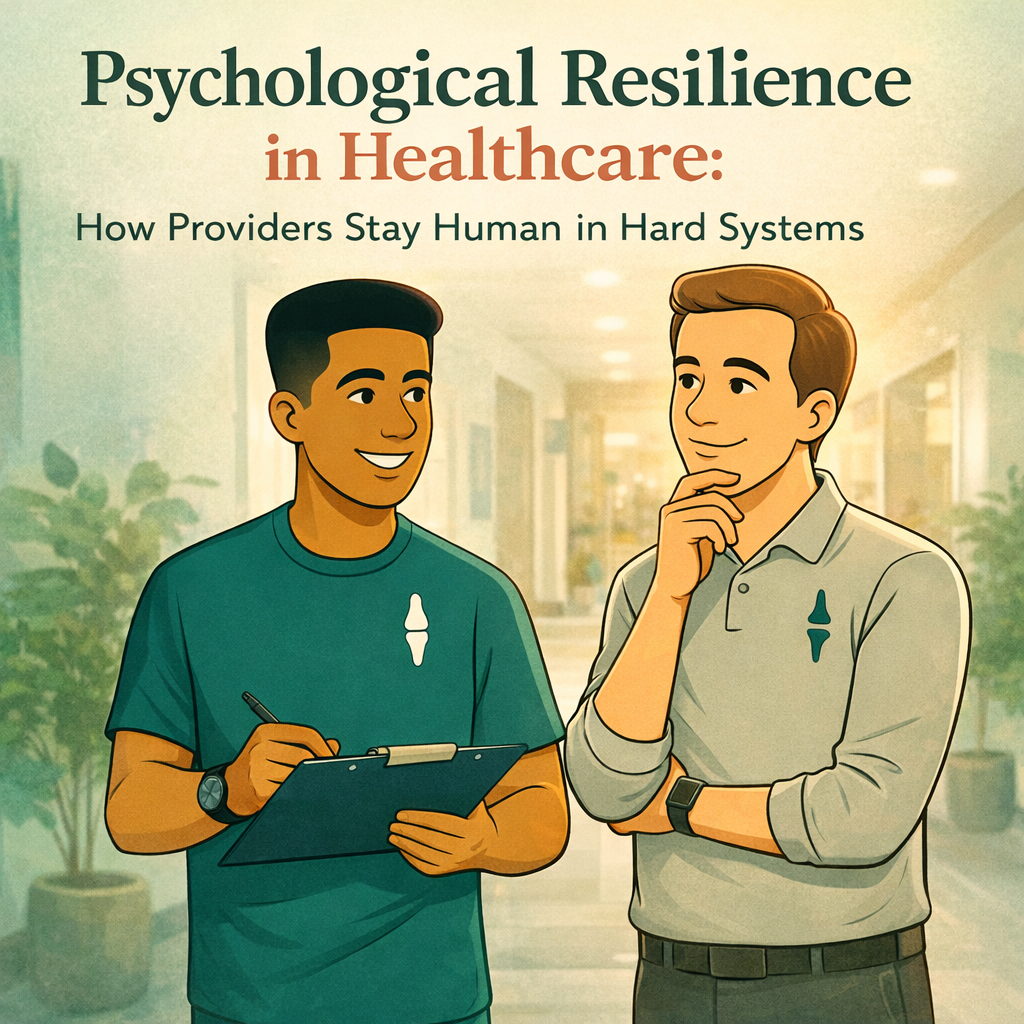
Healthcare professionals are strong—but strength alone is not enough.
Many clinicians entered medicine, rehab, nursing, or allied health to help people heal. Yet today’s healthcare environment often asks providers to move faster, document more, carry heavier emotional loads, and somehow stay endlessly compassionate while doing it.
That is where psychological resilience matters.
Resilience is not “toughing it out.” It is not pretending stress does not exist. It is the ability to adapt, recover, and remain connected to purpose while navigating real adversity.
For providers, resilience is not a luxury. It is a professional survival skill.
✨ Too Long Didn’t Read (TL;DR) / Summary
Psychological resilience means adapting well during stress and recovering after hardship.
It has been correlated with lower burnout and better wellbeing in healthcare workers.
Resilience is not fixed—it can be strengthened.
Helpful tools include:
flexible coping strategies
self-compassion
meaningful relationships
gratitude
growth mindset
boundaries
purpose-driven work
“Grit” (long-term perseverance + purpose) may help protect against burnout in medicine.
Individual tools matter—but system-level support matters too.
Great providers do not need to be invincible. They need support, skills, and space to recover.
🧾 Psychological Resilience: General Information
What Is Psychological Resilience?
Researchers define psychological resilience as doing better than expected after adversity.
Some people experience prolonged disruption after hardship. Others maintain function—or even grow through difficulty. That difference is resilience.
For providers, adversity may look like:
emotional exhaustion
difficult patient encounters
staffing shortages
productivity pressure
compassion fatigue
documentation overload
moral distress
personal stress outside work
Resilience does not mean these stressors are harmless. It means your response can be strengthened.
Resilience Is Not One Thing
Researchers describe resilience in three ways:
1. Trait Resilience
Natural tendencies like optimism, adaptability, steadiness.
2. Process Resilience
Skills and supports used during stress:
coping strategies
emotional regulation
social support
perspective shifts
3. Outcome Resilience
Maintaining wellbeing or avoiding severe decline after hardship.
That means resilience is partly who you are, partly what you practice, and partly what support surrounds you.
Why Healthcare Providers Need It Now
Many clinicians report worsening stress, administrative burden, and burnout. Burnout includes:
emotional exhaustion
depersonalization
cynicism
reduced professional efficacy
When providers are depleted, it may show up as:
rushed visits
reduced empathy bandwidth
irritability
“chart-first” communication
disconnection from purpose
Patients feel this. Teams feel this. Providers feel this most of all.
Four Evidence-Informed Ways to Build Resilience
1. Use the Right Coping Tool for the Right Problem
Not every stressor needs the same response.
If the issue is controllable:
ask for help
improve workflow
clarify expectations
address scheduling problems
If the issue is uncontrollable:
acceptance
reframing
emotional processing
connection
Context matters more than pretending one strategy fits all.
2. Practice Self-Compassion
Self-compassion means treating yourself with the same humanity you offer patients.
Three parts:
Mindfulness: “This is hard right now.”
Common Humanity: “Others struggle too.”
Self-Kindness: “What do I need in this moment?”
Research has been shown to link self-compassion with better wellbeing and lower distress.
Try This Between Patients:
Pause for 10 seconds.
Name it: “That was difficult.”
Normalize it: “Anyone would feel stretched right now.”
Respond kindly: “What helps me reset?”
3. Protect Meaning Through Positive Psychology
Positive psychology studies what helps life feel worth living—even during stress.
For providers, this may include:
gratitude moments
patient success reflection
remembering purpose
team recognition
savoring small wins
meaningful connection
One-Minute Reset:
Before next patient, ask:
What went well today?
Who did I help today?
What still matters to me here?
4. Build Grit Without Worshipping Exhaustion
Grit is sustained passion and perseverance toward long-term goals.
Higher grit has been associated with:
lower burnout
better wellbeing
stronger persistence in training and practice
But grit should not mean tolerating dysfunction.
Healthy grit says:
“I care deeply, and I will keep going wisely.”
Unhealthy grit says:
“I must sacrifice myself no matter the cost.”
Those are not the same.
👩⚕️ For Providers 👨⚕️
Practical Scripts for Real Clinical Days
When Overwhelmed
“I can do the next right thing.”
After a Hard Patient Encounter
“That interaction was difficult. I do not need to carry it all day.”
When You Feel Behind
“Urgency is real, but panic is optional.”
When You Need Boundaries
“I cannot safely take more without support.”
When You Forget Why You Started
“Connection still matters—even in small moments.”
What Leaders Should Know
Resilience training helps—but burnout is not solved by yoga in a broken system.
Organizations should also address:
unsafe productivity expectations
chronic understaffing
lack of autonomy
poor communication culture
no recovery time
excessive administrative burden
Individual resilience and healthy systems must work together.
Reflection for This Week
Ask yourself:
What drains me most right now?
What restores me fastest?
What boundary needs protecting?
What part of this work still feels meaningful?
Who can I lean on this week?
Key Takeaway
Psychological resilience is not about becoming emotionless.
It is about staying human in hard environments.
Providers do not need perfection. They need recovery, connection, boundaries, and tools that let them keep caring—without disappearing themselves in the process.
📂 Supplemental Information / Citations
Troy AS, Willroth EC, Shallcross AJ, Giuliani NR, Gross JJ, Mauss IB. Psychological resilience: an affect-regulation framework. Annu Rev Psychol. 2023;74:547-576. doi:10.1146/annurev-psych-020122-041854.
Lee DH, Reasoner K, Lee D. Grit: what is it and why does it matter in medicine? Postgrad Med J. 2023;99(1172):535-541. doi:10.1136/postgradmedj-2021-140806.
Neff KD. Self-compassion: theory, method, research, and intervention. Annu Rev Psychol. 2023;74:193-218. doi:10.1146/annurev-psych-032420-031047.
Zessin U, Dickhäuser O, Garbade S. The relationship between self-compassion and well-being: a meta-analysis. Appl Psychol Health Well Being. 2015;7(3):340-364. doi:10.1111/aphw.12051.
Harvard Health Publishing. Positive psychology. Harvard Health. Accessed October 26, 2025. https://www.health.harvard.edu/topics/positive-psychology
Chen S. Give yourself a break: the power of self-compassion. Harv Bus Rev. 2018;96(5):116-123.
This content drafted, researched, edited, and generated by:
McKinley Pollock, PT, DPT
McKinley Pollock, PT, DPT, OCS, CSCS is a physical therapist with a background in orthopedics and sports rehabilitation. Dr. Pollock earned his doctorate of physical therapy from Campbell University in 2021, is a board-certified orthopedic clinical specialist (OCS), and certified strength and conditioning specialist (CSCS). Dr. Pollock enjoys combining lessons learned from his DPT training and research, translating these into clinical practice. His passions include promoting relationships between patients & clinicians to promote clinical effectiveness, satisfaction, and efficiency, the implementation of primary preventative medicine into clinical practice, and leadership and education development.
© 2026 The Joint Connection Company. All rights reserved.
The content on this website, including all text, graphics, and materials, is the exclusive property of The Joint Connection Company and is protected by applicable copyright and intellectual property laws. No part of this site may be reproduced, distributed, or used without prior written permission.