

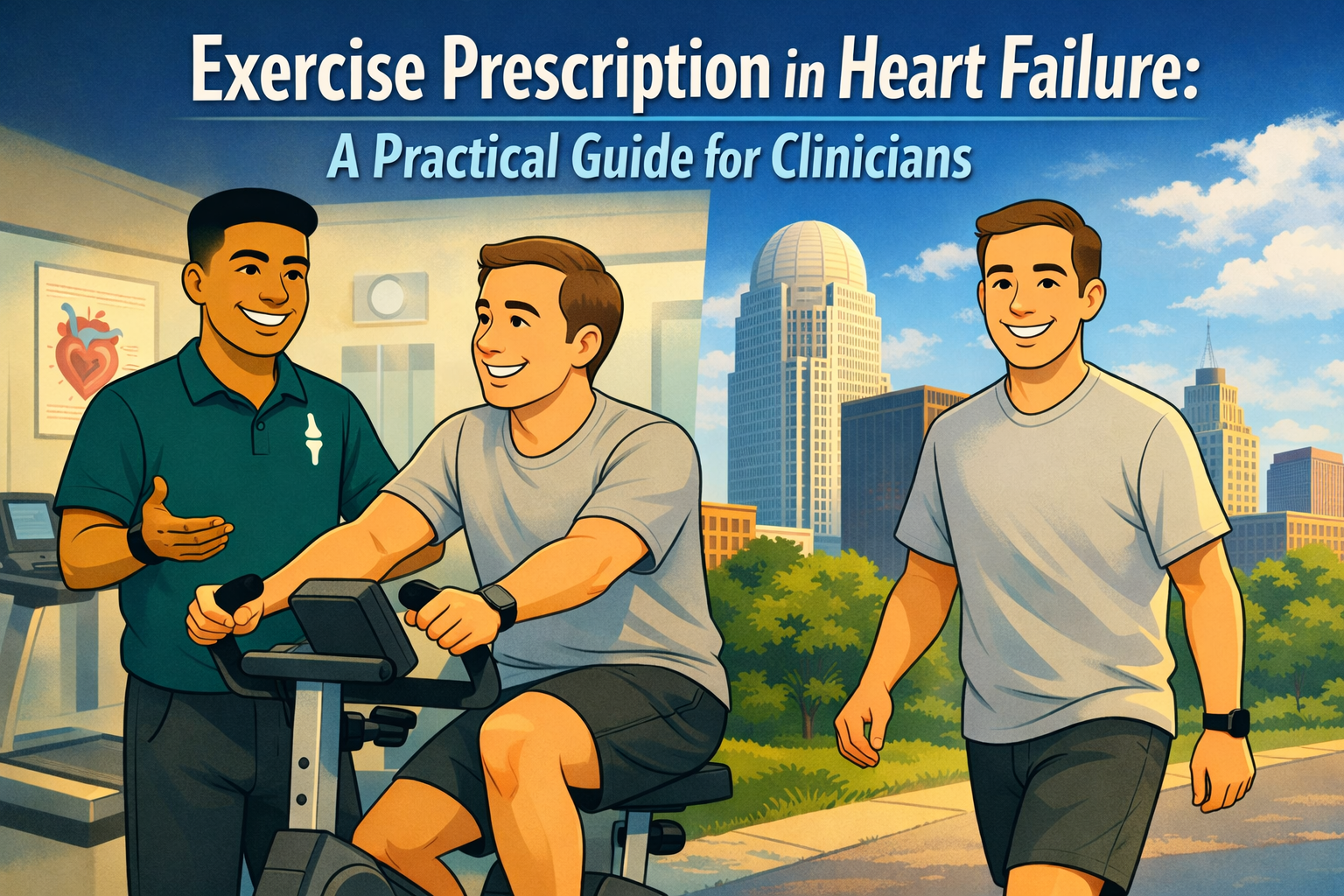
Heart failure is one of the most common and costly chronic conditions in medicine. Yet one of the most powerful therapies available to clinicians isn’t a new medication or device.
It’s movement.
Exercise training is now recognized as a Class I recommendation for patients with stable heart failure, supported by strong evidence demonstrating improvements in functional capacity, quality of life, and reductions in hospitalizations.
But despite the evidence, many clinicians still hesitate when prescribing exercise. Questions arise:
Is it safe?
What type of exercise should patients do?
How do we tailor it to frail or older patients?
The answers lie in both science and something deeper — the clinician-patient partnership.
Helping patients move again is not just about physiology. It is about restoring confidence, independence, and trust in their own bodies.
✨ Too Long Didn’t Read (TL;DR) / Summary
Heart failure affects millions of patients worldwide and is a major driver of hospitalization and disability.
Exercise training is strongly recommended for stable patients with heart failure and improves functional capacity, quality of life, and symptom burden.
Physical therapists and cardiac rehabilitation teams play a critical role in assessing functional limitations, prescribing exercise, and monitoring stability in patients with heart failure.
The FITT principle (Frequency, Intensity, Time, and Type) is an effective exercise prescription framework for patients to utilize.
Cardiac rehabilitation programs combine exercise, education, lifestyle modification, and psychosocial support.
Strong clinician endorsement dramatically increases patient participation and adherence to exercise programs.
Movement is medicine — but communication and trust determine whether patients actually follow through.
🧾 Condition-Specific General Information
Heart failure occurs when the heart cannot pump enough blood to meet the body’s metabolic needs, often due to weakness or stiffness of the heart muscle.
This dysfunction leads to fluid accumulation and decreased circulation, producing common symptoms such as:
• Shortness of breath
• Fatigue
• Peripheral edema
• Orthopnea
• Reduced exercise tolerance⁵
Globally, heart failure affects more than 64 million people, with over 6 million adults living with the condition in the United States alone.
Why Exercise Intolerance Happens
Exercise intolerance is the hallmark functional limitation of heart failure and arises from multiple interacting mechanisms, including:
• Reduced cardiac output
• Abnormal blood flow distribution
• Skeletal muscle dysfunction
• Impaired mitochondrial energy production
• Endothelial dysfunction and increased vascular resistance
Importantly, heart failure does not affect only the heart.
It affects multiple organ systems, including the lungs, kidneys, skeletal muscle, and autonomic nervous system.
These changes often lead to:
• Muscle weakness
• Deconditioning
• Reduced physical activity
• Lower quality of life⁹
Without intervention, this creates a cycle of inactivity and worsening function.
Exercise training is one of the few therapies capable of interrupting this cycle.
👩⚕️ For Providers 👨⚕️
1. Start With Clinical Stability
Exercise training is recommended for clinically stable patients receiving guideline-directed medical therapy.
Stability generally means:
• No recent hospitalization within ~6 weeks
• No worsening symptoms of heart failure
• Optimized medical therapy
Clinicians should assess for signs of acute decompensated heart failure, including:
• Rapid weight gain
• Increasing dyspnea (aka: shortness of breath)
• Peripheral edema (swelling in the legs or hands)
• Orthopnea (aka: shortness of breath when laying down - CLASSIC SIGN OF HEART FAILURE)
• Reduced exercise tolerance⁹
When symptoms worsen, exercise should pause and medical evaluation should occur.
2. Physical Therapists Are Essential Members of the Heart Failure Team
Physical therapists play a fundamental role in evaluating and treating patients with heart failure across the continuum of care.
Their responsibilities may include:
• Functional mobility evaluation
• Exercise prescription and monitoring
• Patient education
• Behavior change strategies
• Detection of early symptom exacerbation⁹
Evidence-based clinical practice guidelines from the American Physical Therapy Association emphasize that rehabilitation interventions—including aerobic exercise, resistance training, inspiratory muscle training, and education—can significantly improve functional capacity, strength, and quality of life in individuals with heart failure.
Physical therapists also play a key role in detecting early clinical deterioration, helping reduce preventable hospital readmissions.
This interdisciplinary collaboration is one of the most effective ways to improve long-term outcomes.
3. Use the FITT Framework for Exercise Prescription
A practical exercise prescription can utilize the FITT (Frequency, Intensity, Time, Type) Framework. For example, an evidence-based FITT Framework for a patient with chronic heart failure may look like:
Frequency: 3–5 sessions per week
Intensity: Moderate intensity typically 40–70% heart rate reserve or Borg RPE 10–14.
Time (Duration): Begin with 10–20 minutes, progressing toward 30–45 minutes per session.
Type: Recommended exercise modalities include:
Aerobic exercise
• Walking
• Cycling
• Swimming
• Dancing
Resistance training
• Elastic bands
• Dumbbells
• Bodyweight exercises
Inspiratory muscle training
• Particularly beneficial in patients with respiratory muscle weakness.
Clinical practice guidelines suggest aerobic training programs lasting 8–12 weeks with sessions lasting 20–60 minutes performed three to five times weekly can significantly improve exercise capacity and quality of life.
4. Cardiac Rehabilitation Is More Than Exercise
Cardiac rehabilitation programs combine:
• Structured exercise training
• Risk factor management
• Nutritional counseling
• Medication adherence education
• Psychosocial support³
These multidisciplinary programs improve:
• Functional capacity
• Quality of life
• Exercise tolerance
• Hospitalization risk
Despite strong evidence, only about 10–30% of eligible patients participate in cardiac rehabilitation programs.
The strongest predictor of participation?
A clear, confident recommendation from the clinician.
5. Encourage Daily Physical Activity — Not Just Structured Exercise
Guidelines emphasize that clinicians should promote a culture of daily physical activity, not just structured exercise sessions.
Physical activity includes any movement that increases energy expenditure beyond resting levels.
Examples include:
• Walking
• Gardening
• Taking stairs
• Household tasks
Patients with heart failure who remain physically active tend to demonstrate:
• Improved exercise capacity
• Better quality of life
• Lower mortality risk
Encouraging movement throughout the day helps break the cycle of inactivity and progressive deconditioning.
6. Communication Matters as Much as the Prescription
Many patients with heart failure are afraid of exertion.
Historically, they were even told to avoid physical activity.
Today we know the opposite is true — prolonged inactivity worsens outcomes.
The key is how we communicate.
Instead of saying:
“Try to exercise more.”
Try:
"Your heart gets stronger when you move. Let’s find a way to help you move safely."
That subtle shift transforms exercise from a vague suggestion into a shared treatment plan.
And that’s where adherence (and healing) begins.
—————————————————————————————————————————————————————————————————
Key Clinical Takeaways
• Exercise training is safe and beneficial for stable heart failure patients.
• Cardiac rehabilitation improves functional capacity, symptoms, and quality of life.
• Physical therapists play a central role in exercise prescription, patient education, and monitoring for decompensation.
• Exercise prescriptions should follow the FITT principle and be individualized.
• Encouraging daily physical activity can help break the cycle of deconditioning and inactivity in heart failure patients.
📂 Supplemental Information / Citations
Taylor JL, Myers J, Bonikowske AR. Practical guidelines for exercise prescription in patients with chronic heart failure. Heart Fail Rev. 2023;28(6):1285-1296. doi:10.1007/s10741-023-10310-9
Mosterd A, Hoes AW. Clinical epidemiology of heart failure. Heart. 2007;93(9):1137-1146. doi:10.1136/hrt.2003.025270
Bozkurt B, Fonarow GC, Goldberg LR, et al. Cardiac rehabilitation for patients with heart failure: JACC expert panel. J Am Coll Cardiol. 2021;77(11):1454-1469. doi:10.1016/j.jacc.2021.01.030
Baman JR, Ahmad FS. Heart failure. JAMA. 2020;324(10):1015. doi:10.1001/jama.2020.13310
Chen J, Aronowitz P. Congestive heart failure. Med Clin North Am. 2022;106(3):447-458. doi:10.1016/j.mcna.2021.12.002
Patti A, Merlo L, Ambrosetti M, Sarto P. Exercise-based cardiac rehabilitation programs in heart failure patients. Heart Fail Clin. 2021;17(2):263-271. doi:10.1016/j.hfc.2021.01.007
Heidenreich PA, Bozkurt B, Aguilar D, et al. 2022 AHA/ACC/HFSA guideline for the management of heart failure. Circulation. 2022;145(18):e895-e1032. doi:10.1161/CIR.0000000000001063
Kitzman DW, Whellan DJ, Duncan P, et al. Physical rehabilitation for older patients hospitalized for heart failure. N Engl J Med. 2021;385(3):203-216. doi:10.1056/NEJMoa2026141
Shoemaker MJ, Dias KJ, Lefebvre KM, et al. Physical therapist clinical practice guideline for the management of individuals with heart failure. Phys Ther. 2020;100(1):14-43. doi:10.1093/ptj/pzz127
This content drafted, researched, edited, and generated by:
McKinley Pollock, PT, DPT
McKinley Pollock, PT, DPT, OCS, CSCS is a physical therapist with a background in orthopedics and sports rehabilitation. Dr. Pollock earned his doctorate of physical therapy from Campbell University in 2021, is a board-certified orthopedic clinical specialist (OCS), and certified strength and conditioning specialist (CSCS). Dr. Pollock enjoys combining lessons learned from his DPT training and research, translating these into clinical practice. His passions include promoting relationships between patients & clinicians to promote clinical effectiveness, satisfaction, and efficiency, the implementation of primary preventative medicine into clinical practice, and leadership and education development.
© 2026 The Joint Connection Company. All rights reserved.
The content on this website, including all text, graphics, and materials, is the exclusive property of The Joint Connection Company and is protected by applicable copyright and intellectual property laws. No part of this site may be reproduced, distributed, or used without prior written permission.