

✨ Too Long Didn’t Read (TL;DR) / Summary
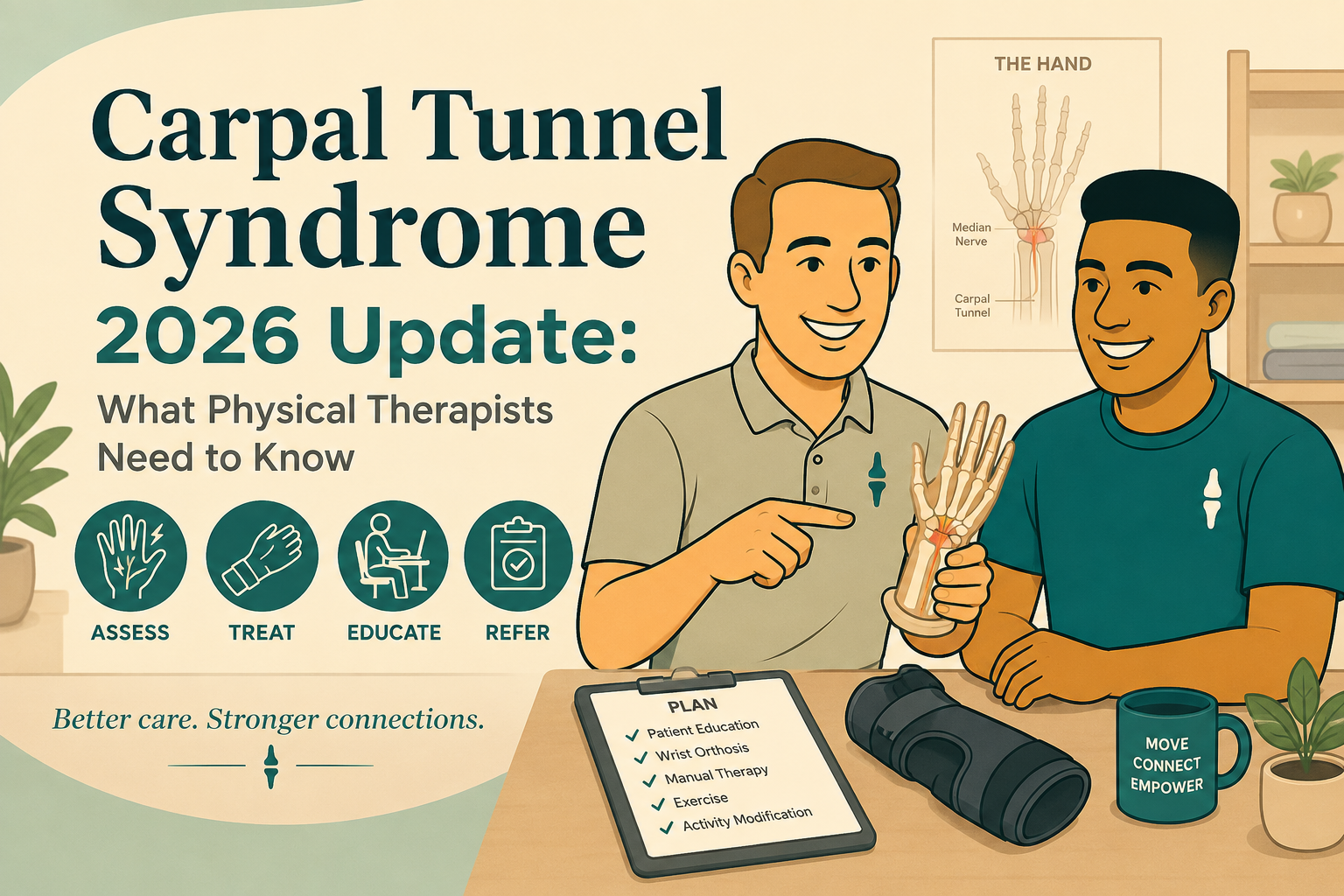
Carpal tunnel syndrome (CTS) is still one of the most common nerve compression conditions physical therapists see in the clinic. The 2026 Journal of Orthopedic and Sports Physical Therapy (JOSPT) clinical practice guideline update reinforces a practical message: start with a strong exam, listen closely to the patient’s story, use evidence-supported tools, and know when to refer.
For mild to moderate CTS, the strongest physical therapy-supported intervention remains a forearm-based wrist orthosis that keeps the wrist near neutral, usually worn at night. Ergonomic education, activity modification, manual therapy, selected exercise, kinesiology taping, laser therapy, shockwave therapy, interferential current, superficial heat, and diathermy may help some patients, but many of these recommendations are based on weak or limited evidence.
The big clinical reminder: thenar atrophy, objective weakness, sensory loss, progressive symptoms, atypical presentation, or failed conservative care should raise the referral conversation early.
🧾 Condition-Specific General Information
What Is Carpal Tunnel Syndrome?
Carpal tunnel syndrome (CTS) occurs when the median nerve is compressed as it travels through the carpal tunnel at the wrist. Patients commonly report numbness, tingling, burning, pain, or weakness in the median nerve distribution of the hand, typically more out towards the thumb, index finger, and middle finger (with some reporting symptoms in the ring finger as well) rather than by the wrist.
Classic symptoms often include:
Nighttime numbness or tingling
Symptoms in the thumb, index finger, middle finger, and radial half of the ring finger
Hand pain or “pins and needles”
Dropping objects
Reduced grip or pinch confidence
Weakness in median nerve-innervated muscles
Thenar atrophy in more chronic or severe cases
One of the most debilitating parts of CTS is sleep disruption. A 2024 systematic review found that sleep-related symptoms can improve after both splinting and carpal tunnel release, with significant post-operative improvements in sleep outcome measures.
Who Is More Likely to Develop CTS?
CTS is more common in women than men, with higher prevalence noted in females ages 40 to 49 and males ages 50 to 59. Intrinsic risk factors include age, female sex, and obesity.
There is strong evidence that forceful hand exertion is an occupational risk factor (including jobs that involve heavy gripping, pinching, or utilization of vibrating tools). Evidence is conflicting for diabetes, alcohol use, smoking, pregnancy history, and physical activity as CTS risk factors.
Important nuance: the 2024 American Academy of Orthopedic Surgeons (AAOS) guideline summary notes that, in the absence of reliable evidence, there is no established association between high keyboard use and CTS. That does not mean keyboarding cannot aggravate symptoms for a specific person. It means we should be careful with causation claims.
How Should Physical Therapists Examine CTS?
The 2026 JOSPT clinical practice guideline recommends using a combination of patient history, symptom location, clinical tests, sensory testing, motor testing, and patient-reported outcome measures.
Recommended examination tools include:
Screening and symptom mapping
Katz and Stirrat hand symptom diagram
Kamath and Stothard questionnaire for possible work-related CTS
Provocative testing
Phalen test
Tinel sign
Carpal compression / Durkan test
Sensory and motor testing
Semmes-Weinstein monofilaments
Static 2-point discrimination
Grip and pinch strength when clinically appropriate
Purdue Pegboard or Dellon-modified Moberg pick-up test
Thenar muscle inspection for atrophy
Diagnostic combination tool
CTS-6 is recommended to help infer potential diagnosis of suspected CTS
What Outcome Measures Should PTs Use?
The 2026 guideline recommends the Boston Carpal Tunnel Questionnaire Symptom Severity Scale at baseline and at least one follow-up point.
For function, clinicians should use:
DASH, or
QuickDASH
The Boston Carpal Tunnel Questionnaire Functional Status Scale may also be used if DASH or QuickDASH are unavailable.
👨⚕️👩⚕️ For Providers
1. Start With the Conversation
Before the splint, before the test cluster, before the plan of care, ask good questions.
Try:
“When do you notice your symptoms the most?”
“Are your symptoms waking you up?”
“Are you dropping things?”
“What activities make you feel nervous about your hand?”
“What have you already tried?”
“What are you hoping PT helps you avoid or return to?”
This keeps the visit patient-centered and helps identify irritability, severity, work demands, fear, and referral needs.
2. Orthoses Remain the Main Conservative Anchor
For mild to moderate CTS, clinicians should recommend a forearm-based wrist immobilization orthosis that keeps the wrist near neutral in the sagittal plane, typically worn at night for short- and mid-term symptom and function improvement.
If night-only wear is not enough, clinicians may adjust wear time to daytime, symptomatic, or full-time use.
Clinical pearl: do not just say, “Wear this brace.” Check fit, wrist position, comfort, skin response, and adherence barriers.
3. Education Should Be Practical, Not Blaming
Education may include:
Median nerve compression basics
Symptom monitoring
Sleep positioning
Reducing prolonged wrist flexion or extension
Tool and workstation modification
Mouse alternatives, touchscreens, arrow keys, or alternating mouse hand when relevant
Use collaborative language:
“Let’s test a few small changes, track how you feel, and see how we need to adjust further down the road.”
4. Manual Therapy and Exercise May Help, But Set Expectations
Manual therapy directed to the cervical spine and upper extremity along areas of median nerve entrapment may provide short-term improvement in pain and function for mild to moderate CTS.
A combined orthotic and stretching program may be used in nonsurgical mild to moderate CTS when there is no thenar atrophy and 2-point discrimination is normal.
Be careful not to oversell. Many conservative interventions have weak, limited, or short-term evidence.
5. Modalities: Know the “May Use” vs “Do Not Use” List
According to the 2026 guideline, clinicians should not use:
Iontophoresis with corticosteroids
Phonophoresis with corticosteroids
Magnets
Clinicians may use selected biophysical agents for short-term improvements, including:
Low-level or high-intensity laser therapy
Extracorporeal shockwave therapy
Interferential current
Superficial heat
Microwave or shortwave diathermy
The AAOS summary notes that many nonoperative treatments do not show long-term improvement in patient-reported outcomes. This is where clinical humility matters.
6. When to Refer
Refer to a physician, hand specialist, or surgeon when the patient has:
Thenar atrophy
Objective weakness
Progressive sensory loss
Severe or worsening symptoms
Constant numbness
Significant functional decline
Atypical symptoms suggesting cervical radiculopathy, peripheral neuropathy, vascular involvement, or other pathology
Failed conservative care
Symptoms requiring electrodiagnostic testing or surgical discussion
Refer to a pharmacist or prescribing provider when medication questions arise, including NSAID safety, acetaminophen dosing, anticoagulants, pregnancy-related medication questions, diabetes medication interactions, or post-surgical pain management.
Physical therapists should remain within state practice acts and use referral or consultation when findings fall outside PT scope or when medical management is needed.
7. Shared Decision-Making Is Not Optional
CTS care often includes uncertainty. Steroid injection may help short-term symptoms, but AAOS reports it does not provide long-term improvement. Surgery may be appropriate for severe CTS, and open and endoscopic release techniques are both effective.
📂 Supplemental Information / Citations
Erickson M, Lawrence M, Stegink Jansen CW, et al. Hand pain and sensory deficits: carpal tunnel syndrome. J Orthop Sports Phys Ther. 2026;56(4):CPG1-CPG79. doi:10.2519/jospt.2026.0301
Wipperman J, Penny ML. Carpal tunnel syndrome: rapid evidence review. Am Fam Physician. 2024;110(1):52-57.
Shapiro LM, Kamal RN; Management of Carpal Tunnel Syndrome Work Group; American Academy of Orthopaedic Surgeons. American Academy of Orthopaedic Surgeons/ASSH clinical practice guideline summary management of carpal tunnel syndrome. J Am Acad Orthop Surg. 2025;33(7):e356-e366. doi:10.5435/JAAOS-D-24-01179
Warren JR, Link RC, Cheng AL, Sinclair MK, Sorensen AA. Carpal tunnel syndrome and sleep, a systematic review and meta-analysis. Hand Surg Rehabil. 2024;43(3):101698. doi:10.1016/j.hansur.2024.101698
This content drafted, researched, edited, and generated by:
Jackson Kojima, PT, DPT
Jackson Kojima, PT, DPT, OCS is a physical therapist with an extensive background in orthopedics, geriatrics, and sports rehabilitation. Dr. Kojima is a board-certified orthopedic clinical specialist (OCS) with a passion for post-operative rehabilitation and enjoys treating multi-factorial conditions like low back pain and generalized joint pain. Dr. Kojima earned his doctorate of physical therapy from Campbell University in 2021 and currently practices in Greenville, SC.
© 2026 The Joint Connection Company. All rights reserved.
The content on this website, including all text, graphics, and materials, is the exclusive property of The Joint Connection Company and is protected by applicable copyright and intellectual property laws. No part of this site may be reproduced, distributed, or used without prior written permission.