

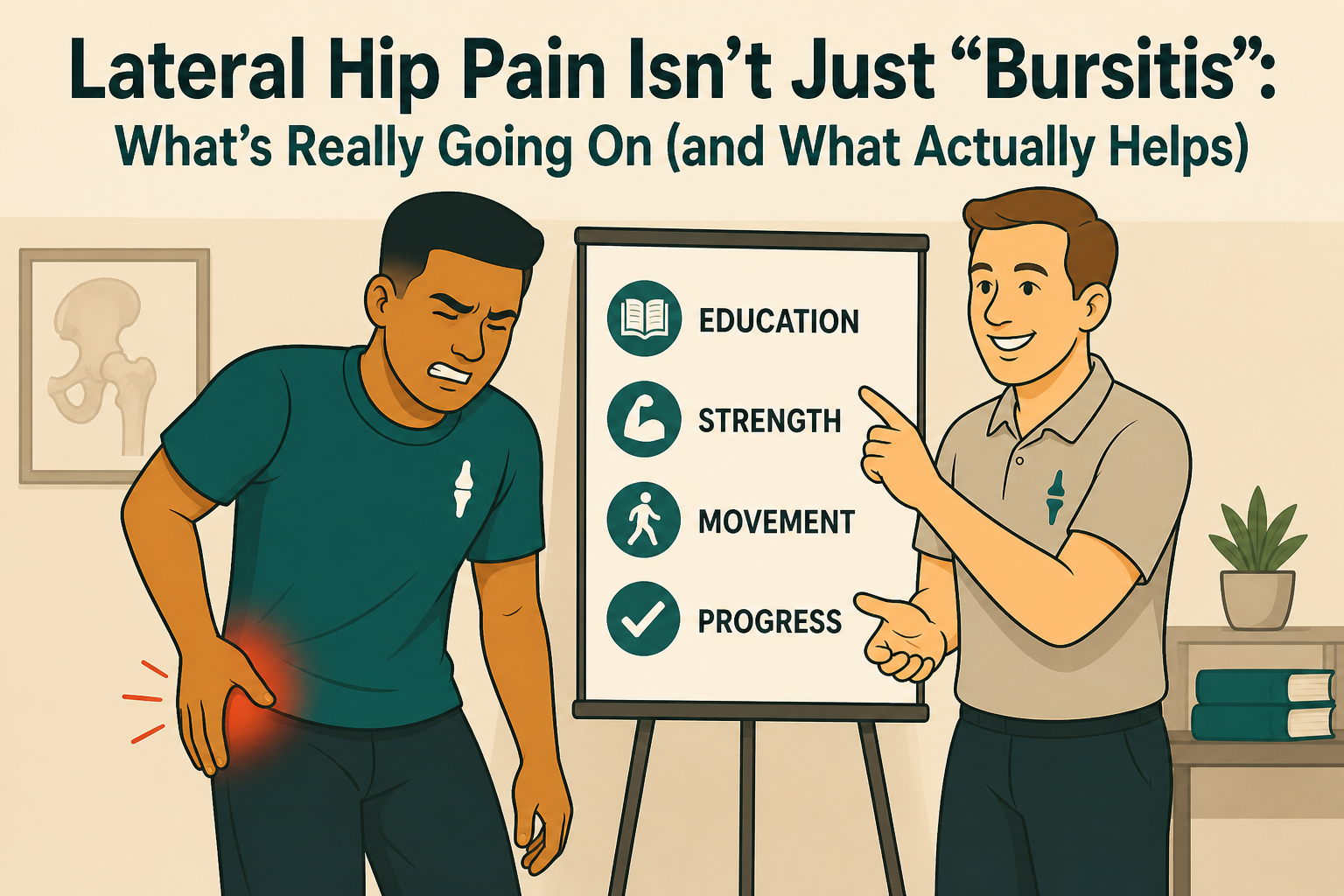
✨ Too Long Didn’t Read (TL;DR) / Summary
“Lateral hip pain” is often grouped under Greater Trochanteric Pain Syndrome (GTPS)—not just bursitis.
It commonly affects middle-aged women and is linked to hip tendon irritation, weakness, and movement patterns.
Pain often shows up with walking, stairs, single-leg tasks, or lying on your side.
There’s no single perfect test—it’s about the whole clinical picture.
Treatment works best when it focuses on:
Education (huge)
Load management (reduce irritation early and modify as needed)
Progressive strengthening (especially hip + core)
This is usually a gradual, chronic condition—not something caused by one big injury.
The goal isn’t just to “fix pain”—it’s to restore confidence, movement, and trust in your body.
🧾 Condition-Specific General Information
What is Lateral Hip Pain, Really?
Lateral hip pain is a broad, umbrella term. Most commonly, it falls under Greater Trochanteric Pain Syndrome (GTPS)—a condition typically involving irritation of the musculature and surrounding structures that attach on the Greater Trochanter of the femur bone.
Despite how often you hear “bursitis,” research shows that tendon-related issues (tendinopathy) are usually the main driver—not just inflammation of a bursa.
Who Gets It?
Most common in women aged 40–60
Often develops gradually over time (not from one injury)
Can be associated with:
Changes in activity
Decreased hip strength/control
Repetitive loading patterns
What Does It Feel Like?
Patients often describe:
Pain on the outside of the hip
Tenderness when pressing over the greater trochanter
Pain with:
Walking
Stairs
Standing on one leg
Getting in/out of a car or bathtub
Pain when lying on your side (classic finding)
This pain can be highly irritable, especially early on.
Why Does It Happen?
Think of this less as a “damaged structure” problem and more as a load + movement problem.
Common contributors:
Weak or underperforming hip abductors
Poor pelvic control
Repetitive hip adduction positions (hips collapsing inward)
Increased compressive load on the lateral hip
Over time, these factors can lead to tendon irritation and sensitivity.
Important: What Else Could It Be?
Lateral hip pain should never be evaluated in isolation.
A good clinician will also screen for:
Hip osteoarthritis
Lumbar spine referral
Other intra-articular hip conditions
There is no single “gold standard” test—diagnosis is based on history + movement + symptom reproduction.
What Actually Helps?
This is where things get encouraging.
1. Education (Underrated but Critical)
Patients need to understand:
Why certain movements hurt
How to modify positions temporarily
That pain ≠ damage
Avoiding irritating positions early (like prolonged hip adduction when sleeping/sitting or side-lying on the painful side) can dramatically reduce symptoms.
2. Load Management (Calm It Down First)
In highly irritable phases:
Reduce aggravating activities
Avoid “pushing through pain”
Use isometric exercises to maintain muscle activity without flaring symptoms
3. Progressive Strengthening (Build It Back Better)
Once symptoms settle:
Focus on the impairments you found in your assessment:
Hip abduction strength
External rotation strength
Core + pelvic control
Gradually reintroduce:
Walking
Stairs
Single-leg activities
This progression is key—too much too soon can lead to a flare-up.
4. Movement Matters
We’re not just strengthening—we’re retraining how you move.
That includes:
Controlling hip drop during walking
Avoiding excessive hip adduction
Improving single-leg stability
Big Picture Takeaway
Lateral hip pain isn’t just something to “rest and wait out.”
It’s a condition that responds best to:
👉 Understanding + intentional movement + gradual loading
👨⚕️👩⚕️ For Providers
Clinical Framing
Treat lateral hip pain within the framework of GTPS and movement system impairment
Prioritize tendon-based gradual loading models over isolated bursitis diagnoses
Use a classification-based approach (irritable vs non-irritable)
Key Assessment Priorities
Symptom behavior (irritability, load tolerance)
Palpation over greater trochanter
Functional tasks:
Single-leg stance
Step-down
Gait
Rule out:
Lumbar referral
Hip OA
Intra-articular pathology
Treatment Strategy
High Irritability Phase:
Education + load modification
Isometrics to decrease painful symptoms (analgesia)
Avoid compressive positions
Low Irritability Phase:
Progressive loading:
Isometric → Isotonic → Functional → Dynamic
Emphasize:
Hip abduction
External rotation
Pelvic control
Common Mistakes
Over-labeling as “bursitis”
Progressing loading too quickly
Ignoring movement patterns
Underutilizing education
The Conversation Matters
This population often presents with chronic, frustrating pain.
What they need:
Clarity (“what is this actually?”)
Reassurance (“this is manageable”)
A plan (“here’s how we build you back”)
This is where outcomes are won.
📂 Supplemental Information / Citations
Lespasio MJ. Lateral hip pain: relation to greater trochanteric pain syndrome. Perm J. 2022;26(2):83-88. doi:10.7812/TPP/21.110
Enseki KR, Bloom NJ, Harris-Hayes M, et al. Hip pain and movement dysfunction associated with nonarthritic hip joint pain: clinical practice guidelines. J Orthop Sports Phys Ther. 2023;53(7):CPG1-CPG70. doi:10.2519/jospt.2023.0302
Yeo PY, Kasivishvanaath A, Pérez-Carro L, et al. Top ten causes of non-arthritic hip pain: a comprehensive review. World J Orthop. 2025;16(6):107397. doi:10.5312/wjo.v16.i6.107397
Disantis AE, Martin RL. Classification based treatment of greater trochanteric pain syndrome with integration of the movement system. Int J Sports Phys Ther. 2022;17(3):508-518. doi:10.26603/001c.32981
This content drafted, researched, edited, and generated by:
Jackson Kojima, PT, DPT
Jackson Kojima, PT, DPT, OCS is a physical therapist with an extensive background in orthopedics, geriatrics, and sports rehabilitation. Dr. Kojima is a board-certified orthopedic clinical specialist (OCS) with a passion for post-operative rehabilitation and enjoys treating multi-factorial conditions like low back pain and generalized joint pain. Dr. Kojima earned his doctorate of physical therapy from Campbell University in 2021 and currently practices in Greenville, SC.
© 2026 The Joint Connection Company. All rights reserved.
The content on this website, including all text, graphics, and materials, is the exclusive property of The Joint Connection Company and is protected by applicable copyright and intellectual property laws. No part of this site may be reproduced, distributed, or used without prior written permission.