

✨ Too Long Didn’t Read (TL;DR) / Summary
Hypermobility isn’t just “being flexible.” For many patients, it’s a complex, often misunderstood condition that can affect the entire body—not just joints.
Hypermobile Ehlers-Danlos syndrome (hEDS) and hypermobility spectrum disorders (HSD) can present with chronic pain, fatigue, anxiety, and multisystem symptoms. Diagnosis can take years, and patients often feel dismissed along the way.
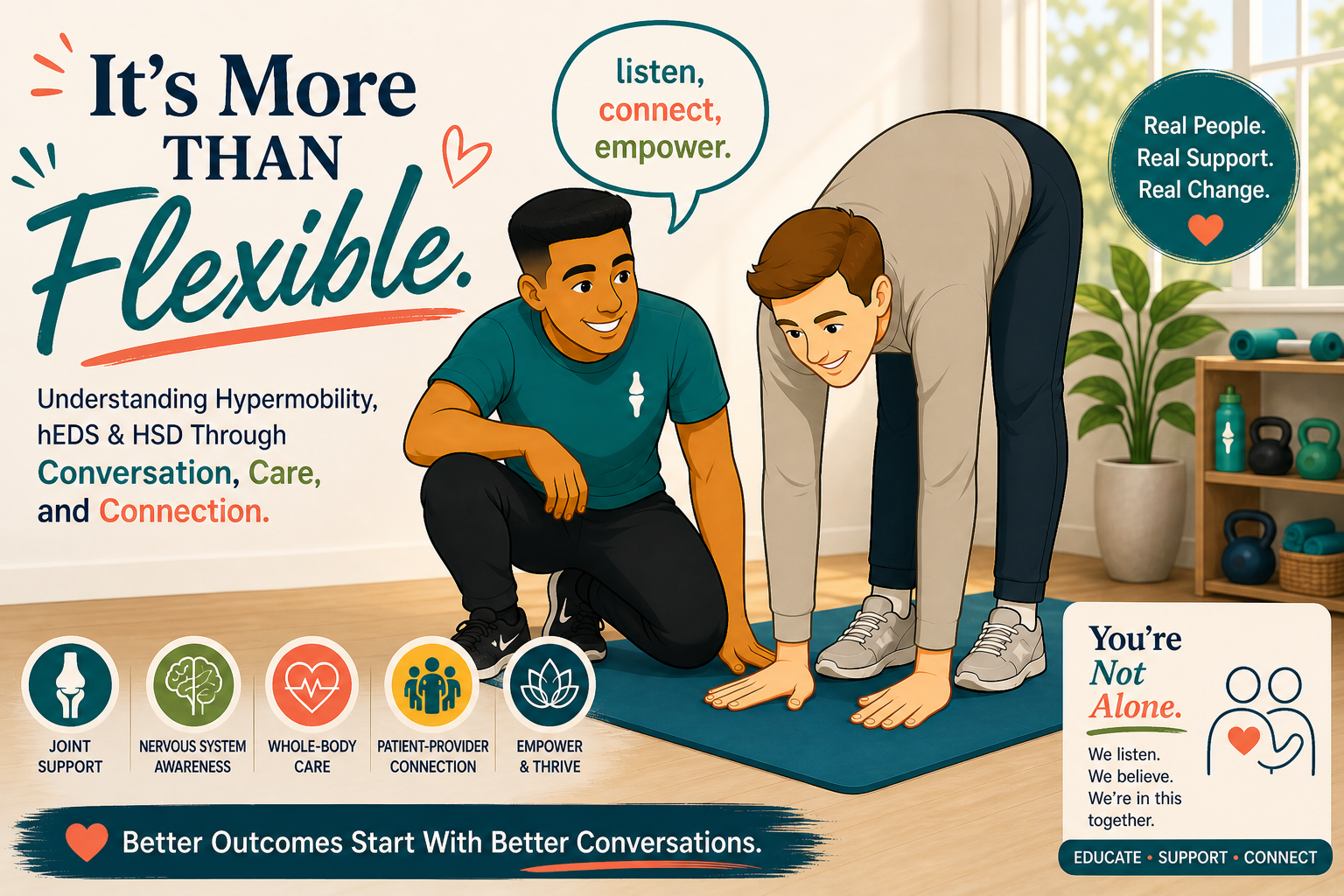
The most effective care isn’t just clinical—it’s relational. When providers listen, validate, and collaborate, outcomes improve. Treatment works best when it’s multidisciplinary, patient-centered, and focused on long-term self-management.
🧾 Condition-Specific General Information
What Is Hypermobility?
Joint hypermobility refers to movement beyond normal limits. Some people are naturally flexible without symptoms—but others experience pain, instability, and systemic challenges.
In 2017, diagnostic terminology shifted:
Hypermobile Ehlers-Danlos Syndrome (hEDS) → stricter criteria, systemic involvement
Hypermobility Spectrum Disorders (HSD) → symptomatic patients who don’t meet hEDS criteria
Why It’s More Than a Joint Problem
These conditions affect connective tissue, meaning they can impact multiple systems:
Musculoskeletal: joint pain, dislocations, instability
Neurological: headaches, dizziness, “brain fog”
Cardiovascular/autonomic: Postural Orthostatic Tachycardia Syndrome (POTS), fatigue
Gastrointestinal: Irritable Bowel Syndrome (IBS), reflux
Psychological: anxiety, depression
Patients often don’t realize these symptoms are connected—and providers may miss the bigger picture if they don’t ask.
The Diagnosis Gap
The average time to diagnosis can be up to 10 years.
Why?
Symptoms are variable and overlap with other conditions
No definitive genetic test for hEDS
Many patients are told “everything looks normal”
This is where communication becomes clinical care.
👩⚕️ For Providers 👨⚕️
1. Start With Curiosity, Not Conclusions
Patients with hypermobility often arrive with long, complex histories. Instead of narrowing too quickly:
Ask about multisystem symptoms
Explore childhood patterns (clumsiness, flexibility)
Validate lived experience
A simple shift:
“I want to hear about your pain but tell me what your body has been going through overall. Have you noticed anything in addition to pain during movement, during sleeping, or at rest?”
can open more diagnostic insight than a checklist alone.
2. Think Biopsychosocial—Always
Pain in HSD/hEDS isn’t just structural. It involves:
Biomechanics (joint instability)
Neurology (central sensitization)
Psychology (fear, anxiety, coping)
Ignoring one domain limits outcomes.
3. Build a Team, Not a Treatment Plan
Evidence strongly supports a multidisciplinary approach:
Physical therapy (core stability, proprioception)
Occupational therapy (joint protection, daily function)
Psychology (pain coping, anxiety management)
Primary care coordination¹
Patients do best when care feels connected—not fragmented.
4. Movement Is Medicine—But It Must Be Personalized
Exercise helps—but poorly prescribed exercise can harm. If a person with hypermobility engages in exercises with altered form, poor control, or excessive load, it can cause harmful stress/strain on the muscles and joints.
Effective strategies:
Slow progression
Focus on control, not range
Emphasize proprioception and strength
Think: not just how much weight you can lift but how well can you control your body (can use bands, lasers, balance pads, and more to generate that proprioceptive connection)
Avoid high-impact overload early
Patients often fear movement. Your role is to restore confidence, not just function.
5. Education Is Treatment
Patients with hEDS/HSD benefit from understanding:
Joint protection strategies
Energy pacing
Sleep hygiene
Self-management skills
When patients feel informed, they feel in control—and that changes everything.
6. The Relationship Is the Intervention
Patients consistently report that what matters most is:
Being believed
Being heard
Being included in decisions
Clinical expertise matters — connection drives adherence, trust, and outcomes.
Key Takeaways for Reflection
How often do we pause to connect symptoms across systems?
Are we treating the condition—or the person living with it?
What would change if we saw every hypermobility patient as a long-term partner in care?
📂 Supplemental Information / Citations
Yew KS, Kamps-Schmitt KA, Borge R. Hypermobile Ehlers-Danlos syndrome and hypermobility spectrum disorders. Am Fam Physician. 2021;103(8):481-492.
Atwell K, Michael W, Dubey J, et al. Diagnosis and management of hypermobility spectrum disorders in primary care. J Am Board Fam Med. 2021;34(4):838-848.
Russek LN, Stott P, Simmonds J. Recognizing and effectively managing hypermobility-related conditions. Phys Ther. 2019;99(9):1189-1200.
Darnell SC, Shotwell C, Brown S, et al. Therapeutic Management of Hypermobility Spectrum Disorder, including Hypermobile Ehlers-Danlos Syndrome: Evidence-Based Clinical Care Guideline. Cincinnati Children’s Hospital Medical Center; 2025.
Brittain GM, Flanagan S, Foreman L, Teran-Wodzinski P. Physical therapy interventions in generalized hypermobility spectrum disorder and hypermobile Ehlers-Danlos syndrome: a scoping review. Disabil Rehabil. 2024;46(10):1936-1953.
Clark NL, Kainth GS, Johnson M, et al. Psychological interventions to improve pain, fatigue, anxiety, depression, and quality of life in individuals with hypermobility spectrum disorders and Ehlers-Danlos syndrome: a systematic review. Rheumatol Int. 2024;44(1):41-55.
The Ehlers-Danlos Society. hEDS diagnostic checklist. https://www.ehlers-danlos.com/wp-content/uploads/hEDS-Dx-Criteria-checklist-1-Fillable-form.pdf
This content drafted, researched, edited, and generated by:
McKinley Pollock, PT, DPT
McKinley Pollock, PT, DPT, OCS, CSCS is a physical therapist with a background in orthopedics and sports rehabilitation. Dr. Pollock earned his doctorate of physical therapy from Campbell University in 2021, is a board-certified orthopedic clinical specialist (OCS), and certified strength and conditioning specialist (CSCS). Dr. Pollock enjoys combining lessons learned from his DPT training and research, translating these into clinical practice. His passions include promoting relationships between patients & clinicians to promote clinical effectiveness, satisfaction, and efficiency, the implementation of primary preventative medicine into clinical practice, and leadership and education development.
© 2026 The Joint Connection Company. All rights reserved.
The content on this website, including all text, graphics, and materials, is the exclusive property of The Joint Connection Company and is protected by applicable copyright and intellectual property laws. No part of this site may be reproduced, distributed, or used without prior written permission.