

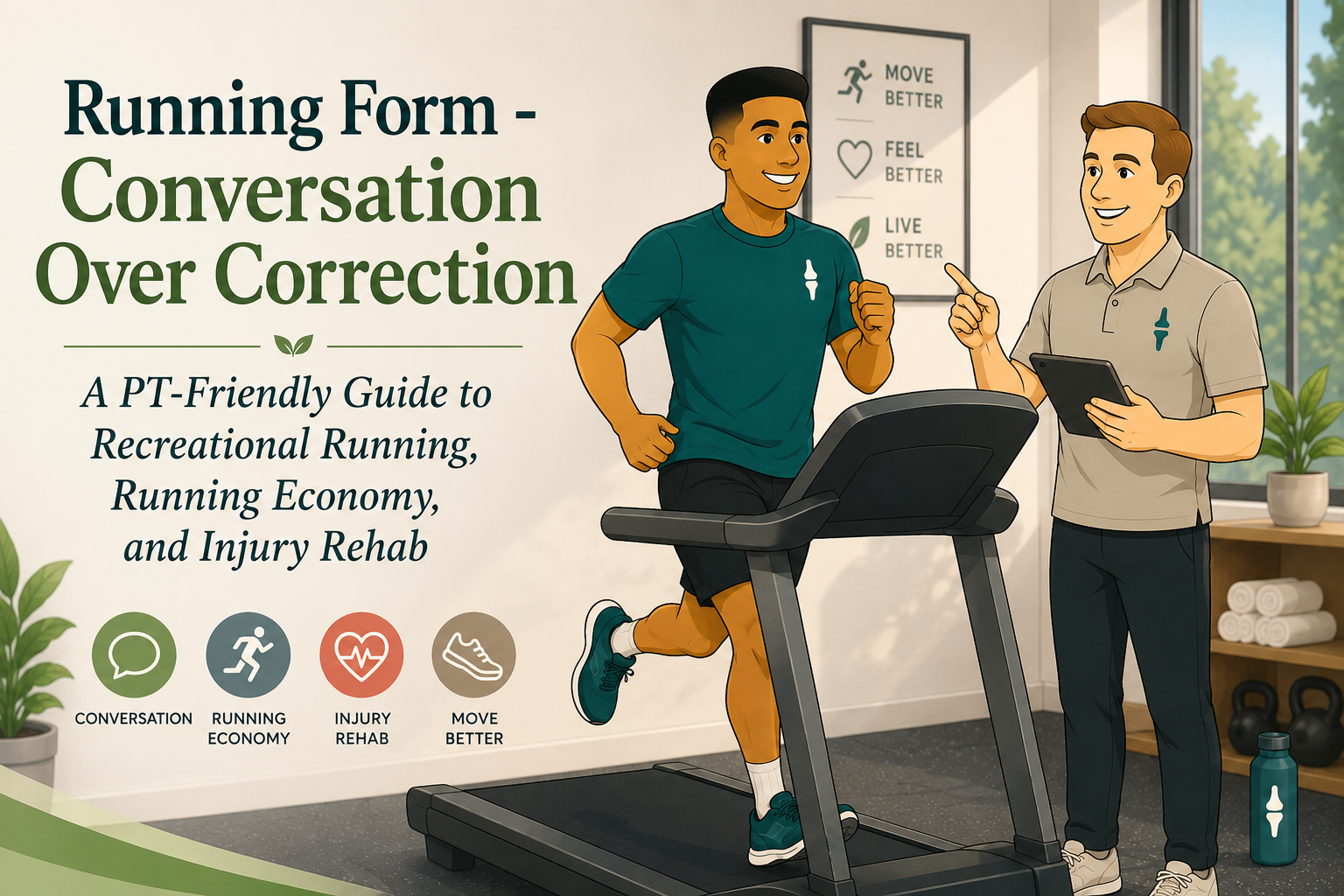
Running is simple until it is not.
A patient walks into the clinic and says, “I think my form is wrong.” Another says, “My knee hurts because I heel strike.” Someone else says, “I just want to run again but don’t know where to start.”
That is where physical therapy gets interesting.
Running rehab is not just about cadence, foot strike, hip strength, or tissue capacity (although all are important). It’s about the conversation between the runner and the clinician. It’s about the relationship between the runner and their body, their mindset, and their confidence. It’s about listening long enough to understand what running means to the person in front of us: stress relief, identity, cardiovascular health, competition, community, or simply thirty quiet minutes alone.
Running form is a movement strategy. And like any strategy, it should match the runner, the injury, the goal, the training history, and the life attached to the legs.
✨ Too Long Didn’t Read (TL;DR) / Summary
Recreational physical activity, including sports and walking/cycling activity, was not associated with increased risk of incident knee osteoarthritis in a large individual participant-level meta-analysis.
That matters because many runners still worry that running is “wearing out” their knees. Research is not supporting this claim. In fact, it may be starting to refute it.
Running injuries are common, but they are multifactorial. A systematic review found that roughly 1/4th of runners sustained a running-related injury, often in the knee, foot/ankle, and lower leg. The same review found evidence linking injury-onset to specific training parameters such as distance, duration, frequency, or intensity remains conflicting.
Translation: running-related injuries happen but it’s rarely just “one thing” that caused it. (Unless it’s a rolled ankle… then you definitely know what happened… Looking at you (with love), trail runners!)
For novice runners, injury can be the reason they stop. In one 6-week beginner running program, almost 30% of novice runners had stopped running by 26 weeks, with running-related injury as the main reason for discontinuation.
Note: That is a clinical opportunity for PTs: not just to “fix pain,” but to help runners restart with confidence.
A 2D running video analysis can be a useful part of a PT evaluation when paired with history, symptom behavior, strength testing, mobility testing, training review, and patient goals. It is not a crystal ball. It is a conversation starter.
There is no universal “best” foot strike.
Changing a rearfoot striker to a non-rearfoot strike pattern should not be recommended automatically for an uninjured runner, especially because evidence does not clearly show improved running economy and the change may shift load toward the ankle and plantarflexors.
Strength training belongs in the running conversation. High-load strength training, plyometrics, and combined strength methods may improve running economy in middle- and long-distance runners.
The best running rehab plan is rarely just “rest.” It is usually education, graded exposure, thoughtful loading, symptom monitoring, and shared decision-making.
🧾 General Information
What is running economy?
Running economy is the energy cost of running at a submaximal speed.
Translation: running economy = “how much energy it takes for a runner to maintain a given pace.”
A runner with better running economy can often run the same pace with less energy demand. That does not mean they look perfect on video. It means their body is using energy efficiently for the task.
Running economy can be influenced by training history, strength, tendon stiffness, biomechanics, fatigue, footwear, terrain, and psychological factors. Strength training appears to help. A 2024 systematic review and meta-analysis found that high-load strength training, plyometric training, and combined strength methods all improved running economy in middle- and long-distance runners compared with control conditions.
For the recreational runner, the takeaway is simple:
You do not need to obsess over looking like an elite marathoner. You probably need a body that is strong enough, conditioned enough, and prepared enough for the amount of running you are asking it to do.
Is running bad for your knees?
This is one of the most common questions runners ask, and it deserves an answer that does not scare people away from movement.
A large international meta-analysis found that recreational physical activity was not associated with incident radiographic knee osteoarthritis, painful radiographic knee osteoarthritis, or osteoarthritis-related knee pain.
That does not mean every painful knee should be ignored. Pain still matters. Swelling matters. A sharp change in symptoms matters. A history of trauma matters. But recreational running should not automatically be framed as “joint destruction.”
A better clinical response might sound like this:
“Your knee is not a tire with a fixed number of miles. It is living tissue. Let’s look at your symptoms, your training pattern, your strength, your recovery, and your running mechanics so we can decide what needs to change.”
That kind of answer builds trust. It respects the runner’s fear without feeding it.
Common running injuries: less blame, more investigation
Running injuries often show up around the knee, lower leg, foot/ankle, hip, Achilles tendon, and iliotibial band region. But it is usually too simplistic to say, “Your pain is because you heel strike,” or “Your glutes are weak,” or “Your shoes are wrong.”
Training load, recovery, sleep, stress, nutrition, prior injury, tissue capacity, footwear changes, terrain, strength, mobility, and running mechanics can all matter.
That is why a PT evaluation should feel less like a form correction appointment and more like a detective story.
Useful questions include:
What changed recently?
Did the runner increase distance, speed, hills, trails, racing, or frequency?
Did the runner change shoes?
Are symptoms worse at the start, during, after, or the next morning?
Does pain improve as the runner warms up or build as he/she continues?
Is this runner sleeping and eating enough to recover?
What does the runner believe is wrong?
Note: That last question is often the most important one.
A runner who believes their body is fragile may need education and graded exposure as much as they need strengthening. A runner who believes pain means damage may need help learning which symptoms are acceptable and which symptoms require follow-up.
Running form: what should we actually look at?
A video-based running analysis can be helpful, especially when it is systematic. A practical 2D running biomechanics framework is essential - ideally one that includes lateral and posterior views, symptom-matched treadmill speed when possible, adequate warm-up or acclimation, and assessment of multiple variables rather than one isolated “fault.”
From the side view, a PT may consider:
Foot strike pattern
Foot inclination angle at initial contact
Tibia angle during loading response
Knee flexion during stance
Hip extension in late stance
Trunk lean
Overstriding
Vertical displacement of the center of mass
Cadence
From the posterior view, a PT may consider:
Base of support
Heel eversion
Foot progression angle
Heel whip
Knee window
Pelvic drop
But here is the key: seeing something on video does not automatically mean it needs to be corrected.
A runner can have a rearfoot strike and be healthy. A runner can have mild pelvic drop and be pain-free. A runner can have a cadence below a popular internet ideal and still run well.
The clinical question is not, “Does this look textbook?”
The better question is, “Does this movement pattern connect to this runner’s symptoms, capacity, goals, and exam findings?”
Treadmill versus overground running
Treadmill running is useful in clinic because it allows controlled video analysis. But people will often ask if treadmill running is the same as overground or “flat road” running.
A systematic review and meta-analysis found that many spatiotemporal, kinematic, kinetic, muscle activity, and muscle-tendon measures are largely comparable between motorized treadmill and overground running. However, clinicians should pay attention to sagittal plane kinematic differences at foot strike when applying treadmill findings to overground running.
So yes, treadmill video can be clinically useful.
But we should still ask: “Is this how you normally run outside?”
A runner who changes mechanics on a treadmill may need overground observation, outdoor video, or symptom testing that better matches their real running environment.
Cadence: useful, not magical
Cadence is step rate. It is easy to measure and often easy to change.
Increasing cadence can reduce vertical displacement, braking impulse, mechanical energy absorbed at the knee, peak hip adduction angle, and hip adduction/internal rotation moments in certain runners. But that does not mean every runner needs to chase 180 steps per minute.
The best cadence cue is individualized. A small increase of 5% to 10% may be useful for a runner who is overstriding, landing loudly, or reporting symptoms linked to impact sensitivity. But a dramatic cadence change may feel awkward, increase fatigue, or shift symptoms elsewhere.
A friendly cue might be:
“Let’s make your steps a little quieter and a little quicker, not frantic.”
That is a very different message than:
“You run wrong.”
Foot strike: not a personality test
Foot strike gets too much blame.
A 2020 systematic review found limited retrospective evidence suggesting non-rearfoot strike running may be associated with lower reported repetitive stress injury rates, but prospective evidence comparing injury risk between strike patterns is lacking. The same review found no clear running economy advantage between habitual rearfoot and non-rearfoot runners, and immediately changing a rearfoot striker to a non-rearfoot pattern may reduce economy and shift loading toward the ankle and plantarflexors.
So, should PTs ever cue foot strike?
Yes, sometimes.
A foot strike change may be considered when it fits the patient’s symptoms, tissue irritability, goals, and exam.
But foot strike should not be sold as a universal injury-prevention rule.
A better clinical frame:
“We are not changing your foot strike because heel striking is bad. We are testing whether a slightly different loading strategy helps your symptoms and keeps you running.”
Strength training: the runner’s quiet superpower
Many runners would rather add miles than lift weights.
But strength training deserves a seat at the table. A 2024 systematic review found that high-load strength training, plyometric training, and combined methods may improve running economy in middle- and long-distance runners.
For rehab, strength training also helps build capacity. The more capacity for load your tissues have, the more load they can tolerate.
That being said, the program should match the runner’s injury, irritability, phase of healing, experience, and goals.
A practical running rehab strength plan may include:
Calf raises and soleus-focused loading
Hip abductor and external rotator strengthening
Quadriceps and hamstring strengthening
Single-leg control
Step-downs, split squats, deadlift variations, bridges, and loaded carries
Plyometrics when appropriate
Foot and ankle capacity work when relevant
Hip abductor weakness may be associated with iliotibial band syndrome in distance runners, but the evidence is less clear for other running-related injuries such as patellofemoral pain, medial tibial stress syndrome, tibial stress fracture, or Achilles tendinopathy. That means hip strengthening can be valuable, but it should not become the only tool in the toolbox.
Return to running: do not just hand out a mileage chart
A return-to-running plan should be understandable, flexible, and collaborative.
The runner should know:
What pain level is acceptable
What symptoms mean “modify”
What symptoms mean “stop and contact the PT”
How to progress volume
When to add speed, hills, or trails
How strength training fits into the week
How recovery will be monitored
One helpful framework is a “traffic light” system:
Green light: Mild symptoms that stay stable or improve during the run and return to baseline by the next day.
Yellow light: Symptoms that increase during the run, change mechanics, or linger longer than expected. Modify volume, intensity, terrain, or recovery.
Red light: Sharp pain, worsening swelling, limping, night pain, neurological symptoms, systemic symptoms, chest pain, fainting, or symptoms that feel medically concerning. Stop and seek appropriate care.
Return to running works best when the runner feels included. Instead of saying, “Do this plan,” try:
“Here is the plan I recommend. Let’s talk through what feels realistic with your schedule, your confidence, and your goals.”
That one sentence can change the whole relationship.
When should a runner see another provider or physician?
Physical therapists can screen, evaluate, treat movement-related impairments, educate, and help guide rehabilitation within their professional, jurisdictional, and personal scope of practice. Physical therapists should also recognize when symptoms require referral, co-management, or urgent medical evaluation.
A runner should be referred to another provider, physician, urgent care, or emergency services when appropriate, especially with:
Chest pain, pressure, unusual shortness of breath, fainting, or near-fainting
New neurological symptoms such as numbness, weakness, foot drop, bowel/bladder changes, or saddle anesthesia
Suspected fracture, traumatic injury, visible deformity, inability to bear weight, or rapidly worsening pain
Bone stress injury concerns, especially focal bone pain that worsens with impact, night pain, or pain with hopping
Calf swelling, redness, warmth, unexplained shortness of breath, or symptoms concerning for vascular involvement
Fever, unexplained weight loss, night sweats, infection signs, or feeling systemically ill
Persistent swelling, locking, catching, giving way, or major loss of function
Pain that is not behaving mechanically or does not match the exam
Pregnancy/postpartum concerns requiring medical coordination
Nutrition, menstrual health, energy availability, or eating disorder concerns beyond the PT’s scope
Medication questions, cardiometabolic concerns, or medical conditions that affect safe exercise participation
👩⚕️ For Providers 👨⚕️
Start with the runner’s story, not the runner’s stride
Before the camera comes out, ask better questions.
Try:
“What does running give you that you do not want to lose?”
“What are you most worried this pain means?”
“What have you already tried?”
“What would a good outcome look like for you?”
“What does your ideal running week look like?”
These questions give you clinical data. They also tell the patient, “I see you as a person, not just a gait pattern.”
A practical PT running evaluation flow
A strong running evaluation may include the following:
Symptom behavior and irritability
Training history and recent changes
Footwear, terrain, pace, hills, racing, and cross-training
Medical screening and red flags
Strength, mobility, balance, power, and tissue capacity testing
Functional testing such as squat, step-down, hop, calf endurance, or single-leg tasks when appropriate
Running video analysis when it will answer a clinical question
Shared plan with symptom rules and follow-up progression
Running analysis should complement the physical exam and history, not replace them.
Use video as a mirror, not a weapon
Video can help runners understand their movement, but it can also make them self-conscious.
Instead of saying:
“See how bad that looks?”
Try:
“Here is one thing I notice. Let’s see if changing it changes your symptoms or effort.”
The first phrase creates shame. The second creates curiosity.
Common clinical targets and how to frame them
Overstriding:
“Your foot is landing a little farther ahead of your body. Let’s test a slightly quicker step rate and see if that reduces braking and impact.”
Cadence:
“We are not chasing a magic number. We are looking for a rhythm your body tolerates.”
Foot strike:
“Your heel strike is not automatically bad. We only change it if the change helps your symptoms, load tolerance, or goal.”
Hip/pelvis mechanics:
“I see some motion here, but motion is not automatically a problem. Let’s compare it with your strength, symptoms, and fatigue.”
Strength:
“This is not punishment for getting injured. This is how we give your tissues more options.”
Return to running:
“You are not starting over. You are rebuilding with better information.”
What not to overpromise
Avoid saying:
“This foot strike will prevent injury.”
“Your glutes are the reason you got hurt.”
“Never run through pain.”
“Running is bad for your knees.”
“You must run at 180 steps per minute.”
“Your form is wrong.”
Try saying:
“Let’s test this.”
“Let’s see how your symptoms respond.”
“Let’s build capacity.”
“Let’s make the plan fit your life.”
“That finding matters only if it connects to your symptoms and goals.”
The best cue is the one the runner understands, feels, and can repeat.
A sample patient-facing script
“Your pain makes sense, and it does not mean you are broken. Running injuries are usually multifactorial, so I do not want to blame one thing like your shoes, your foot strike, or your hip strength without looking at the full picture. Today we will review your training, test your strength and mobility, look at your running if needed, and build a plan that lets us calm symptoms while keeping you as active as possible. If anything suggests this needs medical evaluation, I will tell you clearly and help guide that next step.”
That script is clinical. It is also human.
That is The Joint Connection.
Key Clinical Takeaways
Running is not automatically harmful to knees, and recreational physical activity was not associated with incident knee osteoarthritis outcomes in a large pooled analysis.
Running injuries are common, but training parameters alone do not fully explain injury risk.
Novice runners may stop running because of injury, so PTs should address both injury recovery and confidence with restarting.
2D running video analysis is useful when performed systematically and interpreted alongside the full clinical picture.
Treadmill running is often clinically useful, but clinicians should be cautious when applying treadmill foot-strike findings to overground running.
Foot strike changes should be individualized, not prescribed as a universal fix.
Strength training can improve running economy and should be part of many running rehab plans.
Hip abductor weakness may matter most clearly in iliotibial band syndrome, but it is not a universal explanation for every running injury.
PTs should practice within professional, jurisdictional, and personal scope, and should refer or co-manage when symptoms or patient needs exceed PT scope.
📂 Supplemental Information / Citations
Lavie CJ, Lee DC, Sui X, Arena R, O’Keefe JH, Church TS, Milani RV, Blair SN. Effects of running on chronic diseases and cardiovascular and all-cause mortality. Mayo Clin Proc. 2015;90(11):1541-1552. doi:10.1016/j.mayocp.2015.08.001
Gates LS, Perry TA, Golightly YM, et al. Recreational physical activity and risk of incident knee osteoarthritis: an international meta-analysis of individual participant-level data. Arthritis Rheumatol. 2022;74(4):612-622. doi:10.1002/art.42001
Fredette A, Roy JS, Perreault K, Dupuis F, Napier C, Esculier JF. The association between running injuries and training parameters: a systematic review. J Athl Train. 2022;57(7):650-671. doi:10.4085/1062-6050-0195.21
Fokkema T, Hartgens F, Kluitenberg B, et al. Reasons and predictors of discontinuation of running after a running program for novice runners. J Sci Med Sport. 2019;22(1):106-111. doi:10.1016/j.jsams.2018.06.003
Souza RB. An evidence-based videotaped running biomechanics analysis. Phys Med Rehabil Clin N Am. 2016;27(1):217-236. doi:10.1016/j.pmr.2015.08.006
Van Hooren B, Fuller JT, Buckley JD, et al. Is motorized treadmill running biomechanically comparable to overground running? A systematic review and meta-analysis of cross-over studies. Sports Med. 2020;50(4):785-813. doi:10.1007/s40279-019-01237-z
Anderson LM, Bonanno DR, Hart HF, Barton CJ. What are the benefits and risks associated with changing foot strike pattern during running? A systematic review and meta-analysis of injury, running economy, and biomechanics. Sports Med. 2020;50(5):885-917. doi:10.1007/s40279-019-01238-y
Llanos-Lagos C, Ramirez-Campillo R, Moran J, Sáez de Villarreal E. Effect of strength training programs in middle- and long-distance runners’ economy at different running speeds: a systematic review with meta-analysis. Sports Med.2024;54(4):895-932. doi:10.1007/s40279-023-01978-y
Mucha MD, Caldwell W, Schlueter EL, Walters C, Hassen A. Hip abductor strength and lower extremity running related injury in distance runners: a systematic review. J Sci Med Sport. 2017;20(4):349-355. doi:10.1016/j.jsams.2016.09.002
This content drafted, researched, edited, and generated by:
McKinley Pollock, PT, DPT
McKinley Pollock, PT, DPT, OCS, CSCS is a physical therapist with a background in orthopedics and sports rehabilitation. Dr. Pollock earned his doctorate of physical therapy from Campbell University in 2021, is a board-certified orthopedic clinical specialist (OCS), and certified strength and conditioning specialist (CSCS). Dr. Pollock enjoys combining lessons learned from his DPT training and research, translating these into clinical practice. His passions include promoting relationships between patients & clinicians to promote clinical effectiveness, satisfaction, and efficiency, the implementation of primary preventative medicine into clinical practice, and leadership and education development.
© 2026 The Joint Connection Company. All rights reserved.
The content on this website, including all text, graphics, and materials, is the exclusive property of The Joint Connection Company and is protected by applicable copyright and intellectual property laws. No part of this site may be reproduced, distributed, or used without prior written permission.