

✨ Too Long Didn’t Read (TL;DR) / Summary
Returning to sport after an ACL tear usually takes 9–12+ months, and rushing the process dramatically increases the risk of re-injury. Safe return-to-sport decisions should be based on objective data—like quadriceps strength, balance, and functional testing—not just time on the calendar.
Quadriceps weakness is common after ACL injury and surgery, and tools like neuromuscular electrical stimulation (NMES) can accelerate early recovery. Returning too soon—especially before 9 months—can increase re-tear risk by up to seven times.
Most importantly, ACL rehab works best when it’s a conversation, not a countdown. Trust, education, and collaboration between patient and provider are just as important as strength and mechanics.
🧾 Condition-Specific General Information
Understanding ACL Injury & Recovery
An ACL tear can disrupt more than movement—it can disrupt confidence, identity, and daily routines. Whether someone is a competitive athlete or simply wants to return to work, parenting, or recreational activity, the recovery process should reflect their goals, not just the MRI.
Typical Return-to-Activity Timeline
9–12+ months for return to sport after ACL reconstruction
Timeline may extend with:
Concomitant injuries (meniscus, cartilage)
Graft type (quad tendon, hamstring tendon, patellar tendon)
Persistent strength or control deficits
Key Physical Factors We Monitor
Knee range of motion (ROM)
Quadriceps strength (often significantly reduced post-op)
Balance and neuromuscular control
Multi-planar lower-extremity strength and power
Functional performance (hopping, agility, landing mechanics)
Not everyone with an ACL tear requires surgery. Some individuals—often called “copers”—can return to daily life or low-demand activities through structured rehabilitation alone. These decisions should be shared, thoughtful, and pressure-free.
👩⚕️ For Providers 👨⚕️
Reframing Return-to-Sport as a Dialogue
Patients don’t just ask “When can I play again?”
They’re often really asking:
“Can I trust my knee?”
“Am I going to get hurt again?”
“Do you believe in my recovery?”
How we answer matters.
Early-Phase Rehab Priorities
Restore quadriceps activation
Reduce inhibition and fear avoidance
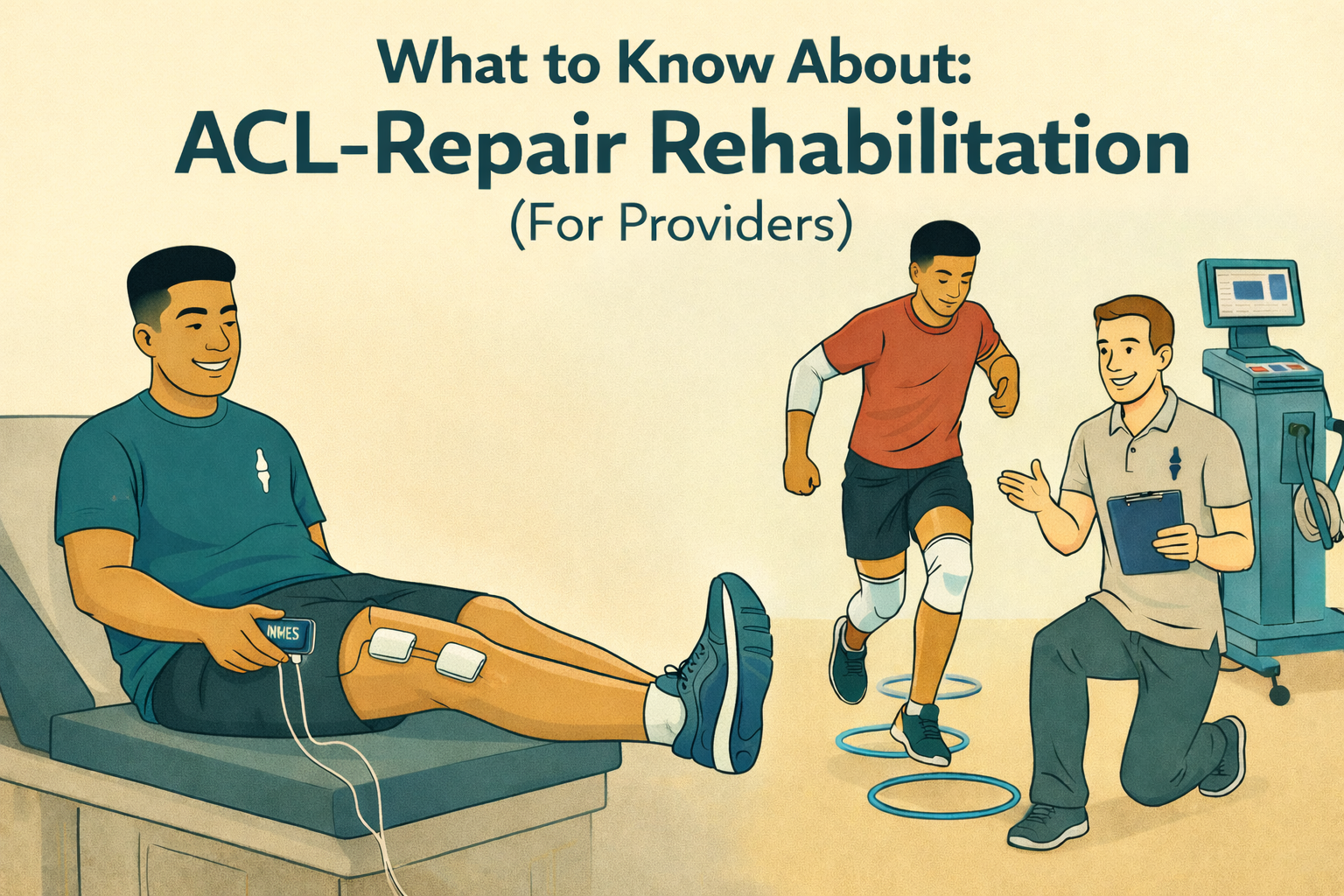
Use NMES alongside exercise to accelerate quad recruitment
Reinforce progress with clear explanations and reassurance
Brace & Quad Control Milestones
Ability to perform 10 straight-leg raises without quad lag
Normalized gait without deviations
Gradual brace unlocking only after control is established
(The brace is protection, not punishment—removing it too early can increase pain and setbacks.)
Strength-Based Functional Progression
Rather than weeks post-op, consider deficit-based milestones:
Return-to-Activity Benchmarks
≤30% quad deficit: Begin straight-line running/jogging
≤20% quad deficit: Introduce jumping and plyometrics
≤10% quad deficit: Progress to sport-specific drills
Functional Testing to Support Decision-Making
Isokinetic/Biodex testing (gold standard)
Hop tests (single, triple, crossover)
Y-Balance Test
Agility tests (T-test)
Single-leg stance and heel raises
Vertical and broad jumps
Why Waiting Saves Careers
ACL re-tear rates remain as high as 20%
Returning before 9 months post-reconstruction increases new injury risk 7-fold
Evidence supports progressive loading, not fear-based restriction
Providers who explain why we wait—not just that we wait—build trust, adherence, and safer outcomes.
Return-to-Sport Conversation Starters (For Patients)
Encourage patients to ask:
“What tests show I’m ready—or not ready—yet?”
“How does my quad strength compare to my other leg?”
“What movements put me most at risk right now?”
“What would waiting longer protect me from?”
“What does success look like at 12 months, not just today?”
Return-to-Sport Readiness Checklist
✔ Full knee ROM
✔ No effusion with activity
✔ Normalized gait without brace
✔ Quadriceps strength within 10% of uninvolved side
✔ Pass functional hop and balance tests
✔ Psychological readiness and confidence
✔ Clear understanding of re-injury risk
📂 Supplemental Information / Citations
Marom N, Xiang W, Wolfe I, et al. High variability and lack of standardization in the evaluation of return to sport after ACL reconstruction: a systematic review. Knee Surg Sports Traumatol Arthrosc. 2022;30(4):1369-1379.
Li Z, Jin L, Chen Z, et al. Effects of neuromuscular electrical stimulation on quadriceps femoris muscle strength and knee joint function after ACL surgery: a systematic review and meta-analysis. Orthop J Sports Med.2025;13(1):23259671241275071.
Rambaud AJM, Ardern CL, Thoreux P, Regnaux JP, Edouard P. Criteria for return to running after ACL reconstruction: a scoping review. Br J Sports Med. 2018;52(22):1437-1444.
Pamboris GM, Pavlou K, Paraskevopoulos E, Mohagheghi AA. Open vs closed kinetic chain exercises in ACL rehabilitation: a systematic review and meta-analysis. Front Sports Act Living. 2024;6:1416690.
Beischer S, Gustavsson L, Senorski EH, et al. Young athletes returning to sport before 9 months after ACL reconstruction have a rate of new injury 7 times higher. J Orthop Sports Phys Ther. 2020;50(2):83-90.
Cristiani R, Forssblad M, Edman G, Eriksson K, Stålman A. Age, time from injury to surgery, and quadriceps strength affect revision risk after ACL reconstruction. Knee Surg Sports Traumatol Arthrosc. 2021;29(12):4154-4162.
This content drafted, researched, edited, and generated by:
Jackson Kojima, PT, DPT
Jackson Kojima, PT, DPT, OCS is a physical therapist with an extensive background in orthopedics, geriatrics, and sports rehabilitation. Dr. Kojima is a board-certified orthopedic clinical specialist (OCS) with a passion for post-operative rehabilitation and enjoys treating multi-factorial conditions like low back pain and generalized joint pain. Dr. Kojima earned his doctorate of physical therapy from Campbell University in 2021 and currently lives in Kernersville, NC.
© 2026 The Joint Connection Company. All rights reserved.
The content on this website, including all text, graphics, and materials, is the exclusive property of The Joint Connection Company and is protected by applicable copyright and intellectual property laws. No part of this site may be reproduced, distributed, or used without prior written permission.