

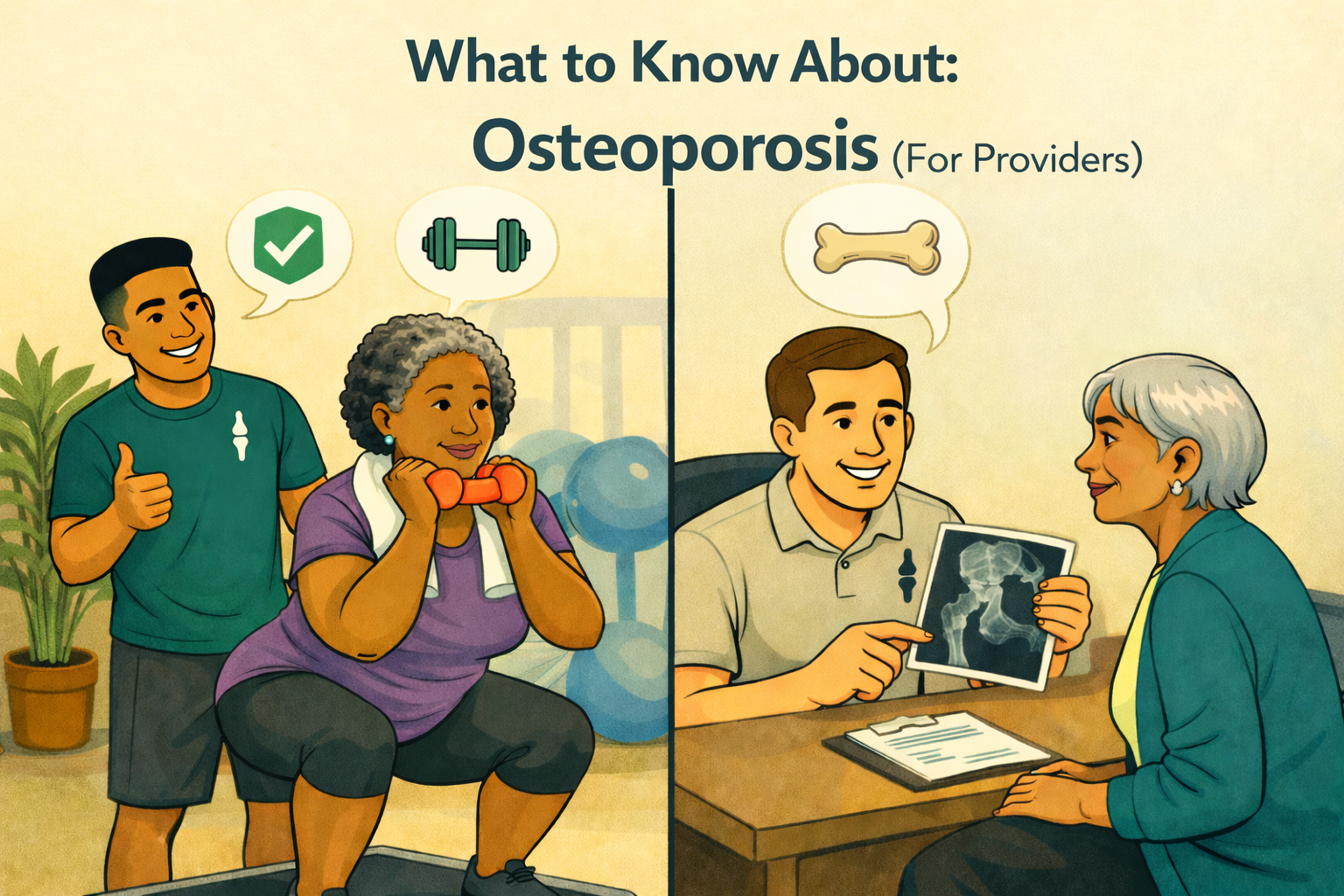
If you’ve ever heard “your bones are thinning” and felt your stomach drop, you’re not alone. Osteoporosis can sound like a silent, inevitable slide—until it isn’t. The truth: there’s a lot we can do, and the most powerful starting point is often the simplest one: a real conversation between a patient and a provider.
Because osteoporosis care isn’t just numbers on a scan. It’s fear of falling, confidence to move, medication questions, family history, and the moment someone finally says, “I didn’t know that fracture counted.”
Let’s break it down—clearly, kindly, and with action steps you can actually use.
✨ Too Long Didn’t Read (TL;DR) / Summary
Osteoporosis = bones become weaker and more fragile, raising fracture risk—even from a fall from standing height.
You can be at risk even with osteopenia (mildly low bone density). Many fractures happen in this group.
Diagnosis often comes from a DXA scan (T-score), or any fragility fracture, especially hip/spine.
FRAX is a common tool that estimates 10-year fracture risk. In the US, treatment is often considered if hip risk ≥3% or major fracture risk ≥20%.
Lifestyle matters: strength + balance training can reduce falls, which is huge—falls are often the domino that starts everything.
A hard truth: fewer than 30% of patients receive osteoporosis medication after a fragility fracture in the US. That gap is where better communication saves bones.
One takeaway: If you’ve had a low-trauma fracture or you’re worried about risk—bring it up. Ask for a plan. Ask what your number means.
🧾 Condition-Specific General Information
What is postmenopausal osteoporosis?
After menopause, estrogen levels drop. Estrogen helps keep bone breakdown (resorption) in check. When estrogen decreases, bone breakdown speeds up and can outpace bone building—especially in the years right before and after menopause. This can lead to lower bone density and higher fracture risk.
Osteoporosis vs osteopenia (and why the labels can be misleading)
Bone density is often described using a T-score from a DXA scan:
Normal: T-score ≥ -1.0
Osteopenia (low bone mass): T-score between -1.0 and -2.5
Osteoporosis: T-score ≤ -2.5
Severe/established osteoporosis: T-score ≤ -2.5 plus a fragility fracture
Here’s the tricky part: a lot of fractures happen in osteopenia, simply because more people fall into that category. So “only osteopenia” is not the reassurance it sounds like—especially if FRAX risk is high or there’s a prior fracture history.
What counts as an “osteoporotic” or fragility fracture?
A fragility fracture is generally a fracture from low-trauma force—like a fall from standing height.¹,²
Commonly “major osteoporotic fracture” sites include: hip, spine, humerus (upper arm), and distal forearm (wrist).
Also important: newer evidence suggests some fractures after “higher trauma” (like falling down stairs) can still be linked to low bone density and predict future fractures—so don’t self-dismiss an injury just because it didn’t feel “minor.”
Who should be screened?
Many guidelines recommend DXA screening for:
All women ≥65, and
Women <65 with risk factors (like prior fractures, low body weight, smoking, steroid use, family history, etc.).
FRAX: a quick self-check tool that can start a better visit
FRAX estimates 10-year risk of hip and major osteoporotic fractures using age, sex, weight, smoking, steroid use, prior fracture, parental hip fracture history, rheumatoid arthritis, alcohol intake, and more (with optional femoral neck BMD).⁴
In the US, treatment consideration often begins at:
Major osteoporotic fracture risk ≥20%, or
Hip fracture risk ≥3% over 10 years.
Patient-friendly move: If you’re comfortable, you can run FRAX before your appointment and bring the results as a conversation starter. (It’s not a diagnosis—but it can be a great “here’s why I’m asking” tool.)
What you can do today (the “boring stuff” that works)
Non-medication strategies matter for everyone, regardless of treatment plan.
Movement that protects your future self
Balance + functional training (≥2x/week): reduces falls.
Progressive resistance training (≥2x/week): improves strength and can support bone density.
Other activities (walking, yoga, Pilates) can be great in addition to—not instead of—balance + strength, and should be modified for safety based on fracture risk.
Nutrition basics
Many guidelines suggest 1000–1200 mg/day calcium (preferably from diet) and vitamin D intake to support bone health, though fracture-prevention evidence is debated and supplementation should fit the individual (dietary intake, deficiency risk, medication plan).
Over-supplementing can carry risks (for example, kidney stones; cardiovascular risk signals have been discussed in some analyses).
Fall prevention is fracture prevention
Falls aren’t just “clumsy moments.” They are often the event that turns risk into reality. Exercise, home safety, vision checks, medication review, and footwear choices are all part of prevention.
👩⚕️ For Providers 👨⚕️
The “connection moment” you can’t skip
Many patients don’t realize that a wrist fracture after a simple fall can be a bone health warning. Others feel shame (“I’m getting old”), fear (“I’ll break again”), or confusion (“My scan wasn’t that bad”). Your tone sets the trajectory.
Try:
“This fracture may be telling us something important about your bone strength. Can we talk about your risk and what we can do to prevent the next one?”
“Even osteopenia can carry real fracture risk—especially when we factor in your history and FRAX.”
Close the post-fracture treatment gap (the systems-level win)
A striking point: less than 30% of patients receive anti-osteoporosis treatment after a fragility fracture in the US.
That’s not just an adherence issue—it’s often a handoff issue. Consider fracture liaison services, automatic DXA/FRAX pathways, and clear “who owns bone health follow-up” agreements.
Risk stratification: make it feel understandable
Patients do better when they can repeat the plan back to you.
A clear script:
“Here’s what we know.” (DXA T-score, fracture history, FRAX)
“Here’s what that means.” (high vs very high risk; what matters most)
“Here’s what we’re doing next.” (labs for secondary causes, exercise referral/PT, medication discussion, monitoring timeline)
High-level risk categories used in major guidelines often distinguish high risk vs very high risk (e.g., recent fracture, multiple fractures, very low T-score), and therapy selection may differ—anabolic-first strategies are often favored for very high risk when appropriate.
Exercise counseling that patients can actually follow
Patients hear “exercise” and think “walk more.”
Walking is good—but fall reduction and strength gains often require more targeted work.
From recent guidelines and physical therapy clinical practice guidance:
Balance/functional training ≥2x/week (progress difficulty over time).
Progressive resistance training ≥2x/week (major muscle groups + back extensors/abdominals).
Encourage enjoyable activity (yoga/Pilates/walking) as add-ons, with safety modifications for high-risk patients.
Clinical pro-tip: If your patient is anxious about movement, consider a PT referral framed as empowerment:
“Let’s get you moving in a way that builds confidence and lowers fall risk—safely.”
Monitoring & follow-up: set expectations early
Many guidelines recommend repeating DXA 1–2 years after starting or changing therapy, then individualizing.
Also: no treatment reduces fracture risk to zero. If BMD declines meaningfully or fractures occur, reassess adherence, secondary causes, and therapy choice.
Conversation Topics and Discussion Points Checklist
✅ Have I had a fracture from a fall from standing height (or similar) since age 40?
✅ Do I know my DXA T-scores (spine/hip/femoral neck)? What do they mean?
✅ What is my FRAX 10-year risk (hip and major osteoporotic fracture)?
✅ Am I at low, moderate, high or very high fracture risk—and what does that change?
✅ What’s my plan for: strength training + balance training, fall prevention, calcium/vitamin D intake, and medication options (if indicated)?
✅ When do we recheck DXA or reassess?
📂 Supplemental Information / Citations
Subarajan P, Arceo-Mendoza RM, Camacho PM. Postmenopausal osteoporosis: a review of latest guidelines. Endocrinol Metab Clin North Am. 2024;53(4):497-512. doi:10.1016/j.ecl.2024.08.008
Walker MD, Shane E. Postmenopausal osteoporosis. N Engl J Med. 2023;389(21):1979-1991. doi:10.1056/NEJMcp2307353
Morin SN, Feldman S, Funnell L, et al. Clinical practice guideline for management of osteoporosis and fracture prevention in Canada: 2023 update. CMAJ. 2023;195:E1333-E1348.
Morin SN, Leslie WD, Schousboe JT. Osteoporosis: a review. JAMA. 2025;334(10):894-907. doi:10.1001/jama.2025.6003
Hartley GW, Roach KE, Nithman RW, et al. Physical therapist management of patients with suspected or confirmed osteoporosis: a clinical practice guideline from the Academy of Geriatric Physical Therapy. J Geriatr Phys Ther.2022;44(2):E106-E119. doi:10.1519/JPT.0000000000000346
Silverstein WK, Cantor N, Cheung AM. Postmenopausal osteoporosis. N Engl J Med. 2024;390(7):673-674. doi:10.1056/NEJMc2314624
This content drafted, researched, edited, and generated by:
McKinley Pollock, PT, DPT
McKinley Pollock, PT, DPT, OCS, CSCS is a physical therapist with a background in orthopedics and sports rehabilitation. Dr. Pollock earned his doctorate of physical therapy from Campbell University in 2021, is a board-certified orthopedic clinical specialist (OCS), and certified strength and conditioning specialist (CSCS). Dr. Pollock enjoys combining lessons learned from his DPT training and research, translating these into clinical practice. His passions include promoting relationships between patients & clinicians to promote clinical effectiveness, satisfaction, and efficiency, the implementation of primary preventative medicine into clinical practice, and leadership and education development.
© 2026 The Joint Connection Company. All rights reserved.
The content on this website, including all text, graphics, and materials, is the exclusive property of The Joint Connection Company and is protected by applicable copyright and intellectual property laws. No part of this site may be reproduced, distributed, or used without prior written permission.