

What to Know About: Lateral Ankle Sprains (For Providers)
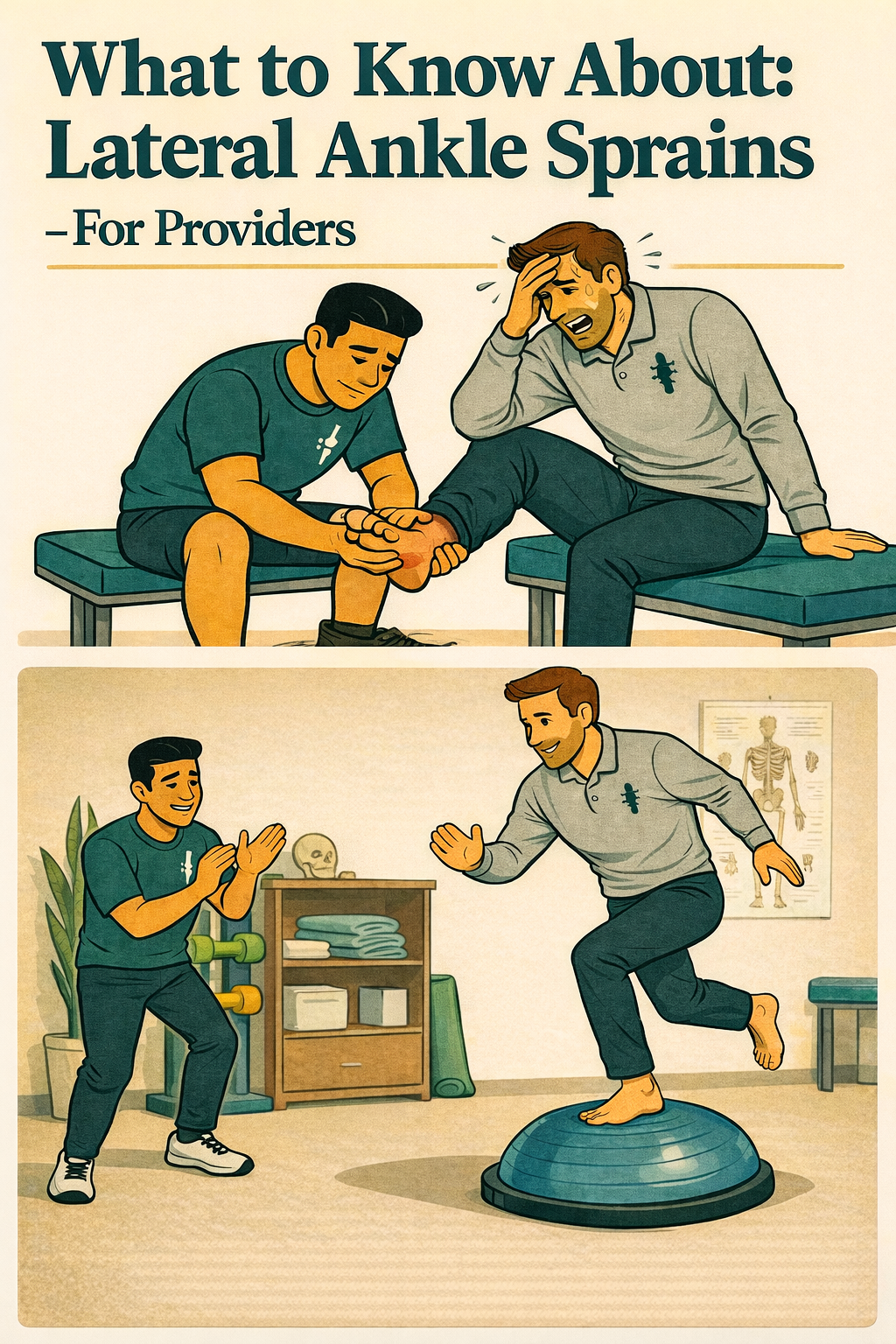
A two-panel illustration showing the emotional and clinical arc of a severe lateral ankle sprain: first, a visibly distressed patient in acute pain receiving a careful ankle exam from a calm physical therapist, followed by guided recovery as the patient performs barefoot balance training on a BOSU ball with supportive supervision.
✨ Too Long Didn’t Read (TLDR) / Summary
What is it? An outward “roll” of the ankle stretches/tears the lateral ligaments including (but not limited to) the anterior talofibular ligament (ATFL), calcaneofibular ligament (CFL), and/or the posterior talofibular ligament (PTFL).
Common symptoms: Pain on the lateral portion of the ankle, swelling, bruising (may track into the foot), stiffness, and trouble bearing weight.
Recovery window: Mild sprains often improve in ~1 week; moderate sprains in 3–4 weeks; severe/athletic cases can take longer. All degrees of sprain could benefit from structured rehab.
Care focus: Favor PEACE & LOVE principles—early protection, elevation, compression, education → gradual return to loading and exercise. Ice can be used early for symptom relief, but prioritize gentle mobility.
Prevention: Balance/proprioception training; prophylactic bracing in higher-risk sports like basketball or football.
🧾 Condition-Specific General Information
A lateral ankle sprain happens when the foot rolls outward and stresses the ligaments on the outer side of the ankle. Swelling can appear quickly; bruising often shows over the next 24–48 hours and may extend into the foot. Stiffness and reduced motion are common.
Typical recovery: Mild ≈ 1 week; moderate ≈ 3–4 weeks; severe = months (often with PT) depending on your activity goals.
Why early motion? Gentle, progressive movement supports circulation, reduces stiffness, and helps maintain strength.
Helpful early tools: Compression, elevation, short-term bracing/taping for comfort and walking tolerance (avoid immobilizers > ~10 days).
👩⚕️ For Providers
What to expect: Pain and swelling near the outside of the ankle, sometimes with bruising into the foot. Walking can be sore at first but is usually safe as tolerated.
Priorities: Educate clearly, set shared goals, and pair objective tests with functional outcomes. Validate concerns and use teach-back for understanding.
🔑 Key Education Points
Framework: Emphasize PEACE & LOVE rather than strict RICE (Protection, Elevation, Avoid anti-inflammatories early, Compression, Education → Load, Optimism, Vascularization, Exercise).
Imaging: Apply Ottawa ankle/foot rules to guide radiography.
Severity: Review grades of sprain and realistic timelines.
Programming: Early ROM → progressive loading → proprioception/balance → sport-specific work.
❓ Potential Questions Your Patients May Ask + Potential Answers
How do I reduce swelling? Elevation + compression + gentle mobility. Ice can help early if it makes you feel better.
How long will healing take? Mild: ~1 week to 1 month; more serious sprains can take months to return to normal activity.
What should I do now? Use a brace/tape briefly to regain weight bearing; avoid immobilizers beyond ~10 days. Start range-of-motion, stretching, and light strengthening as tolerated.
How long until I walk normally? Depends on severity; early, progressive movement usually speeds recovery.
When can I run or play sports? After pain settles and you’ve rebuilt motion, balance/proprioception, and strength. Progress sport-specific drills as tolerable and appropriate.
Do I need an X-ray? Discuss with provider. If the patient cannot put weight on the ankle/foot or pain is severe, seek evaluation to rule out fracture.
Is it safe to walk/work out? Usually yes—as tolerated. Let pain guide modifications.
Do I need a brace? A brace can reduce symptoms and improve early walking. Can also help with prophylactic prevention for recurrent lateral ankle sprains.
Do I need PT? Not always, but PT helps restore motion/strength, improves balance, and lowers re-injury risk.
How do I prevent another sprain? Proprioceptive/balance training and prophylactic bracing in high-risk activity (example: cutting sports like soccer and basketball).
🗓️ Patient Timeline
Day 0–2: Elevate, compress, and keep it gently moving. If you cannot bear weight, see a medical provider to rule out fracture.
Early rehab (first 1–2 weeks): Begin ankle range-of-motion, light strengthening, and balance drills; short-term brace/tape can help walking.
Progression: Advance strengthening, single-leg balance, and step-ups. Add light jogging/agility only when walking is pain-free and swelling is controlled.
Return to sport/work: Add sport-specific drills and impact gradually; consider a brace initially for confidence.
🏃 Return-to-Sport Readiness Assessments
Star Excursion Balance Testing (SEBT)
Y-Balance Testing
Single-leg heel raises
T-test
🤝 Soft-Skills Focus
Translate milestones (“Balance work reduces re-sprain risk when you cut and pivot”).
Reflect concerns (“You’re worried about rolling it again—let’s plan bracing for early return”).
Close with teach-back (“How will you progress your exercises this week?”).
📂 Supplemental Information / Citations
⚕️Lateral Ankle Sprain - Clinical Practice Guideline (cite: American Physical Therapy Association (APTA))
📚 Martin RL, Davenport TE, Fraser JJ, et al. Ankle Stability and Movement Coordination Impairments: Lateral Ankle Ligament Sprains Revision. JOSPT. 2021;51(4):CPG1–CPG80.
📚 Dubois B, Esculier J. Soft-tissue injuries simply need PEACE and LOVE. Br J Sports Med. 2020;54:72–73.
📚 Bachmann LM, Kolb E, Koller MT, Steurer J, ter Riet G. Accuracy of Ottawa ankle rules to exclude fractures. BMJ. 2003;326(7386):417.
This content drafted, researched, edited, and generated by:
Jackson Kojima, PT, DPT
Jackson Kojima, PT, DPT, OCS is a physical therapist with an extensive background in orthopedics, geriatrics, and sports rehabilitation. Dr. Kojima is a board-certified orthopedic clinical specialist (OCS) with a passion for post-operative rehabilitation and enjoys treating multi-factorial conditions like low back pain and generalized joint pain. Dr. Kojima earned his doctorate of physical therapy from Campbell University in 2021 and currently lives in Kernersville, NC.
© 2025 The Joint Connection Company. All rights reserved.
The content on this website, including all text, graphics, and materials, is the exclusive property of The Joint Connection Company and is protected by applicable copyright and intellectual property laws. No part of this site may be reproduced, distributed, or used without prior written permission.