

The Heart of Healing: Why Empathy Matters on Both Sides of the Exam Table
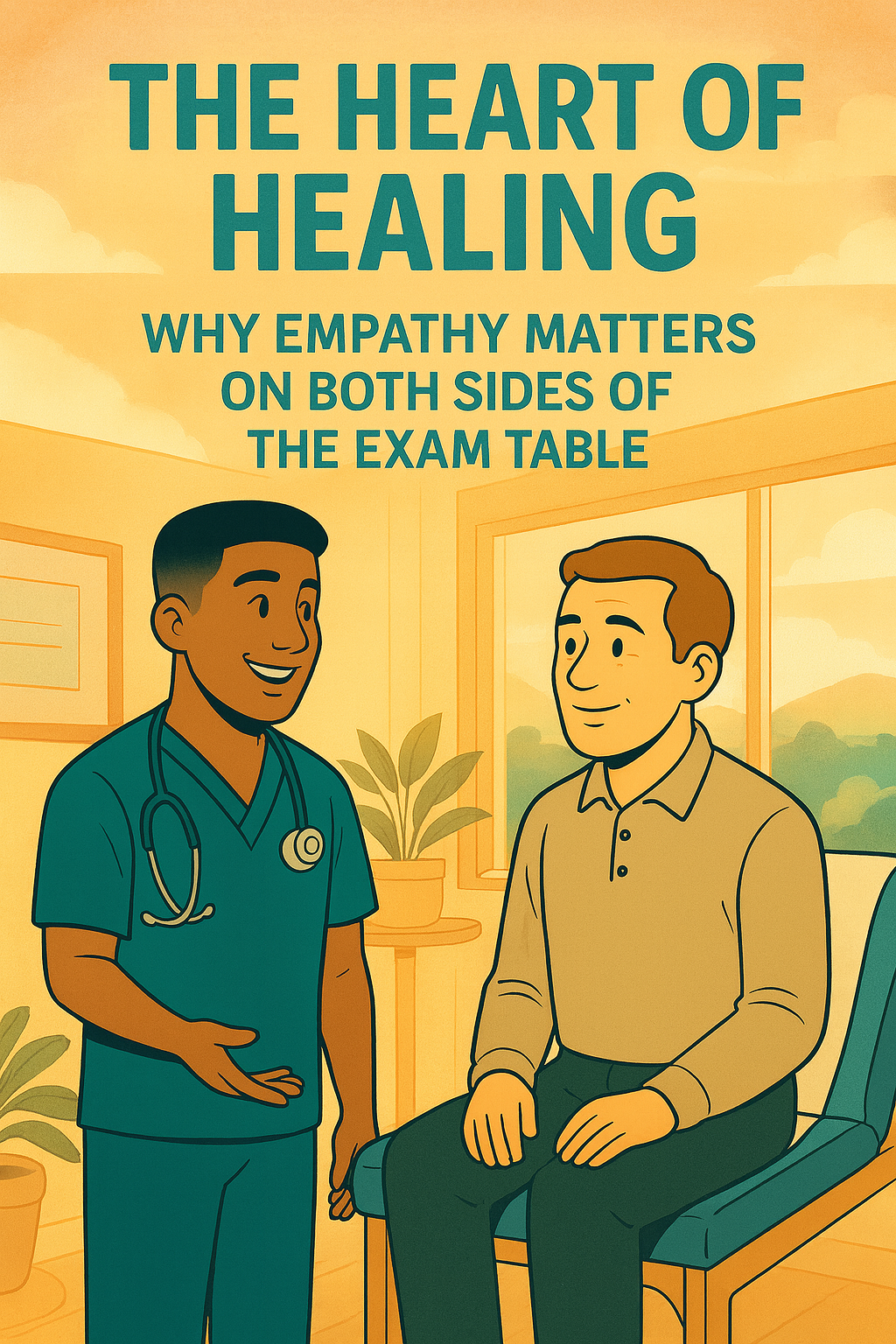
An illustrated healthcare scene showing a provider and patient sharing a compassionate conversation during a medical exam, reinforcing the theme “The Heart of Healing: Why Empathy Matters on Both Sides of the Exam Table.” The provider stands warmly beside the seated patient, creating a supportive, trust-centered interaction.
✨ Too Long Didn’t Read (TLDR) / Summary
Empathy is the heart of healing. It’s not just kindness—it’s the bridge between medical skill and human understanding.
When clinicians show empathy, patients trust more, share more, and heal better. Studies show empathy improves satisfaction, adherence, and even physical health outcomes.
Patients play a role too. Openness, honesty, and clear communication make care more personal and effective.
Empathy can be taught. Training that focuses on communication, relationship-building, and emotional resilience strengthens both clinicians and patients.
Empathy can fade under stress. Heavy workloads, emotional fatigue, and “professional distancing” can make it hard for providers to stay connected.
The brain rewards connection. Warm communication and trust has been shown to reduce stress, lower blood pressure, and help the body feel safe enough to heal.
Small shifts make a big difference. Simple actions like listening fully, checking for understanding, or expressing appreciation build trust and better outcomes.
Introduction
Empathy isn’t just a “nice-to-have” in healthcare—it’s the bridge that connects medical expertise with human experience. When providers attempt to understand what their patients are going through, care feels personal, not procedural. And when patients sense that their clinicians genuinely care, they’re more likely to trust, follow advice, and feel empowered in their own recovery.
But empathy is complex. It can be emotionally draining, misunderstood, and difficult to sustain in a busy medical world. For both clinicians and patients, learning how to balance empathy with self-care can transform the experience of healthcare itself.
What Empathy Really Means in Healthcare
Empathy is more than feeling sorry for someone—it’s understanding another person’s perspective and responding in a way that shows care and respect. Research shows that empathy has measurable effects on patient satisfaction, adherence, and even physical health outcomes.
To fully understand empathy, you have to understand the different kinds and layers. Cognitive empathy means understanding what someone else is feeling; emotional empathy means sharing those feelings; and empathic concern (or compassion) means caring enough to help. These work together to create a strong clinician–patient bond that supports healing.
Clinicians who express empathy through their tone of voice, facial expressions, and language reduce patient stress and build trust. Patients who feel seen and understood are more likely to share honest information, make lifestyle changes, and follow care plans effectively.
Why Empathy Can Be Hard to Maintain
Despite its benefits, empathy often fades during medical training. Howick et al, 2023 reviewed 16 studies and found that empathy commonly declines as students progress through medical school, often because of heavy workloads, stress, and limited emotional support. Over time, students learn to “distance” themselves as a coping mechanism, which can reduce human connection in care.
In practice, clinicians face additional challenges. Emotional exhaustion, compassion fatigue, and time pressure can make it difficult to stay open and connected. Without the right tools, even the most caring professionals can feel drained or disconnected from the people they serve.
How the Brain Helps Us Stay Connected
Neuroscience provides an interesting perspective on empathy through something called the “free-energy principle.” In simple terms, our brains are prediction machines. They constantly guess what’s going to happen next—what we’ll see, feel, or hear. When our guesses are right, we feel safe and in control. When they’re wrong, we feel surprised or uneasy.
In healthcare, empathy helps bridge those prediction gaps. When a provider offers a calm tone, steady eye contact, and reassurance, it signals safety to the patient’s brain. This reduces stress hormones, lowers blood pressure, and strengthens trust. In this way, empathy doesn’t just feel good—it helps the body heal.
Practical Steps for Clinicians
Begin each visit with a pause. Take a moment to reset before entering the room.
Ask open-ended questions such as, “What’s most important to you today?”
Listen without interrupting for at least 30 seconds. It sounds small but builds trust.
Practice teach-back—ask the patient to explain what they understood to ensure clarity.
Reflect after emotionally intense encounters to prevent burnout.
Empathy can also be taught and reinforced through training. Studies show that structured programs focusing on communication, relationship building, emotional resilience, and counseling skills significantly improve both clinician well-being and patient satisfaction.
The Patient’s Role in Empathy
Empathy is not a one-way street. Patients play an active part, too. By being open about their worries, preferences, and values, patients help providers understand their perspective. When patients feel safe to speak up—especially about fears or confusion—they create space for empathy to grow.
Simple actions, like making eye contact, expressing appreciation, or asking clarifying questions, build connection. A strong partnership between patients and providers turns medical visits into meaningful conversations, not rushed transactions.
Practical Steps for Patients
Prepare questions before your appointment.
Share how you’re feeling, not just your symptoms.
Be honest about what’s working or not working in your care plan.
Express appreciation—your provider is human, too.
Remember: asking for clarity isn’t “bothering” your clinician—it’s part of good care.
Empathy as a Shared Responsibility
Empathy should not be an added burden; it should be part of how we deliver and receive care. Effective communication means respecting patients as people—not just diagnoses—and using language that shows care and awareness.
When clinicians and patients work together to understand one another, healthcare becomes more humane, more effective, and more fulfilling. Empathy connects us—not only to better outcomes but also to each other.
At The Joint Connection Company, we believe that connection is treatment. By nurturing empathy on both sides of the exam table, we can all help make healthcare feel a little more human again.
References
Nembhard IM, David G, Ezzeddine I, Betts D, Radin J. A systematic review of research on empathy in health care. Health Serv Res. 2023;58(2):250-263. doi:10.1111/1475-6773.14016
Keshtkar L, Madigan CD, Ward A, et al. The Effect of Practitioner Empathy on Patient Satisfaction: A Systematic Review of Randomized Trials. Ann Intern Med. 2024;177(2):196-209. doi:10.7326/M23-2168
Hojat M, DeSantis J, Shannon SC, Mortensen LH, Speicher MR, Bragan L, LaNoue M, Calabrese LH. The Jefferson Scale of Empathy: A nationwide study of measurement properties, underlying components, latent variable structure, and national norms in medical students. Adv Health Sci Educ Theory Pract. 2018;23(5):899-920. doi:10.1007/s10459-018-9839-9
Decety J. Empathy in Medicine: What It Is, and How Much We Really Need It. Am J Med. 2020;133(5):561-566. doi:10.1016/j.amjmed.2019.12.012
Geyer C. Empathy and Language in the Clinician Patient Relationship: Improving the Translation of Evidence to Practice. Am J Health Promot. 2021;35(4):590-592. doi:10.1177/08901171211002328
Howick J, Dudko M, Feng SN, et al. Why might medical student empathy change throughout medical school? a systematic review and thematic synthesis of qualitative studies. BMC Med Educ. 2023;23(1):270. doi:10.1186/s12909-023-04165-9
Lajante M, Del Prete M, Sasseville B, Rouleau G, Gagnon MP, Pelletier N. Empathy training for service employees: A mixed-methods systematic review. PLoS One. 2023;18(8):e0289793. doi:10.1371/journal.pone.0289793
This content drafted, researched, edited, and generated by:
McKinley Pollock, PT, DPT
McKinley Pollock, PT, DPT, OCS, CSCS is a physical therapist with a background in orthopedics and sports rehabilitation. Dr. Pollock earned his doctorate of physical therapy from Campbell University in 2021, is a board-certified orthopedic clinical specialist (OCS), and certified strength and conditioning specialist (CSCS). Dr. Pollock enjoys combining lessons learned from his DPT training and research, translating these into clinical practice. His passions include promoting relationships between patients & clinicians to promote clinical effectiveness, satisfaction, and efficiency, the implementation of primary preventative medicine into clinical practice, and leadership and education development.