

Surgery: Rotator Cuff Repair
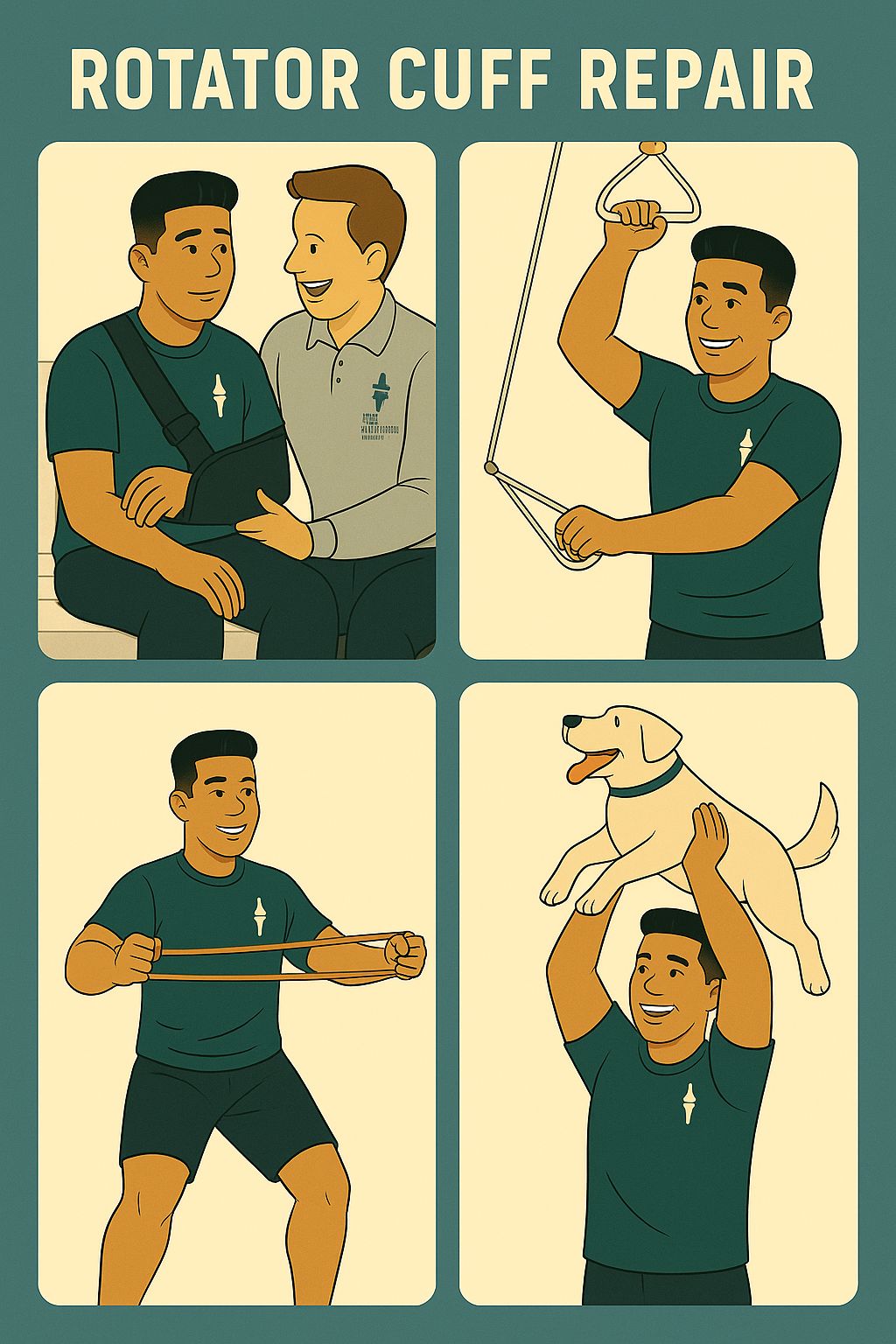
✨ Too Long Didn’t Read (TLDR) / Summary
Who needs a Rotator Cuff Repair? People with shoulder pain, weakness, or limited movement from a torn rotator cuff tendon (from trauma, overuse, or age‑related changes).
What is a Rotator Cuff Repair? Surgical repair of one or more of the four rotator cuff tendons that stabilize and move the shoulder. As a patient, you have a choice and opportunity to talk with your physician about options - whether to manage the tear with or without surgery.
Note: Not all rotator cuff tears necessarily need repairing - in fact, it’s not uncommon for people with small-to-medium sized rotator cuff tears to recover and get back to their normal, every day function without surgery!
Why this matters: If deemed necessary, rotator cuff repairs can reduce pain, improve strength, and restore function.
Post-operative timeline: Typically, patients will be in a sling for 4–6 weeks. Gradual progression towards day-to-day activities will occur 2-4 months post-operatively. Sports/heavy work will begin and resume ~6 - 12 months post-operatively.
Note: This timeline depends on the severity of the tear, the muscle torn, and the repair technique/surgeon’s preferences. Small tears will heal quicker ; large tears will heal slower. Talk with your surgeon and physical therapist to tailor this plan specifically to you!
Patient keys: Talk with your surgeon and physical therapist to determine best course of action. Keep log of small wins to track progress and remain encouraged throughout a long rehabilitation. Perform home exercise program consistently and be patient with yourself.
Rehab keys: Protect healing tissue early → restore shoulder motion → strengthen cuff, deltoid, and scapular muscles to provide stability.
🧾 Condition-Specific General Information
The rotator cuff is a team of four small muscles and tendons that keep the shoulder joint stable and let you lift, rotate, and reach. Tears can happen from a fall, heavy lifting, repetitive overhead work, or age‑related tendon wear. Not everyone notices pain right away—some feel weakness or limited motion first. People with rotator cuff tears can feel pain when they lift their arm overhead, reach, lift heavy objects, and more.
Treatment options include conservative care (AKA: non-operative care) and surgery:
Conservative: Physical therapy to reduce pain, restore motion, and strengthen the shoulder using the muscles that remain intact.
Surgical: Repair of torn tendon(s) when pain or function doesn’t improve with therapy or when the tear is significant.
Diagnostic & Management Considerations
Imaging is not always needed, as in-clinic testing can help rule in/out rotator cuff tear ; tears can be confirmed using MRI or ultrasound when indicated.
NSAIDs, acetaminophen, and injections may help reduce short-term pain.
Need to talk to your physician for guidance
Surgery remains most-appropriate for selected full-thickness tears.
Need to talk to your surgeon for guidance
Video Credit: Demystifying Science (link: https://www.youtube.com/watch?v=Dwuxqs_h3Js)
💙 For Patients
❓ Smart Questions for Your Healthcare Team
Do you feel that I need surgery? Are there other options other than surgery?
Are there any exercises I can do to help my pain or mobility?
How long is the recovery?
What can I NOT do after surgery?
What can I safely do after surgery?
When can I drive?
Will I have pain afterward? How will this be managed?
How long does a repair last?
Can I re-injure my shoulder? What activities do I have to avoid?
Will I be able to get back to all of my activities?
Tip: Pick 2-3 activities that you want others to ask about specifically
What happens if I don’t have surgery?
Can I wait to schedule surgery?
Your Healing Timeline: What to Expect
Recovery from a rotator cuff repair is significant—it deserves patience and support.
0–6 Weeks After Surgery: Protection Comes First
Expect to wear a sling for 4–6 weeks to protect the repair.
You will generally not use your arm during this time.
Your physical therapist will focus on gentle passive range of motion—they move your arm for you.
6–12 Weeks: Gradual Movement Returns
Depending on what was repaired, you may not start moving your arm on your own for 2–3 months.
You may begin assisted movement and eventually active motion as the tissue heals.
3–6 Months: Strength & Function
Most patients return to normal daily activities and begin restoring strength by 6 months.
Returning to sports, heavy lifting, or overhead work can take 6–12+ months.
Full Recovery Expectations
Rotator cuff healing can continue for up to one year, especially for patients returning to demanding activities.
📈 Your Rehab Targets
Protect first: Respect sling and movement restrictions.
Regain motion gradually: Directed by your physical therapist guidance and surgeon’s protocol.
Strengthen: Rotator cuff, deltoid, and scapular stabilizers to ensure muscles work together to produce motion.
Return step-by-step: Lifting, work tasks, and sports will be reintroduced safely.
🧊 Managing Pain & Daily Life
In the first 4–6 weeks
Use ice/cryotherapy to help with swelling and pain.
Keep the sling on unless your team says otherwise.
Avoid using the surgical arm for lifting/reaching.
Tip: Wearing the sling will help you avoid accidentally using your surgical shoulder
Consistency beats intensity
Follow your home exercise plan as prescribed.
Share pain/sleep issues with your therapist and surgeon.
Keep a log of small wins to track your progress and keep your spirits high
Celebrate small wins to stay motivated.
👩⚕️ For Providers
🔑 Patient Education Priorities
Timeline: Sling 4–6 wks; functional recovery 4 – 12 months (depending on size of tear and repair procedure); set realistic milestones.
Pain expectations: Normalize repair pain vs. pre‑op symptoms; discuss pain strategies, particularly at night.
Rehab progression: PROM → AAROM → AROM → strengthening → functional return.
Expectation setting: Full recovery may take up to a year depending on goals.
Essential Tip: Celebrate small wins and milestones!
🤝 Communication Tips (Soft Skills)
Translate goals → daily life: “Strengthening these muscles helps you reach overhead to put away dishes.”
Reflective listening: “It sounds like you’re worried about reinjury—let’s review how the sling protects your shoulder and how we’ll progress safely.”
Teach‑back: “Just so I’m clear, how will you protect your shoulder during the first 6 weeks?”
🧾 Common Patient Questions (from anecdotal experience)
Do you think I need surgery? How do I know if I need surgery?
When will I be able to drive?
When can I come out of the sling?
What are strategies to help me sleep better? Do I have to sleep in my sling?
How can I manage my pain?
I shrug my shoulder when I lift my arm - what can I do about this?
When do my lifting restrictions come off?
How long does the repair last?
Could I need surgery again?
What happens if I wait to have surgery?
Will my shoulder ever feel “normal” again?
🏥 Rehab Considerations & Clinical Pearls ⚪️
Restore ROM early without compromising healing
Address posterior capsule and pectoralis minor tightness
Strengthen the rotator cuff and scapular stabilizers (including serratus anterior, upper trap, and lower trap) to establish upward rotation scapular biomechanics
Gradual, tested, graded progression will give comfort to both you as a clinician and the patient - have objective information to track progress!
Integrate task-specific and return-to-work planning
Initiate progressive strengthening ~12 wks, tailored to tear size and tissue quality.
Advance to functional tasks: lifting, overhead reach, sport‑specific progressions.
📂 Supplemental Downloads / Information
📄 Patient Handout: Common Questions for Before and After Rotator Cuff Repair Surgery
📄 Provider Checklist: RTC Education Points Before & After Surgery
📚 Example: Rotator Cuff Repair Physical Therapy Protocol (Credit: Massachusetts General Hospital)
📚 Example: Massive Rotator Cuff Repair Physical Therapy Protocol (Credit: Ohio State College of Medicine)
Bibliography / Citations:
American Academy of Orthopaedic Surgeons. Management of Rotator Cuff Injuries Evidence-Based Clinical Practice Guideline. Published August 18, 2025. https://www.aaos.org/rccpg2025
American Academy of Orthopaedic Surgeons. Management of Rotator Cuff Injuries Evidence-Based Clinical Practice Guideline. https://www.orthoguidelines.org/guideline-detail?id=1869&tab=all_guidelines
American Academy of Orthopaedic Surgeons. Management of Rotator Cuff Injuries Evidence-Based Clinical Practice Guideline. https://www.orthoguidelines.org/guideline-detail?id=1870&tab=all_guidelines
American Academy of Orthopaedic Surgeons. Management of Rotator Cuff Injuries Evidence-Based Clinical Practice Guideline. https://www.orthoguidelines.org/guideline-detail?id=1891&tab=all_guidelines
Lafrance S, Charron M, Roy JS, et al. Diagnosing, Managing, and Supporting Return to Work of Adults With Rotator Cuff Disorders: A Clinical Practice Guideline. J Orthop Sports Phys Ther. 2022;52(10):647-664. doi:10.2519/jospt.2022.11306
Hodakowski AJ, McCormick JR, Damodar D, et al. Rotator cuff repair: what questions are patients asking online and where are they getting their answers? Clin Shoulder Elbow. 2023;26(1):25.
Dickinson RN, Ayers GD, Archer KR, et al. Physical therapy versus natural history in outcomes of rotator cuff tears: the ROW cohort study. J Shoulder Elbow Surg. 2019;28(5):833-838. doi:10.1016/j.jse.2018.10.001
Dickinson RN, Kuhn JE. Nonoperative Treatment of Rotator Cuff Tears. Phys Med Rehabil Clin N Am. 2023;34(2):335-355. doi:10.1016/j.pmr.2022.12.002
This content drafted, researched, edited, and generated by:
Jackson Kojima, PT, DPT & McKinley Pollock, PT, DPT
Jackson Kojima, PT, DPT, OCS is a physical therapist with an extensive background in orthopedics, geriatrics, and sports rehabilitation. Dr. Kojima is a board-certified orthopedic clinical specialist (OCS) with a passion for post-operative rehabilitation and enjoys treating multi-factorial conditions like low back pain and generalized joint pain. Dr. Kojima earned his doctorate of physical therapy from Campbell University in 2021 and currently lives in Kernersville, NC.
McKinley Pollock, PT, DPT, OCS, CSCS is a physical therapist with a background in orthopedics and sports rehabilitation. Dr. Pollock earned his doctorate of physical therapy from Campbell University in 2021, is a board-certified orthopedic clinical specialist (OCS), and certified strength and conditioning specialist (CSCS). Dr. Pollock enjoys combining lessons learned from his DPT training and research, translating these into clinical practice. His passions include promoting relationships between patients & clinicians to promote clinical effectiveness, satisfaction, and efficiency, the implementation of primary preventative medicine into clinical practice, and leadership and education development.