

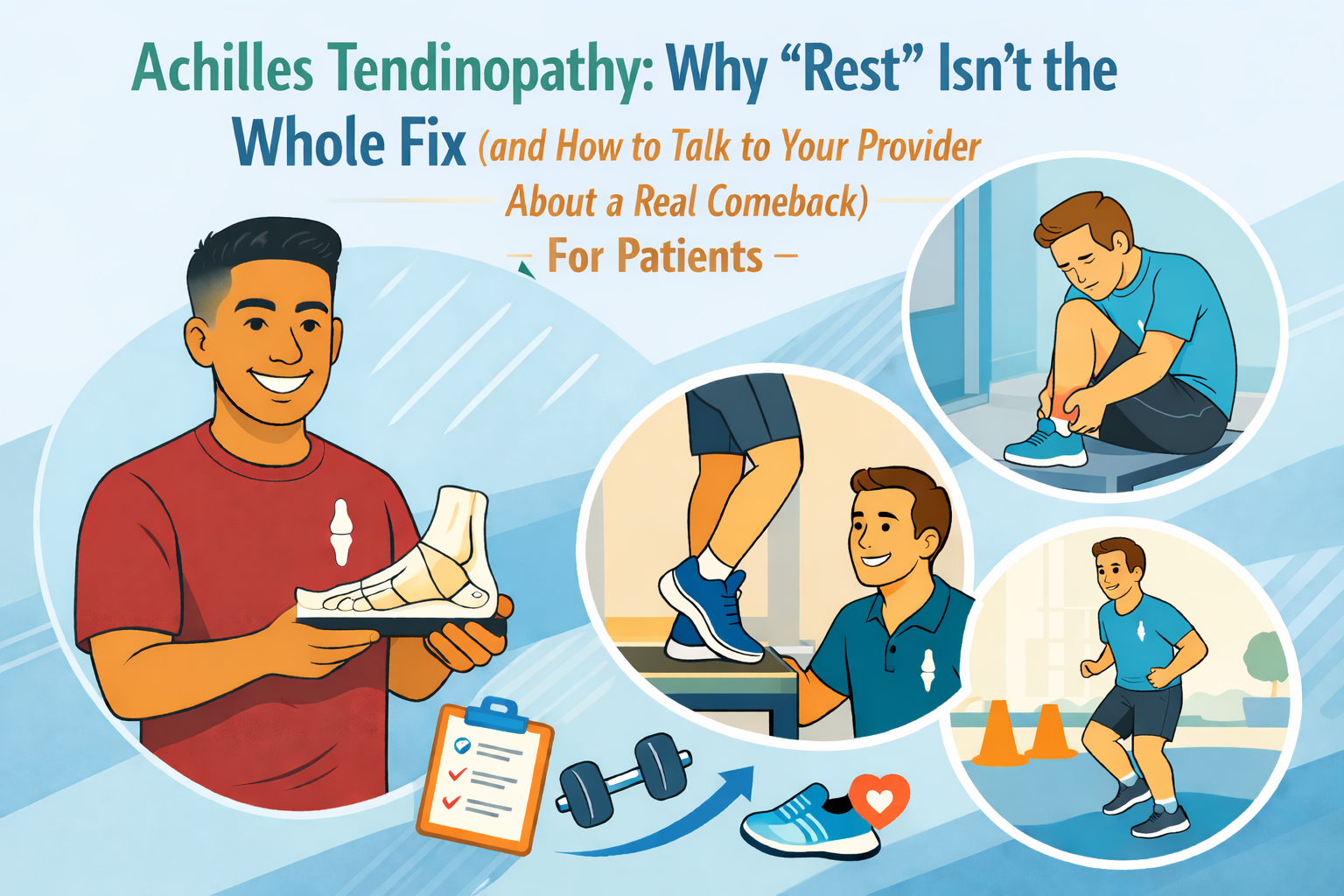
✨ Too Long Didn’t Read (TL;DR) / Summary
If the back of your ankle hurts and your Achilles feels “angry,” you’re not alone—Achilles tendinopathy is a common overuse problem, especially after activity ramps up fast (like after running again when you’ve taken years off).
Here’s what matters most:
Rest can calm pain, but complete rest usually doesn’t rebuild tendon capacity, so symptoms often return when you jump back in.
The best-supported treatment is progressive tendon loading (a step-by-step strengthening plan).
Early on—when it’s very irritable—your provider may start with isometrics (static holds) to settle symptoms, then progress into strength work, eccentrics, and eventually impact/plyometrics as you’re ready.
Where it hurts matters: insertional (right at the heel) often needs a plan that reduces compression (too much dorsiflexion/“deep calf stretch” positions) more carefully than midportion pain.
You don’t need to “tough it out” silently. The best outcomes happen when you and your provider compare notes: what flares it, what helps, and what your goals actually are.
🧾 Condition-Specific General Information
What is Achilles tendinopathy?
Achilles tendinopathy is a painful overuse condition of the Achilles tendon (the thick cord behind your ankle). Many people call it “Achilles tendinitis,” but ongoing Achilles pain is often more about tendon overload and sensitivity than simple inflammation.
Common symptoms (what people usually notice)
You might feel:
Achy pain at the back of the ankle (sometimes sharp with walking/push-off)
Morning stiffness or stiffness after sitting
Tenderness when you press the tendon
Pain during or after activity like running, jumping, hills, or stairs
A sense of weakness or “I can’t push off like I used to”
The “why did this happen?” story (loading vs rest)
A very common pattern is a training-load jump:
“I started walking more.”
“I did a new workout class.”
“I tried running again after a long break.”
Your Achilles is mechano-responsive—it adapts to what you ask it to do. The issue is usually how quickly the demand increased compared to what the tendon was ready for.
Where the pain is matters: insertional vs midportion vs musculotendinous
Think of Achilles pain by location:
Insertional Achilles tendinopathy: pain right where the tendon meets the heel bone (calcaneus). Often crankier with deep ankle bend (dorsiflexion), hills, or certain shoes.
Midportion Achilles tendinopathy: pain typically a couple centimeters above the heel bone (the “ropey” part of the tendon).
Musculotendinous junction pain: higher up where calf muscle blends into tendon; it can behave a bit differently and may feel more “calf-ish.”
Your provider’s plan should match your pain location—not just the label.
Loading vs stretching (and why both can be confusing)
Loading (strength work) is the main event because it helps your tendon tolerate life again.
Stretching can feel relieving short-term, especially if you’re stiff, but it’s not always the priority—especially for insertional pain, where too much dorsiflexion can add compression.
Translation: stretching can be a tool, but it’s usually not the whole plan.
How providers “test” this (and why it’s helpful)
A good exam often checks:
Ankle dorsiflexion (mobility)—especially if it’s limited
Calf strength + endurance (often with a single-leg heel raise test)
Single-leg balance, hip/quad strength, and how you walk/run (because pain changes mechanics)
These aren’t “gotcha” tests—they’re breadcrumbs that guide a safer comeback.
Isometrics vs eccentrics (what’s the difference?)
Isometrics: you hold a position (no movement). These can be useful when pain is high/irritable to calm symptoms while still giving the tendon a signal to adapt.
Eccentrics: you lower slowly (the “down” phase). Eccentric-focused programs are a long-time staple, and many people do well with them—often later in rehab as tolerance improves.
Most real-life plans aren’t either/or; they’re progressive.
💙 For Patients
A patient-friendly comeback roadmap (progressions)
Here’s a simple, common progression your provider might use (your plan may vary):
Settle symptoms + manage load
Modify activity (not necessarily stop everything)
Choose alternatives that don’t spike pain (bike, pool, short walks)
Isometrics (often first when the Achilles is angry)
Example style: calf/heel raise hold for time, multiple rounds (your provider sets the dose)
Strength with movement (concentric/eccentric)
Controlled heel raises on flat ground → more range → more resistance
Eccentric/control focus
Slower lowering, higher loads as tolerated
Return to impact
Hops, jumps, sport drills, and a gradual return-to-running plan
Key idea: Pain that is monitored and managed is different from pain you ignore. You and your provider should decide what “okay pain” looks like for you.
Questions to ask your provider (steal these!)
Bring these to your appointment:
About the diagnosis
“Where is my pain—insertional, midportion, or higher up—and why does that matter?”
“Do you think I need imaging?”
About the plan
“What does progressive loading look like for me this month?”
“Should I stretch? If yes, what kind—and if no, what are we doing instead?”
“What’s my next step after isometrics—when do we add eccentrics or heavier strength?”
About activity
“What can I keep doing safely right now?”
“What’s the sign that I’m doing too much?” (Example: next-day pain spike, limp, swelling)
About goals
“I want to get back to ____. What are the milestones we’re aiming for?”
(Examples: single-leg heel raises, walking tolerance, hop test readiness)
How to talk about what’s working (and what’s not)
If you only say “it still hurts,” your provider has to guess. Try this instead:
Use the 3-part check-in
Trigger: “It hurts most when I ____ (first steps, hills, stairs, after running).”
Intensity: “It’s a ___/10 during activity and ___/10 the next morning.”
Response: “After my exercises, it feels ____ (better/same/worse) for ____ (hours/day).”
Bring a mini log (super simple)
Morning stiffness: none / mild / moderate / severe
Pain with exercises (0–10): ___
Next-day pain compared to baseline: better / same / worse
Activity done: ___
This helps your provider adjust your loading plan without guessing.
A few “green flags” and “red flags” (so you don’t feel lost)
Green flags (usually okay with guidance):
Mild discomfort during rehab that settles by the next day
Gradual improvement in walking tolerance or strength
You can do controlled heel raises with better form over time
Red flags (call your provider / seek care):
A sudden “pop,” in your Achilles, followed by bruising or an inability to push off (concern for rupture)
Rapid swelling, severe pain, or worsening limp that doesn’t settle
Symptoms that keep escalating week after week despite a guided plan
(When in doubt: message your provider. That’s part of care.)
📚 Bibliography
Chimenti RL, Neville C, Houck J, Cuddeford T, Carreira D, Martin RL. Achilles pain, stiffness, and muscle power deficits: midportion Achilles tendinopathy revision–2024: Clinical Practice Guidelines linked to the International Classification of Functioning, Disability, and Health from the Academy of Orthopaedic Physical Therapy of the American Physical Therapy Association. J Orthop Sports Phys Ther. 2024;54(12):CPG1-CPG32. doi:10.2519/jospt.2024.0302
Silbernagel KG, Hanlon S, Sprague A. Current clinical concepts: conservative management of Achilles tendinopathy. J Athl Train. 2020;55(5):438-447. doi:10.4085/1062-6050-356-19
von Rickenbach KJ, Borgstrom H, Tenforde A, Borg-Stein J, McInnis KC. Achilles tendinopathy: evaluation, rehabilitation, and prevention. Curr Sports Med Rep. 2021;20(6):327-334. doi:10.1249/JSR.0000000000000855
Pringels L, Capelleman R, Van den Abeele A, et al. Effectiveness of reducing tendon compression in the rehabilitation of insertional Achilles tendinopathy: a randomised clinical trial. Br J Sports Med. 2025;59(9):640-650. doi:10.1136/bjsports-2024-109138
Johannsen F, Olesen JL, Øhlenschläger TF, et al. Effect of ultrasonography-guided corticosteroid injection vs placebo added to exercise therapy for Achilles tendinopathy: a randomized clinical trial. JAMA Netw Open. 2022;5(7):e2219661. doi:10.1001/jamanetworkopen.2022.19661
Martin RL, Chimenti R, Cuddeford T, et al. Achilles pain, stiffness, and muscle power deficits: midportion Achilles tendinopathy revision 2018. J Orthop Sports Phys Ther. 2018;48(5):A1-A38. doi:10.2519/jospt.2018.0302
This content drafted, researched, edited, and generated by:
Jackson Kojima, PT, DPT
Jackson Kojima, PT, DPT, OCS is a physical therapist with an extensive background in orthopedics, geriatrics, and sports rehabilitation. Dr. Kojima is a board-certified orthopedic clinical specialist (OCS) with a passion for post-operative rehabilitation and enjoys treating multi-factorial conditions like low back pain and generalized joint pain. Dr. Kojima earned his doctorate of physical therapy from Campbell University in 2021 and currently practices in Greenville, SC.