

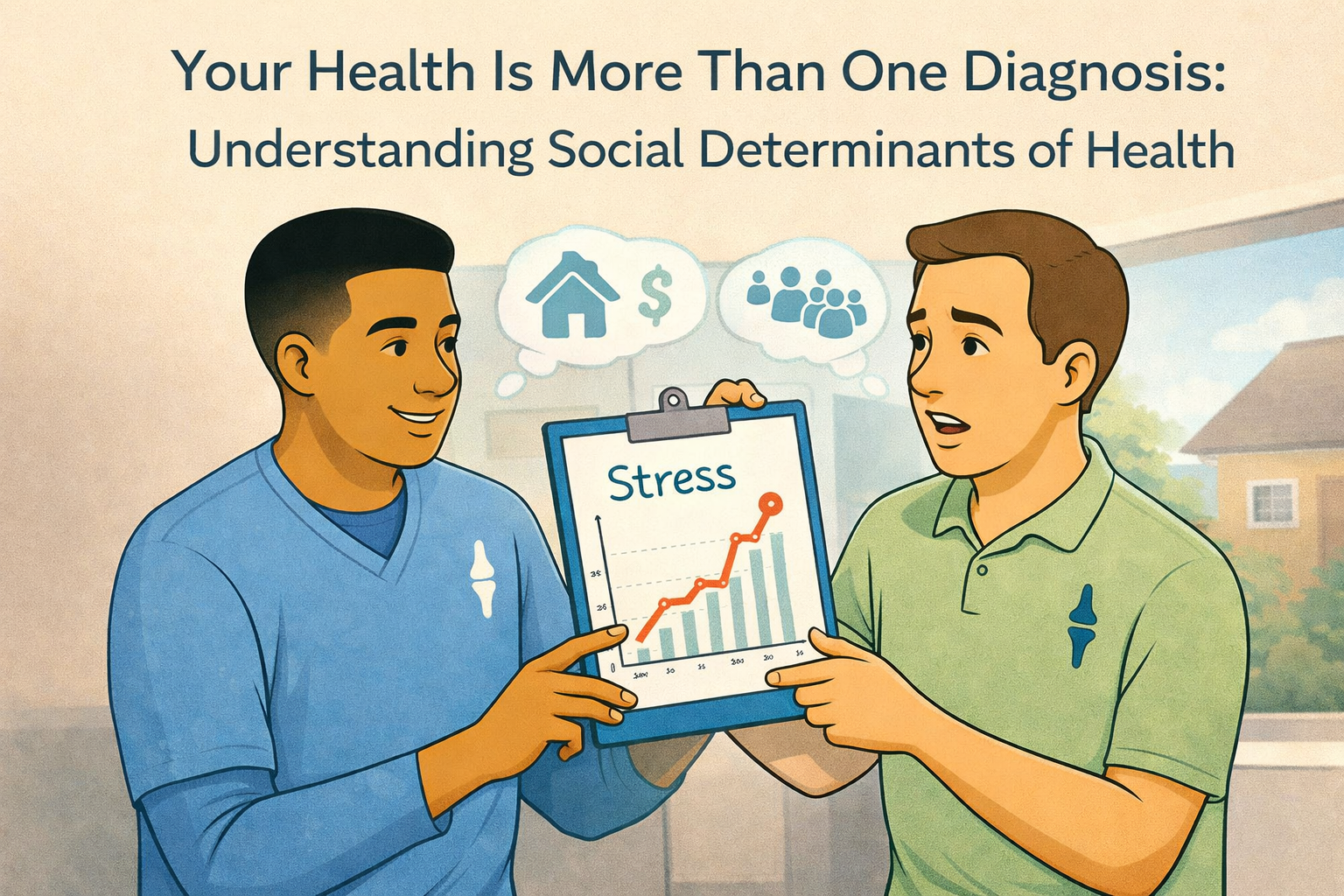
Sometimes the biggest influences on your health aren’t found on a lab report—they’re found in your everyday life.
At The Joint Connection Company, we believe your story matters. Your health is shaped not only by medical care, but by your experiences, your environment, your stress, and your support systems. Understanding social determinants of healthcan help you become a stronger advocate for yourself—and a more active partner in your care.
✨ Too Long Didn’t Read (TLDR) / Summary
Social Determinants of Health (SDoH) are everyday life factors—like housing, food access, work stress, education, and social support—that strongly affect your health.
Research shows these factors can influence up to 40% of health outcomes, while medical care alone (i.e. the care you receive in a clinic) may only account for about 20%.
Chronic stress from life circumstances can affect your heart, immune system, brain, mental health, and even future generations.
Conditions like heart disease, cancer, chronic pain, neurologic disorders, and high blood pressure are closely tied to SDoH.
Talking openly with your provider about what’s happening in your life can improve care, trust, and outcomes.
🧾 General Information
How Social Determinants Show Up in Real Life
You might notice:
Trouble controlling blood pressure despite medication
Chronic pain that doesn’t fully respond to treatment
Fatigue, poor sleep, or frequent illness
Difficulty following care plans due to cost, time, or access
Feeling unheard or rushed during medical visits
These experiences are common—and they’re not a personal failure. They’re often signals that life context needs to be part of the care conversation.
But first… What Are Social Determinants of Health?
The World Health Organization defines social determinants of health as non-medical factors that influence health outcomes—the conditions in which people are born, grow, work, live, and age, and the systems that shape daily life.
These include things like:
Access to safe housing and transportation
Food security and nutrition
Education and employment
Income and financial stress
Social support and connection
Neighborhood safety and environment
Why Do They Matter So Much?
Living with long-term stress—whether from financial strain, unsafe housing, discrimination, loneliness, or job instability—puts constant pressure on the body. Over time, this stress can:
Disrupt hormones like cortisol (which is your “stress” hormone)
Increase inflammation throughout the body
Affect heart and blood vessel health
Worsen mental health
Change how genes are expressed (even across generations)
This helps explain why social and environmental factors can be strongly linked to:
Heart disease and high blood pressure
Cancer risk and outcomes
Neurologic conditions like stroke and dementia
Chronic pain and musculoskeletal conditions
Mental health challenges, including anxiety and depression
💙 For Patients
How to Talk to Your Provider About What’s Really Going On
You don’t need the “right words.” Start with honesty, openness, and (if you feel comfortable) vulnerability.
You might say:
“I’m doing my best, but this plan feels hard to keep up with.”
“Stress at work/home is really affecting how I feel physically.”
“I’m worried about my heart because of what’s going on in my life.”
“I don’t think this treatment is working for me—can we talk about why?”
These conversations help your provider understand you, not just your symptoms.
Questions You Can Ask Your Provider
Consider bringing these kinds of questions to your next visit:
How could stress or my environment be affecting my health?
Are there resources that could help with food, transportation, or support?
What symptoms should I watch for if stress is impacting my heart or blood pressure?
What options do we have if this treatment isn’t realistic for my life right now?
How can we adjust the plan so it actually works for me?
Your provider’s job isn’t just to prescribe—it’s to partner with you.
Symptoms Worth Speaking Up About
Let your provider know if you’re experiencing:
Ongoing fatigue or poor sleep
Chest discomfort, shortness of breath, or palpitations
Persistent pain or tension
Changes in mood, motivation, or concentration
Feeling isolated, overwhelmed, or unsupported
These symptoms are often connected to both physical health and life stressors.
What You Can Do—Even When Life Feels Heavy
Small steps matter:
Build social connection where you can—friends, family, community spaces
Ask about local resources for food, transportation, or financial support
Move your body in ways that feel safe and realistic
Be honest when something isn’t working
You can also use tools like:
The U.S. Department of Housing and Urban Development’s (HUD) Find Shelter tool to find temporary housing, food pantries, medical clinics, and more.
Nutrition.gov to help locate local food sources and assistance programs
You deserve care that fits your life — because your whole life affects your whole health.
📚 Citations
Morelli V. Social determinants of health: an overview for the primary care provider. Prim Care. 2023;50(4):507-525. doi:10.1016/j.pop.2023.04.004
Chaturvedi A, Zhu A, Gadela NV, Prabhakaran D, Jafar TH. Social determinants of health and disparities in hypertension and cardiovascular diseases. Hypertension. 2024;81(3):387-399. doi:10.1161/HYPERTENSIONAHA.123.21354
Rosendale N. Social determinants of health in neurology. Neurol Clin. 2022;40(1):231-247. doi:10.1016/j.ncl.2021.08.012
Braaten AD, Hanebuth C, McPherson H, et al. Social determinants of health are associated with physical therapy use: a systematic review. Br J Sports Med. 2021;55(22):1293-1300. doi:10.1136/bjsports-2020-103475
Anaya B, Triplett R, Rogers CE, Smyser CD. Social determinants of health and early brain development. Pediatr Clin North Am. 2025;72(5):975-990. doi:10.1016/j.pcl.2025.05.013
This content drafted, researched, edited, and generated by:
McKinley Pollock, PT, DPT
McKinley Pollock, PT, DPT, OCS, CSCS is a physical therapist with a background in orthopedics and sports rehabilitation. Dr. Pollock earned his doctorate of physical therapy from Campbell University in 2021, is a board-certified orthopedic clinical specialist (OCS), and certified strength and conditioning specialist (CSCS). Dr. Pollock enjoys combining lessons learned from his DPT training and research, translating these into clinical practice. His passions include promoting relationships between patients & clinicians to promote clinical effectiveness, positivity, and efficiency, the implementation of primary preventative medicine into clinical practice, and leadership and education development.