

A patient-friendly guide to understanding heel pain, what helps, and how to talk about it
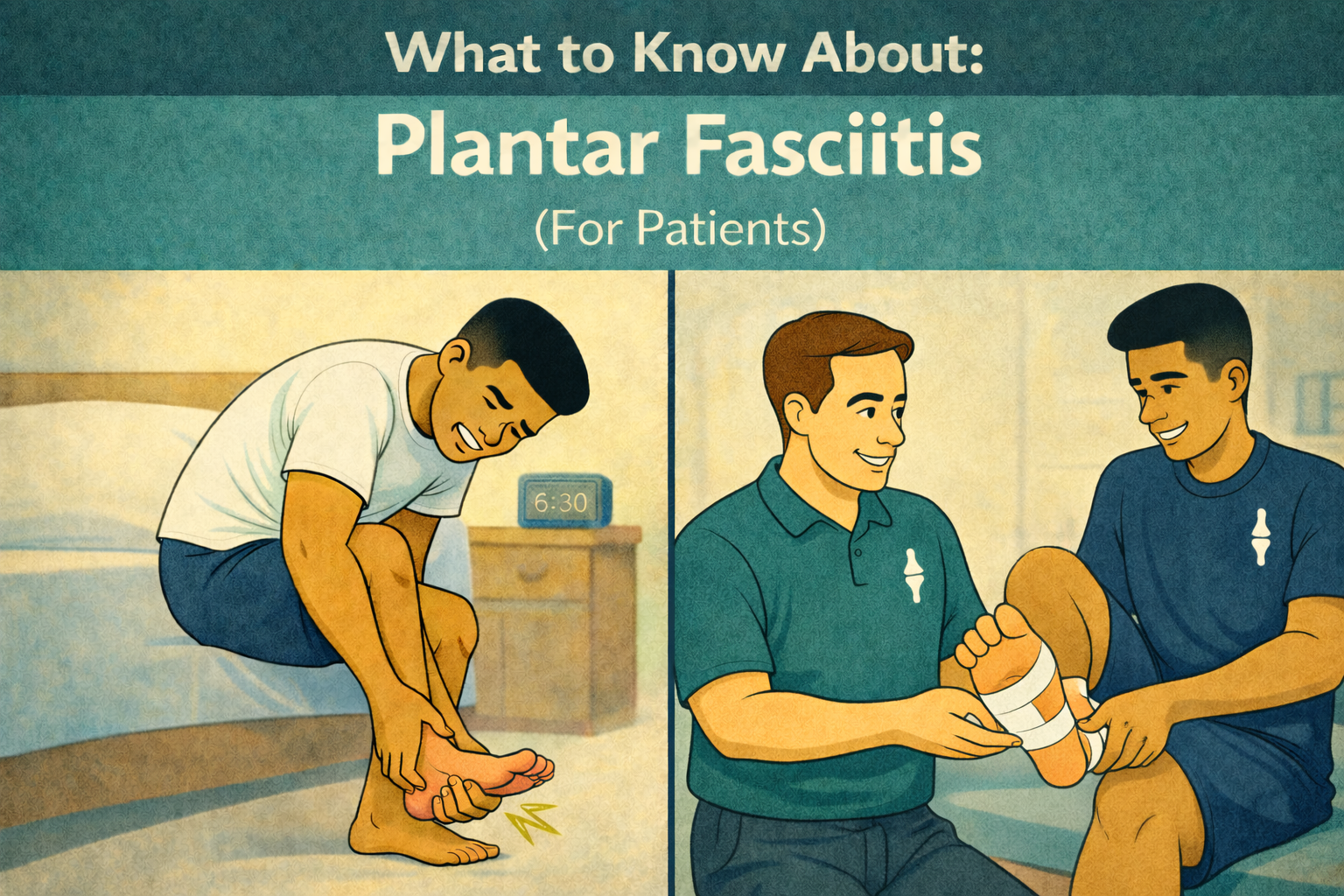
If you’ve ever stepped out of bed and felt a sharp pain in your heel that made you pause and brace yourself—you’re not imagining it. That “first-step pain” is one of the most classic signs of plantar fasciitis, and it’s one of the most common foot conditions adults experience.
But plantar fasciitis is rarely just about the heel.
It’s about how your ankle moves, how your toes function, how your arch supports you, and how all of that connects to the way you walk, work, exercise, and live.
Let’s break it down—clearly, calmly, and in a way that helps patients and providers actually work together.
✨ Too Long Didn’t Read (TLDR) / Summary
Plantar fasciitis is irritation or degeneration of the plantar fascia on the bottom of the foot.
Pain is often worst with the first steps in the morning or after sitting.
It’s influenced by ankle stiffness, calf tightness, foot strength, toe mobility, and arch mechanics.
High arches and low arches can both contribute—there’s no single “bad foot.”
Most people (>80%) improve with conservative care, especially physical therapy.
Stretching, strengthening, taping, night splints, and load management matter.
The best outcomes often start with better conversations.
🧾 Condition-Specific General Information
What is plantar fasciitis?
Plantar fasciitis is a condition involving the plantar fascia, a thick band of connective tissue that runs from the heel to the toes and helps support the arch of the foot.
Despite the “-itis” in the name, research shows that many cases—especially long-standing ones—reflect degeneration rather than inflammation. Because of this, you may also hear terms like plantar fasciosis or plantar fasciopathy.
👉 Translation:
This tissue is getting overloaded faster than it can recover.
Common symptoms people report
Heel or arch pain with first steps in the morning
Pain after sitting, then standing
Pain that improves as you move—but returns later
Tenderness at the inside of the heel
Rarely: swelling (bruising may suggest a different injury)
If this sounds familiar, you’re far from alone.
Why the ankle matters (more than most people realize)
Limited ankle movement—often from tight calf muscles —is one of the most consistently reported risk factors for plantar fasciitis.
When the ankle doesn’t move well:
The foot compensates
The arch absorbs more stress
The plantar fascia takes the hit
This is why calf stretching isn’t “basic” care—it’s foundational care.
High arch vs. low arch: which is worse?
Research says that both can matter and affect your risk.
High arches may increase tension through the plantar fascia.
Low or pronated arches may increase strain from prolonged loading.
What matters more than arch type is how your foot adapts under load—and whether it has the strength and mobility to do so.
The big toe and the arch of the foot
Your big toe plays a surprisingly important role in heel pain.
As the big toe bends upward during walking, it tightens the plantar fascia through something called the windlass mechanism, helping lift and support the arch.
Problems like:
Limited big-toe motion
Structural changes (like bunions or overly curled toes)
Poor coordination during walking
These can all increase strain on the plantar fascia.
Internal foot muscles: the quiet stabilizers
Small muscles inside your foot help:
Support the arch
Control toe motion
Reduce strain on passive tissues like the plantar fascia
Weakness in these muscles has been linked to foot pain and plantar fasciitis. Strengthening them—when done correctly—can improve function and reduce pain.
Other known risk factors
Increased body weight
Prolonged standing or repetitive loading
Sudden increases in walking or running
Decreased ankle mobility
Inadequate recovery time
Age (most common between 40–60 years)
💙 For Patients
How to talk to your provider (and what to ask)
Appointments can feel rushed, and foot pain is often brushed off as “just part of life.” It’s okay to ask for clarity.
Consider asking:
“What do you think is driving my heel pain?”
“Does my ankle or calf mobility play a role?”
“What exercises are safe for me right now?”
“If something isn’t helping, when should we change the plan?”
“Would physical therapy help me move with less pain?”
If something isn’t working, it’s okay to say:
“I’ve been doing this for a few weeks, and it’s not helping—what’s our next step?”
That’s not complaining. That’s good healthcare.
What treatments commonly help
Most people improve without surgery.
Conservative care may include:
Stretching (especially calves and plantar fascia)
Strengthening (foot and ankle muscles)
Manual therapy to improve joint and tissue mobility
Taping for short-term symptom relief
Night splints (often helpful for morning pain)
Activity modification, not complete rest
Some people may also discuss:
Injections (corticosteroid or PRP)
Shockwave therapy
These tend to work best alongside rehabilitation like physical therapy, not on their own.
A few important reminders
Morning heel pain is common—but not something you have to “push through.”
Shoes can help—but they don’t replace strength and mobility.
Pain doesn’t mean damage—it means your body needs a smarter plan.
Recovery is rarely instant, but improvement is common.
The goal isn’t just pain relief—it’s helping you walk, work, and live with confidence.
📚 Bibliography
Tseng WC, Chen YC, Lee TM, Chen WS. Plantar fasciitis: An updated review. J Med Ultrasound. 2023;31(4):268-274.
Motley T. Plantar fasciitis/fasciosis. Clin Podiatr Med Surg. 2021;38(2):193-200.
Koc TA Jr, Bise CG, Neville C, et al. Heel pain—plantar fasciitis: Revision 2023. J Orthop Sports Phys Ther.2023;53(12):CPG1-CPG39.
Huffer D, Hing W, Newton R, Clair M. Strength training for plantar fasciitis and the intrinsic foot musculature. Phys Ther Sport. 2017;24:44-52.
Voelker R. What is plantar fasciitis? JAMA. 2024;332(13):1120.
Aranda Y, Munuera PV. Plantar fasciitis and its relationship with hallux limitus. J Am Podiatr Med Assoc.2014;104(3):263-268.
Cobden A, Camurcu Y, Sofu H, et al. Evaluation of the association between plantar fasciitis and hallux valgus. J Am Podiatr Med Assoc. 2020;110(2).
This content drafted, researched, edited, and generated by:
Jackson Kojima, PT, DPT
Jackson Kojima, PT, DPT, OCS is a physical therapist with an extensive background in orthopedics, geriatrics, and sports rehabilitation. Dr. Kojima is a board-certified orthopedic clinical specialist (OCS) with a passion for post-operative rehabilitation and enjoys treating multi-factorial conditions like low back pain and generalized joint pain. Dr. Kojima earned his doctorate of physical therapy from Campbell University in 2021 and currently practices in Greenville, SC.